Last week I Jeffrey Banks and Doria de La Chapelle presented me with a copy of their new book, “Preppy: Cultivating Ivy Style.” It was a great honor as a couple of my Q&As for Ivy Style are cited in the credits, as is W. David Marx’s article on the Miyuki-zoku, plus work from early Ivy Style contributor Deirdre Clemente.
While “Preppy: Cultivating Ivy Style” doesn’t boast groundbreaking research, it’s a solid overview well timed for a new trend and new generation. Perhaps a quarter to a third of the book may seem extraneous (fashion writers, like literary scholars, feel they must cite sources they feel are related but which often feel tangential). However the bulk of it is devoted to precisely the origins of this style — prep and college students in the Northeast and the WASP establishment — while still taking an inclusive approach apropos for 2011.
Here the authors offer a terse summary of the style:
Preppy has always been acknowledged as an inherently American phenomenon, a fashion — or anti-fashion as some have called it — whose imagery perpetually connects us to idyllic college days, sport, and the spirit and vitality of youth. Preppy’s origins are rooted in the grounds of the elite Ivy League universities of the 1920s, where young, WASPy and wealthy gentlemen invented a relaxed new way for collegians to dress by co-opting athletic clothes form the playing fields, mixing them with genteel classics, and decking themselves out with caps, ties, pins and other regalia to signify membership in a prestigious club or sport. They then embellished the look with the best possible accessory: an air of complete and utter nonchalance.
But you can’t feign nonchalance until you nail the details:
In the elite, insular and often snobbish collegiate world, one’s identity was in the details: what a man wore, how his tie was tied, where his hair was parted and what club he joined were of paramount importance. Among the reasons behind Ivy League style’s resounding popularity with college students was the immense peer pressure to conform and its close relative, the deep need to belong.
And speaking of conformity, here’s Banks and de La Chappelle the Ivy heyday:
It didn’t take [postwar, college-educated men] long to learn that “working in corporate America demanded a knowledge of certain codes, many of which were embedded in the corporate uniform.” America had become more and more politically conservative, and Ivy League clothes — with their inherently understated quality and ability to blend in — were the perfect expression of the new “buttoned-down” philosophy. Ivy college graduates, well schooled in conformity, went to work uncomplainingly in their narrow-lapeled sack suits with skinny ties, while older alums, inspired by the slimmer, more youthful-seeming style, also joined the growing band of sack-suited men.
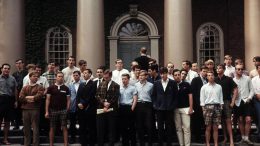
Some of the photos will be familiar, while others are fresh. Here is a handful of images I liked, which Rizzoli was kind enough to provide. Above is a scene from the film adaptation of Philip Roth’s “Goodbye, Columbus.” Below, Groton students, from the graduating class of ‘67, in madras jackets: (Continue)

The chaps at the Fine & Dandy Shop blog dug up these images from the 1956 Princeton yearbook. Say, is that Dickie Greenleaf’s graduating class? (Continue)

I banged out a little piece on the navy blazer for Gilt MANual, calling it the Swiss Army Knife of tailored jackets. And yes, I’ve actually worn it as a warm-up jacket to the tennis court. That’s probably a bit affected.
But it’s all part of downplaying the blazer’s stuffiness, since many guys find them garish (gold buttons) or boring.
While writing it, I thought of the 1964 Yale student in the photo above, who downplays his rep-striped and blazered propriety with sunglasses indoors and no socks, which, speaking of affectation, somehow seems a lot more natural in front of the lens of LIFE Magazine in 1964 than in front of street-style photographers in 2011. — CHRISTIAN CHENSVOLD

We close this week’s tribute to white bucks in autumn with some random images. Convinced yet? (Continue)

In 1952, LIFE Magazine ran a profile on the Taft family, one of America’s great political dynasties, having produced President William Howard Taft.
The family also produced a prep school — The Taft School in Watertown, CT — which was founded by William’s brother Horace Dutton Taft, an early Skull & Bones member.
Pictured above is Peter Rawson Taft III, great-nephew of the school’s founder. The kid is the epitome of ’50s preppy sportiness with his good looks, well worn school sweatshirt, and roman numeral after his name.
The LIFE profile on the family can be found here. — CC

Last week Women’s Wear Daily ran a feature on the upcoming book “Preppy: Cultivating Ivy Style,” by Jeffrey Banks and Doria de La Chapelle.
Among other things, the story includes the great photo above of Deerfield Academy’s class of 1961. The story’s author, David Lipke, goes on to note preppy style’s relative imperviousness to change in the 50 years since the photo was taken.
Princeton gets mentioned as the leading artiber of the Ivy League Look in the following passage:
The book traces the origins of the style to the Ivy League universities of the East Coast, where, following World War I, a privileged set of young men developed a new style centered on a greater amount of leisure time and athletic influences. Princeton, in particular, was fertile ground for the cohesive new look, as it was among the more homogenous and isolated of the Eastern schools, with a student body largely compiled from just a handful of preparatory schools.
“Preppy: Cultivating Ivy Style” is due out October 4. — CC

In honor of Ivy Style’s 400th post, we present this visual tribute to “manly trad” courtesy of Kent clothiers and the latest issue of the Japanese magazine Free & Easy (with a little inspiration from Steve McQueen).
Always remember that trad is man’s clothes, and that nothing compliments a three-piece sack suit, buttondown oxford and rep tie like a Ferrari Berlinetta Lusso.
Running with the bulls in a pink buttondown? Swimming with sharks in madras trunks? Personally, I’m a swing-dancing badass in white bucks, but leave a comment and tell us your ideal of manly trad. — CC

With fashion in a constant state of flux, it’s no wonder apparel brands are less than assiduous when it comes to keeping company histories.
But the heritage movement has given brands the impetus to better chronicle and curate their personal histories. Case in point: Gant. The company, which was founded in New Haven in 1949 and is currently owned by a Swiss firm, has been slowly rebuilding its clothing archives under the direction of designer Christopher Bastin.
In the following email interview, Bastin discusses sourcing items for the collection, discovering voices from the past, the Ralph Lauren x Gant collaboration that never manifest, and reading transcripts of the Amalgamated Shirtmakers Union meetings. — CC
* * *
IS: Tell us about the archive project and how it came about.
CB: When I started at Gant six years ago, we had a huge archive but it was entirely based on what had been produced for the European market. Nothing dated before 1980. I’m a total vintage nerd, so it was pretty much heaven for me to start hunting down vintage stuff from our 1949–79 New England roots. It helps having a CEO who understands the importance of our American heritage and exploring our origins. He pretty much gave me an unlimited budget to rebuild our archives.
IS: What is your goal with the archive?
CB: The end goal is to educate our customers and people within our company about the history of Gant. What sends a clearer message than showing someone an artifact? Unlike stories and pictures, holding an actual archival shirt in your hands is tangible and indisputable. Hell, even the smell is fantastic!
Rebuilding our archives also helps us put the pieces back together. Through the years we went through a number of different owners and a lot of our history has been lost along the way. Things like fabric swatches, sketches, patterns, sales books, sales guidelines, and advertising materials were basically thrown out. We’ve been able to relocate some pretty amazing stuff, but there’s still a lot to be discovered.
There has been a learning curve for me because I started this project from scratch. Understanding the different historical labels, how to date pieces, discovering old collaborations and co-branded products. You can tell how old a garment is from the stitching, label, fit and fabrication. But you have to know what to look for. To a large degree I’ve been drawing conclusions by comparing stuff I found against old ad material, looking up old stores that used to carry us, when they where in business, and so on. I’ve also been reading old transcripts from Amalgamated Shirt Makers Union meetings. (Continue)

Digital style omnivore Derek Guy recently spotted a tumblr loosely entitled Rich White People, which consists of a potpourri of vintage photos, contemporary advertising images, movie stills, and snapshots of British royals. It’s all very pleasant on the eyes, and most germane to tradly types are the various vintage Ralph Lauren ads scattered pell-mell among the tumblr’s current 45 pages. Look for it soon on Admiral Cod’s blogroll. — CC
Addendum: Having looked at all 45 pages, I was left with a curious impression of tumblr, which offers a new kind of visual experience in which random images are collected under the loose guideline of an “aesthetic” or whim of an anonymous curator.
Rich White People randomly juxtaposes three things that bear little relation to each other beyond their surface style: Real people, such as royals and athletes; movie stills of actors pretending to be real people; and lifestyle fashion advertisements attempting an even further watered-down simulacrum of real life.
The randomness and lack of exposition of tumblrs is surely a sign of the bottomless slide into shallowness and the dumbing down of American culture.
Last year I read a book by George WS Trow. I don’t remember much of it beyond the title, which seems strangely fitting to the Rich White People tumblr: “Within the Context of No Context.”
As an encore to last week’s Japanese illustration gallery, here’s a super-cool discovery: A pack of 1960s playing cards using cover art for the magazine Heibon Punch, by artist Ayumi Ohashi.
The cards, our translator tells us, depict a wide range of social situations and leisure activities and the proper attire for each. — CC (Continue)