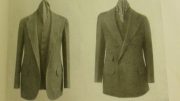
The Hartmarx Corporation has closed up its Hart, Schaffner & Marx and Hickey Freeman archives until their full public unveiling. These are the last images I was able to grab before the gate closed.
They date from the 1950s and document the trend in menswear to the natural-shouldered look. The final document has a nice breakdown of how the long, lean effect in the other images is achieved, beyond the svelte physique that nature (or in this case, the artist) has bestowed on the models.
The image above has an interesting collegiate theme: the homecoming reunion of the class of ‘31 (making this presumably ‘51 or ‘56). With the collar roll, glasses and overall vibe, somehow the word that pops into my head to describe this image is “trad.” Also, those familiar with the identity of the blogger Longwing might see a certain resemblance to the gentleman on the left. (Continue)

Students in science and technology today aren’t exactly known for their style (then again, what students are?) But in 1956, MIT’s graduating class of 900 was better dressed than just about any random group of 900 people you could find anywhere today, even among the rich or the glamor professions.
There are also some real characters in there. Click here for the hi-res version. — CC

Here are some early collegiate images from the Hart, Schaffner & Marx archives. Check out the sprezzatura of the guy in the chair above: college sweater with formal pumps — now that’s a juxtaposition. (Continue)

Recently I was invited to Hickey Freeman on New York’s Madison Avenue, where, in the offices above the retail store, I found the menswear equivalent of buried treasure: Four rooms packed with thousands of documents chronicling 100 years of American history through the lens of men’s fashion.
The recently bankrupt Hartmarx Corporation — which owns the brands Hart, Schaffner & Marx and Hickey Freeman — has brought its extensive archives out of storage and is currently at work digitizing the collection for the Internet.
The archives consist of everything from turn-of-the-century catalogs to Deco-era original oil paintings. Here’s a fraction of it: (Continue)

One of the saddest phrases in the English language is “You missed a great party.” Well here’s one we all missed.
In 1957 jazz historian and Harvard/Yale alum Marshall Stearns threw the ultimate jazz-Ivy shindig. Held in honor of sitar player Ravi Shankar, the party juxtaposed Indian music with jazz, and included a jam session with Dizzy Gillespie. LIFE Magazine captured the soirée, which drew the kind of crowd only possible in New York: a dazzling melange of socialites and hipsters, artists and businessmen, with everyone dressed to the nines. Though LIFE only devoted one page to the event in the magazine, the LIFE archives include an extensive photo set entitled “East-West Jam Session.” (Continue)

The annual Harvard-Yale football game — known to students and alumni simply as The Game — has been played since 1875 and alternates each year between Harvard Stadium and the Yale Bowl. The Game is famous for its always-waning-but-never-quite-dead tradition of genteel tailgating, nowadays conducted alongside college parties more squarely within the “Animal House” tradition.
What we still call Ivy League clothing is rarely seen on the campuses of these premier Ivy League schools. Today’s Harvard and Yale students attend The Game in nondescript jeans, sweatshirts and fleece — or shorts and t-shirts if they want to signal that dressing for the weather is beneath them. But in the heyday of the Ivy League Look, as this 1962 Sports Illustrated article explains, The Game enabled Cambridge and New Haven clothiers to scout out sartorial trends and keep track of their rivals:
Whenever it is played at Harvard, as it was November 24 last, representatives of the New Haven tailoring establishments—J. Press, Fenn-Feinstein, Chipp, Arthur Rosenberg, et al.—entrain for Cambridge to render biennial obeisance and to see what the young gentlemen are wearing. The tailors themselves wear velour Alpine hats, double-breasted, tweed topcoats and blue oxford shirts to offset their sallow complexions. By custom they do not speak to one another, and, upon arrival, each goes his separate way. Following tradition, Paul Press descends into the basement of J. Press, where he stands his Cambridge branch employees to a buffet luncheon of cream soda and hot pastrami imported from New Haven.
This year’s Game will be played on November 21 at Yale and marks a return for Mory’s, the New Haven dining club that appeared headed for oblivion a few years ago. The Yale Herald reports that Mory’s will have a tent at The Game, serving brunch, drinks, nostalgia, and hope for the future.
Pictured are photos of The 1960 Game from the LIFE archives. — TALIESIN
Taliesin, who works in the federal government, holds a master’s degree from Harvard, where he was always amazed at how badly his fellow students dressed, though how impressive they were in most other respects. He has never been to New Haven. (Continue)

Six months ago we ran a post called “College Miscellany,” comprised of various shots from the LIFE archives. Here’s an encore (click images for hi-res version).
First up are several shots from Bowdoin College in Maine. Above, 1952; below, 1957: (Continue)
What was it like for a public-school kid from nowhere to go to an Ivy League school during the heyday?
Sure, you got to wear cool clothes (once you figured out what they were), but even that was fraught with anxiety.
At least it was for Timothy Thompson, whose first semester at Yale was full of loneliness, awkwardness, and rigorous academics requiring 18-hour days just to keep from flunking out.
Tim previously appeared in our post “Blue Man Group.” Now here’s his story: a lengthy LIFE magazine feature on what happens when a “rough country boy” from Oregon gets into Yale, only to endure a “painful struggle trying to fit in.”
In addition to brain-twisting homework and the challenge of making friends, Tim also had to learn strange new words like “avant-garde,” buy new clothes in order to “keep up with his classmates,” sit through French courses conducted in French, and uphold his clean-living Baptist values in the wake of the Sexual Revolution.
But Tim had pluck: “I want to be myself,” he told the magazine. “I don’t want to be classified as a sophisticate, a playboy, a screwball, or anything.”
But didn’t LIFE do him a disservice by profiling him in a high-circulating periodical? Talk about piling on the pressure: Now it wasn’t just his parents and campus advisor waiting to see his math grade, but the entire United States of America.
Did Tim eventually graduate, rising from Pacific Northwest obscurity to old-boy network? And where is he now?
Attempts to find an answer via Google came up empty. I’ve a bottle of bay rum for the reader who can find the answers. — CC

In 1969 the old-boy network at America’s most stylish university was broken with the admission of female students.
The fellow above is clearly pleased with the change. Not only in the student body (and what a body it is), but with campus fashion. Sartorially speaking, the pivotal year of change — 1967 — was two years before, and the up-to-date undergrad is now sporting double vents and sideburns. You decide which is the greater travesty. (Continue)

These undated photos of New York’s Gardiners Island have a kind of Slim Aarons quality to them. (Continue)