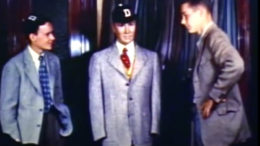
Our recent post on striped sportcoats included a vintage ad by Clipper Craft Clothes, and so we thought it worth following up with a gallery devoted to the brand. During the heyday of the Ivy League Look, Clipper Craft was a brand that explicitly touted its Ivy authenticity in advertorials placed in mainstream magazines.
In 2009 a short thread was started at the Ask Andy Trad Forum in which a member dug up some info on the origins of the brand, which was founded in Boston. By the heyday, the brand was touting its “New England tailoring” along with its affordable prices. It also created a campaign with tiger heads grafted onto its suits, from back when “tiger” was common slang for a ladies’ man:


Other Clipper Craft ads combined real guys, models, and illustrations:


But most interesting are these two advertorials, in which Clipper Craft more or less explains what Ivy is to potential consumers in the nether reaches of the nation, as well as convincing said consumers of its authenticity. That a consumer only partially aware of something should be concerned with authenticity is one of the card tricks of advertising.
This one, entitled “Clipper Craft Goes To the Roots Of Ivy,” ran in Sports Illustrated in 1958:

The ad copy reads:
Once only a ripple in the mainstream of fashion, Ivy has now become a wellspring of inspiration to the top designers in men’s clothing. Ivy’s influence has done much to make men’s clothing more interesting.
Ye, as Ivy has spread, it has been diluted. Much of the clothing being sold as Ivy is, at best, only a distant cousin. If a man wants authenticity, he has to be on guard.
True Ivy fashion, however, is not hard to come by. It’s being made today under “The Authentic Look” label by Clipper Craft, one of America’s largest manufacturers of men’s clothing.
The genuineness of “Authentic Look” clothing is beyond question. It satisfies all such criteria as natural shoulders, narrow lapels, lapped seams, stitched edges, hooked vents, pleatless trousers, tapered sleeves and trousers. But authenticity is more than the sum of these parts. It’s a matter of silhouette and hang. Clipper Craft’s “Authentic Look” clothing was examined and worn by real experts — leaders from all eight Ivy League colleges. “Authentic was the verdict, without dissent.
There’s much of interest here, for starters the suggestion that Clipper Craft can be both authentic and one of the largest clothing manufacturers, something that sounds contradictory today. Also noteworthy is the appeal to college men as the experts most in the position to determine a suit’s Ivy pedigree. But the real gem is the passage about being diluted and a distant cousin, which reads ironic today.
The following year the company ran another advertorial in Sports Illustrated:

Here the copy highlights include:
It’s true that Ivy began on the campus. But no styling so young in spirit, so trim in appearance, could long remain the exclusive property of any one group. So Ivy has branched out. Today, it’s the hallmark of good grooming for men of all ages everywhere. From college classrooms to business offices.
… the Ivy suits they wear are “The Authentic Look,” tailored by Clipper Craft, one of America’s largest manufacturers of men’s clothing. These suits feature natural shoulders, narrow lapels, lapped seams, stitched edges, hooked vents, pleatless trousers, tapered sleeves and trousers — clothing faithful in every respect to the Ivy tradition.
We asked Richard Press for his take on this, and once again he showed himself just one or two degrees of separation removed from apparently everyone who ever donned a sack suit. In the “Roots of Ivy” advertorial above, one of Richard’s classmates at Dartmouth. As for Clipper Craft:
My recollection is that it was a “low grade 2 machine make” using mass-produced domestic mill cloths. The clothing was sold in Main Street department and general stores coast to coast, often with the store label.
If “authenticity” in regards to Ivy is merely a laundry list of tailoring details, then Clipper Craft is pretty darn pure. But if clothing pedigree is what really determines authenticity — what makes something “the real deal” — then Clipper Craft was just another clothing conglomerate cashing in on a fashion trend.
There’s a third way of looking at it, and that is that the brand wasm a genuinely authentic product of its time. — CHRISTIAN CHENSVOLD

One of the pleasures of spending time among archival material is the chance discovery. We recently came across an Izod Lacoste advertisement that was used in 1958 and 1959, placed by The Andover Shop.
On the surface it does not appear different from other Izod-Lacoste advertising material from the period. It carries the sobriety one might expect from the faux Anglo-Franco alliance. While the French side was real — Lacoste was founded by the tennis champ Rene Lacoste, nicknamed “Le Crocodile” — the other pard is English in name only. Izod was a London tailor, but an American bought the rights to use his name to play up the English pedigree.
The ad’s illustrated model is a mature golfer, his trousers pleated and his shirt buttons all buttoned up — quite incorrectly, as The Andover Shop’s Charlie Davidson says this was never done. It is likely a stock image.
The curious part is where the advertisement was placed, who placed it, and the Ivy-relevant copywriting that is going to invite a comparison to our previous piece on the difference — or not — between Ivy and preppy.
The ad appeared in the Phillipian, the student newspaper of Phillips Academy (long known as a feeder school to Yale) and the advertiser is none other than The Andover Shop. The ad copy certainly isn’t stock and is a veritable ode to Ivy:
Through the hallowed halls of learning
And the fields of sport and play
Strides the modern Ivy League man
In the costume of the day.
In his clothing there’s distinction
And he knows the signs of style
On his slacks a silver buckle
On his shirt a crocodile.
For the croc’s a sign of quality
Of shoulders never sagging
Of collars that will always fit
And garments never bagging
Its built a reputation
Its fame just grows and grows
Chemise Lacoste is worn by
Every Ivy man who knows.
Yet further evidence, we think, that the preppy style that flourished in the ’70s had the bulk of its origins in the Ivy League Look of a generation before.
We called Charlie Davidson and asked if he had any recollection of the ad, but he did not. By that time he was running just the Cambridge store, with family members running the branch in Andover.
He did recall that Lacoste shirts from that period were of exceptional quality, and that while he never liked to stock name brands, Lacoste sold better than any brand he’s ever carried.
Charlie also recalled how the shirts were worn with the collar popped, and how “guys in Southampton would wear two at a time,” but he couldn’t tell us precisely what decade these trends first emerged. — CHRISTOPHER SHARP & CHRISTIAN CHENSVOLD

This month marks the 60th anniversary of Gucci’s famous horsebit loafer, which solidified itself in the preppy wardrobe sometime in the 1970s, where it remains to this day. Even a shoemaker as conservative as Alden sees fit to offer a version. (Continue)

In our recent rise and fall essay, you may have noticed that one of the differences between Ivy’s prewar golden age and postwar silver age is that hats used to be worn on campus. But in 1965, after President Kennedy supposedly dealt the hat the coup de grace, the only hats you see in “Take Ivy” are on the working stiffs of Madison Avenue.
You probably didn’t notice, however, that Tuesday was National Hat Day. I only know because the Headwear Association sent me a press release. (Continue)

Once the Ivy League Look gained popularity during the silver age of the ’50s, Main Street clothiers used the term as an advertising buzzword. Needless to say, Brooks Brothers and J. Press never had to resort to the term, and in fact dismissed the term “Ivy League” with mild scorn, as they’ve always done with every popular term applied to their clothing.
This Taylor-Made shoe ad lays it on pretty thick. As if the term “Ivy League” didn’t carry enough weight, the copywriter further drives the point home with “aristocracy” and “patrician.”
The ad dates from 1955, well before the world was turned upside-down in the late ’60s, when it became cooler to identify with the peasantry than the aristocracy.

But Taylor-Made knew how to play to both sides. This 1953 ad shows it could appeal to radicals in penny loafers. Vive la revolution. — CHRISTIAN CHENSVOLD

With 10 days before Christmas with not a snowflake in sight, this bright and sunny day in New York with a high temperature of 47 is perfect weather — for those of us not office bound — for white bucks and grey flannels.
Unlike penny loafers and khakis, white bucks and grey flannels is one of those youthful combinations from the Ivy heyday that didn’t survive. Busting it out these days is neither for the fuddy duddy reactionary nor the neo-prep hipster, but someone in between. That’s probably why the two bloggers who’ve written about it on several occasions include myself and Joe from An Affordable Wardrobe.
Last year someone broached the topic at Andy’s Trad Forum, where the idea wasn’t met with much sympathy, especially from the Southerners.
Perform a Google search for “white bucks grey flannels” and you get some interesting results. In addition to mentions from me and Joe:
• Bucks and flannels were elements of the uniform for Brown University’s acapella group The Jabberwocks. The Jabberwocks are still around, though their clothes, along with their material, has changed a bit.
• The book “Secret Riches” by John Alan Masters includes this passage about Yale in the heyday: “Most of my classmates wandered around in white bucks, grey flannel trousers, and J. Press jackets.”
• The 1954 stage comedy “Father’s Been To Mars” includes specific costuming for a student character, who’s to be clad in grey flannels, white bucks, and “a conservative tweed sport jacket.”

Pulling off something unusual comes down to attitude. With white bucks and grey flannels, people might think you’re stylish. Then again, they might think you’re from another planet. — CC