As a follow-up to Christian’s Hanukkah post, Richard Press authors this year’s Christmas post.
During World War II, Yale professors still wore tweeds, but the boys they taught would soon graduate into khaki. Behind Woolsey Hall are the many rows of names of the boys who never came back.
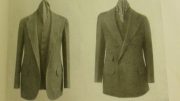
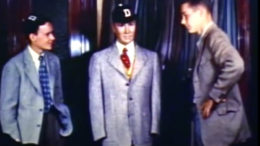
My father, Paul Press, was a riveter who made M-70 rifles at the Winchester factory on Dixwell Avenue in New Haven. His brother Irving ran the PX store at Camp Ritchie, Maryland. My grandfather assisted the war effort overseeing custom-tailored uniform orders for candidates at the Officer’s Training School at Yale. J. Press was on a wartime footing along with the rest of America. The Princeton store was closed in 1942 when the entire staff joined the army. Civilian business necessarily diminished with shortages of inventory and customers during the war years.
My prescient grandfather prepared for the European conflict in the late ’30s and loaded up all available English goods before the start of war in September, 1939. Cases of Welch, Margretson shirts and ties, Twin Steeples hosiery, Druhmohr Shetland sweaters and Locke hats occupied all the space in the basement.
I was six years old in 1944 when grandfather Jacobi set up chairs and blankets for us to watch the Christmas Day Parade on the balcony in front of his office of the J. Press store on York Street. The wartime spectacle offered a key spot to view the brigades of Sherman tanks and armored vehicles clanking their treads towards the rally downtown for speeches and songs later on the New Haven Green. Soldiers, Sailors and Marines blared their bugles and beat the drums in military cadence to “The Caissons Go Rolling Along.” The back of the parade featured All-America Yale Football Captain Paul Walker, the Dink Stover and Frank Merriwell of his time, riding on top of a Ford truck garbed in a Santa Claus suit and beard, both a part of and yet removed from the instuments of war. He directed his Winston Churchiil “V for Victory” salute right to me on the balcony.
Spiffed up in the army uniform my grandfather gave me for Christmas, I returned the salute standing stiffly at attention until the grand old flag finally passed me by. When I got home I couldn’t wait to turn on the Victrola to play my favorite Spike Jones record: “When The Fuhrer Says He Is The Master Race, Sieg Heil (flatulate), Sieg Heil (flatulate), Right In The Fuehrer’s Face!” — RICHARD PRESS
Last night the Broadway revival of “Anything Goes,” which had received nine Tony nominations, ended up winning three. As I watched, I couldn’t help but remember one of the great historical anecdotes of J. Press: The time my grandfather Jacobi helped the musical’s composer Cole Porter evade the New Haven police.
During a 1912 football game at Yale Field, just across the street from where the Yale Bowl was being constructed and would open the following year, Cole Porter joined the band for the halftime march down the field to introduce his new song, “Bulldog, Bulldog, Bow Wow Wow, Eli Yale.” By the time the game was over, Porter and his Delta Kappa Epsilon band of brothers were well lubricated and spotted a Chapel Street trolley passing the stadium. Porter gave the cry: “Hijack!”
A “Keystone Kop” chase ensued to York Street, when Porter leaped out of the trolley and ran to J. Press next to the DKE house where my grandfather hid him in the store cellar until the coast cleared.
Jacobi Press and Cole Porter are both long gone, but a commemorative line has stayed in “Anything Goes” since it first opened in 1932. In one scene, standing on a set designed to be the deck of an ocean liner, the romantic lead throws a stuffed animal to his drunk boss, who is heading for the Henley Regatta to cheer for Yale. “Here, Boss,” he says, “I got you the bulldog at J. Press.”
The following year Cole Porter, along with fellow Yalie Dean Acheson, roomed together at Harvard Law School. Porter eventually abandoned law to return to music, but years later, while serving as Secretary of State in the Truman administration, Acheson, who was renowned for his elegance, was featured in a LIFE Magazine half-page portrait that noted his clothes were from J. Press.
In closing, it’s worth looking at the lyrics of “Anything Goes”:
In olden days a glimpse of stocking
Was looked on as something shocking
Now heaven knows, anything goes!
Campus shenanigans have certain come a long way since Porter highjacked a trolley. “The world has gone mad” indeed. — RICHARD PRESS
Richard Press is the grandson of J. Press founder Jacobi Press. A graduate of Dartmouth, he worked at the family business from 1959-1991, ultimately serving as president. He also spent four years as president and CEO of FR Tripler. He lives in Connecticut.
Recently I purchased a 1926 yearbook for my alma mater, the University of Pennsylvania, and was pleasantly surprised to see a Brooks Brothers advertisement on the first page of the ad section. Flipping through, I also discovered ads for a few local establishments, including a campus menswear shop called Gommy. It seemed like Gommy may have been for Penn and Princeton what J. Press was for Yale. My interest piqued, I began searching for details on the history of the store.
I was not able to find much at all, however. Menswear expert Bruce Boyer, former J. Press president Richard Press, and trad guru David Wilder were unable to provide any details about Gommy. The one solid piece of information I was able to find on this Philadelphia shop was a quote from B. Franklin Reinauer II, a gentleman who graduated from Penn in 1938. He provides some details on Gommy as well as the general menswear retail environment at the time:
There were some good men’s clothing stores: Gommy’s on Woodland Avenue Street just below 36th Street, and Sox Miller on Spruce Street just above 36th Street. People from men’s clothing stores in other cities would travel from college to college campuses get a room in a hotel or elsewhere to show their clothing to students and hopefully make some sales. Student representatives at different schools tried to get students to come to see the clothes.
Reinauer goes on to recount what campus wear was like during his college years:
When we students went to our classes each day we were dressed in slacks, tweed jacket, shirts [many with button down collars] and ties. There was a fine shoe shine place on Spruce Street just above 36th Street where our cordovan shoes were shined to perfection. We wore coats and fedora hats, too. Those students who were members of the football or other team sometimes wore their sweaters with “P” emblazoned.
For Ivy Style’s 300th post, London-based contributor Rebecca C. Tuite examines the most important piece of literature about The Ivy League Look’s most important brand.
There is little doubt that Mary Mccarthy’s short story “The Man in the Brooks Brothers Shirt” is now probably more famous for its punchy title — a dream for the Brooks Brother’s marketing team — than it is for the actual story. But it remains a classic part of the mystique of the Brooks Brothers Look, and indeed, the Brooks Brothers Man.
Taken from Mary McCarthy’s 1942 novel “The Company She Keeps,” which is less a straight narrative and more a collection of six short stories, “The Man in the Brooks Brothers Shirt,” forms the third chapter in the story of Margaret Sargent, a young woman trying to redefine her life following a Reno divorce. “Floundering in a world of casual affairs and squalid intimacies,” Sargent is self-destructive, reinventing herself as a bohemian and rebelling against society, all of which finds a perfect counterpoint in Mr. Breen: a Cleveland-based executive at a steel company and the “hearty stranger in the green shirt” she meets on a Pullman car heading west to Sacramento.
The story opens with the first description of the man, who at this point remains nameless:
The new man who came into the club car was coatless. He was dressed in grey trousers and a green shirt of expensive material that had what seemed to be the figure “2″ embroidered in darker green on the sleeve. His tie matched the green of the monogram, and his face, which emerged rather sharply from this tasteful symphony in cool colours, was bluish pink.
Less than impressed, Sargent sees him “like something in a seed catalogue,” and although feeling “full of contempt for the man, for his coatlessness, for his colour scheme, for his susceptibility, for his presumption,” she still allows herself, firstly, to enter into conversation with him, and secondly, to spend the night with him (subsequently enduring the following morning). All of this is peppered with Sargent’s own disgust for the promiscuity her aunt has always warned her about — “I don’t know why you make yourself so cheap,” and “It doesn’t pay to let men think you’re easy.” (Continue)
This is a 20-minute clip, so watch it over lunch if you’re the kind of poor schlub who eats lunch at his desk. And if you’re at home, pour yourself a drink and get comfortable.
Love the towel worn as a scarf in the opening. Great chinos and sweaters in action at 2:28. Jackets and ties for trip to Cornell at 4:28. White bucks and grey flannels at 5:51. Rowing against Columbia through New York City at 8:29. More traveling clothes at 10:32.
And finally, at 19:28, the climax: a kiss from a debutante in cashmere and pearls.
AldenPyle of Andy’s Trad Forum, one of the most diligent ransackers of the LIFE archives, recently dug up some photos of the 1936 National Amateur Golf Championship at the Garden City Golf Club.
The winner was John W. Fischer, who took the cup not only for his fine form on the fairway, but for being the most Ivishly styled. The shot of him above caught my eye. Note the natural shoulder, 3/2 roll and patch pockets, and perfectly contemporary proportions. The lapel width is even so spot on you could wear the jacket today, nearly 80 years later, and not have to change a stitch. (Continue)
Here are some early collegiate images from the Hart, Schaffner & Marx archives. Check out the sprezzatura of the guy in the chair above: college sweater with formal pumps — now that’s a juxtaposition. (Continue)
One of the saddest phrases in the English language is “You missed a great party.” Well here’s one we all missed.
In 1957 jazz historian and Harvard/Yale alum Marshall Stearns threw the ultimate jazz-Ivy shindig. Held in honor of sitar player Ravi Shankar, the party juxtaposed Indian music with jazz, and included a jam session with Dizzy Gillespie. LIFE Magazine captured the soirée, which drew the kind of crowd only possible in New York: a dazzling melange of socialites and hipsters, artists and businessmen, with everyone dressed to the nines. Though LIFE only devoted one page to the event in the magazine, the LIFE archives include an extensive photo set entitled “East-West Jam Session.” (Continue)
When it comes to starting fashion trends, there’s Princeton and then there’s every other school. From the three-button suit to its namesake haircut, Princeton has popularized such menswear staples as Norfolk jackets, raccoon coats, tweed sport coats, rep ties, spectator shoes, khaki pants and Shetland sweaters.
Princeton’s sartorial influence has been dulled by time, but for much of the 20th century it was well acknowledged by both a watchful fashion industry and rival schools.
LIFE magazine’s 1938 article, “Princeton Boys Dress in a Uniform,” confirms that “tailors and haberdashers watch Princeton students closely,” while students at Harvard and Yale call Princetonians “the prototype of Hollywood’s conception of how the well-dressed college boy should look.”
So how did Princeton men become such recognized style leaders?
Like most clotheshorses, they had money and a penchant for both quality and quantity. As one student wrote in a 1931 campus publication, “As every Princeton father knows, his son’s clothes are expensive.” Yearbooks, newspapers and athletic programs were filled with advertisements for Brooks Brothers and Franks Brothers, a top-tier shoe company.
Not only did Princeton men spend big bucks on their own apparel, but their stamp of approval helped manufacturers court other collegiates. The school’s name attached to a garment conferred integrity. EE Taylor Corporation’s “Princetonian” shoe was advertised as direct “from the campus of the country’s collegiate fashion center,” and was one of the company’s best selling models of 1934.
Secondly, Princetonians lived in a self-regulated environment with a well defined social pecking order. Sure, Harvard and Yale had their share of insularity and rich white kids, but they also pioneered financial aid and scholarships, which fostered a more diverse student body than Princeton. In rural New Jersey with little meddling from administrators, Princeton men created a homogenous campus culture that prioritized fitting in.
In “This Side of Paradise,” F. Scott Fitzgerald, describing his protagonist’s first day at Princeton, wrote, “Amory felt unnecessarily stiff and awkward among these white-flannelled, bare-headed youths who must be juniors and seniors, judging by the savoir-faire with which they strolled,” and he “wondered vaguely if there was something the matter with his clothes.”
For the first half of the century, Princeton freshmen and sophomores were banned by tradition from wearing particular garments, such as white flannel pants or striped ties. One had to earn the right to dress like a Princeton man.
While an ample bank account and the need to dress the part allowed Princeton students to assemble a well honed wardrobe, the leisure-based lifestyle of their campus inspired the actual trends. Athletics dominated Priceton’s student culture. Sportswear was worn around the clock. Earlier trends, such as tweed golfing suits or flannel blazers, had an air of formality. Those that came later in the century couldn’t have been more casual, and included sweatshirts, sneakers and t-shirts. Despite such differences, the collective contribution of Princeton students to the modern American wardrobe is undeniable. Whether you’re wearing khakis and a sport coat or jeans and a cardigan, chances are your clothes were first popularized at Princeton. — DEIRDRE CLEMENTE
Deirdre Clemente is a cultural historian who was denied admission to Princeton three times. She is a former fashion writer and currently a Ph.D. candidate at Carnegie Mellon, where her dissertation dissects the influence of college students on the casualization of the American wardrobe in the first half of the 20th century. Her work has appeared in the Journal of Social History, The New England Quarterly, and Labor Studies Journal.
Historically, Ivy style has always championed durability and functionality. Nowhere is this truer than in the realm of outerwear, where such weathered classics as the toggle coat and balmacaan remain viable and timeless.
However, at certain vivacious moments in the style’s history, discerning collegiate sartorialists have exchanged the reliable for the resplendent, the austere for the ostentatious.
One such moment occurred in the 1920s, when young men threw off their tweedy raglans in favor of a far more flamboyant material: raccoon fur. University of Illinois football star Red Grange (1903-1991) and radio crooner Rudy Vallee are credited with popularizing the wide-collared, ankle-length raccoon coat, a fad which spread quickly across the campuses of the Northeast. The coats were particularly popular among young male jazz enthusiasts who garnered the nickname “collegiates” or Joe College.
The first wave of the fad ended with the dawn of The Great Depression, but the coat saw a brief revival in 1956. This second coming of the coonskin coat saw voracious demand for secondhand furs in, as the Lord and Taylor College Shop proudly announced at the time, “a state of magnificent disrepair.” An article in the New Yorker from August 17th, 1957 traces the origins of the revival back to a group of three young New Yorkers and a presumably jazz and smoke-filled party at their Greenwich Village apartment.
As legend has it, Sue Salzman was about to buy a used raccoon coat on a whim when it was snatched up by another customer. Bemoaning her loss at a party hosted by herself and her husband Stanley, she was approached by an acquaintence whose relatives were in the boys’ clothing business and just happened to have a warehouse full of old raccoon coats. This crop of furs was leftover from the wave of Davy Crockett Mania, during which time they were chopped and used to make coonskin caps. “Feeling manic” from their good fortune, the Salzmans purchased coats for themselves and for every person who attended their party.
After they began receiving inquiries about the coats, the Salzmans and their friend Benjy Bejan decided to go into business and let the fur fly. When Glamourmagazine published a photo of a raccoon coat and credited them as the supplier, the trio received over 300 letters, phone calls and an urgent inquiry from Lord and Taylor. The department store was a collegiate style heavyweight at the time, and, as Mr. Salzman admits, “anything that Lord and Taylor does in college fashions is copied.” Once Lord and Taylor became involved, demand outweighed supply, and a trend was born.
It is no coincidence that the craze for fur coats arose during periods of unprecedented prosperity in which youths actively sought to redefine their own morality. In this age of traditionalism imbued with conservative nostalgia it is sometimes all too easy to forget that collegiate style once represented liberation from the dress of prior generations, a way to dress freely for those who lived freely.
Below are images from 1928, 1959, and from the Fall ‘09 collection by Brooks Brothers (courtesy of Mister Mort), suggesting another raccoon coat revival might be just around the corner. Of course, that would negate the prosperity theory. — ZACHARY DELUCA (Continue)