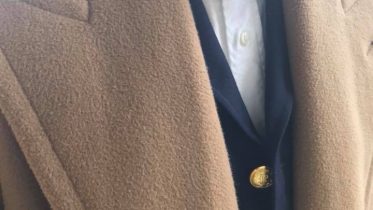
When I was an undergraduate at Moravian College in Bethlehem, PA, there was a wonderful campus shop on Main Street called Tom Bass. It served three colleges and a university (Moravian, Muhlenberg, Lafayette and Lehigh University), and it stocked many of the iconic Ivy League labels: suits by Southwick, buttondowns by Gant and Sero, Pringle and Alan Paine sweaters, flannel and khaki trousers by Corbin, and raincoats by London Fog. Anyone old enough to remember will tell you these manufacturers produced clothing of the highest standards in those days (the ’50s and early ’60s).
But when I went to graduate school at Lehigh in 1963, I moved up a notch, to what was arguably one of the three or four best campus clothing shops in the country. There were of course J. Press in New Haven, The Andover Shop in Cambridge, Chipp in Manhattan… and then there was Langrock on Nassau Street in Princeton.
I don’t want to go into the history of that esteemed firm at the moment, merely give a few fleeting impressions of that sublime outfitters. The owner of Langrock at the time was Alan Frank, a man of impeccable taste who looked as though he could have walked across the street and stepped onto the podium of a lecture hall. In my memory he tended to wear charcoal suits most of the time: flannel in winter, tropical worsted in summer, with the occasional nod to a seasonal Harris Tweed or seersucker sports jacket. Usually a white oxford cloth buttondown, and a dark silk club tie. Very proper, yet he always looked perfectly comfortable and at ease.
The shop itself occupied a regal, colonial-looking brick building on a corner, so the large floor-to-ceiling plate glass display windows (obviously not original because the building had originally been a home) could be seen from two sides. Inside were a series of rooms, each paneled in dark walnut wainscoting and with old Persian rugs on the well worn wooden floors. Hunting prints of course and college shields. Everything to reflect the hushed and slightly dusty ambiance of a gentleman’s club or dining hall. It seemed impervious to time.
In the center of the main room, as one entered from the street, was a large round table, a good five-to-six feet in diameter, laid out with rep striped ties: hundreds of them in military, university and club stripes of the most vivid colors, a wheel of shimmering silk afloat in the dimly polished ambience. To the right was a glass-and-mahogany case which held the club and paisley neckwear. All from England. Also from England and Scotland, in a similar case to the left were the crewneck sweaters (with saddle shoulders), and wool hosiery, as well as cashmere V-necks and beautiful cashmere hosiery in heathery tones of lovat and fawn and tobacco brown and Cambridge grey.
Shirts — mainly buttondowns, with some straight point and rounded club collars mixed in — were stacked on shelves running the length of the left-hand wall from waist to within a foot or so of the ceiling. It was at Langrock that I first saw — and bought — a true royal oxford cloth shirt. It happened to be in a lustrous pale yellow, not quite cream. It was light as a cloud without being delicate, and I got years of wear out of it.
The two other rooms held the tailored clothing: suits, sports jackets, odd trousers, topcoats and raincoats. And there was a real tailor, not just an alterations tailor but a man who worked a pattern, and who had swatch books of handsome Cheviot and Hebrides tweeds, flannels from the West of England, and Irish linens. I once extravagantly commissioned a hearty tweed sports jacket in a camel-and-olive check with an orange windowpane. The tailor put a special sweat-proof lining in the back skirt panel of the jacket, “just in case you want to do some riding, Sir.”
My purchases in this sartorial arcadia were actually few and far between because Langrock was violently expensive, particularly for a young man in grad school. But funnily enough, I still have several of their ties today, and always felt I’d gotten my money’s worth. Since I was an English Studies student, I was thrilled to hear from Mr. Frank that John O’Hara was a customer, although I never had the luck to see him on my rare Saturday appearances. O’Hara’s not read much these days, but in his time he was a literary giant. And he wallowed in campus clothes: Jacob Reed (Philadelphia’s best Ivy League store in its day), J. Press and his beloved Brooks Brothers were his haberdashery haunts. He once invited the dandy columnist George Frazier to drink with him simply because Frazier was wearing a Brooks buttondown. O’Hara lived in Princeton at the end of his life, and is buried there. His epitaph, written by himself:
Better than anyone else, he told the truth about his time,
the first half of the twentieth century.
He was a professional.
— G. BRUCE BOYER
G. Bruce Boyer is the author of numerous books on menswear, most recently “Fred Astaire Style” for Assouline. He is currently a contributing editor at The Rake.
Was John F. Kennedy the most Ivy of US presidents, or did the most important man in the country actually encourage American men not to follow the Ivy League Look?
That depends on whether you’re talking about President Kennedy the nation’s leader, or Jack Kennedy relaxing among friends and family in Hyannis Port.
On assignment for the latest issue of The Rake, I examined the split between Kennedy’s public and private life, and how this was reflected in his wardrobe.
The text of the article is below, or you can download a printable PDF.
Setting the President: John F. Kennedy’s dress sense was central to his public persona, forming no small part of this truly modern president’s enduring iconography
By Christian Chensvold
The Rake, Issue 7
Photographs of John F. Kennedy generally fall into two categories. In the first, we see him at his family’s Cape Cod retreat, sleeves rolled up, wearing khakis grass-stained from touch football, or clad in Nantucket Reds and sunglasses sailing the sea. In the second, his presidential kit, we see another man altogether. Kennedy’s dark suits hang with a certain awkwardness, the shoulders large and high, his two chest buttons both fastened.
Though both are equally iconic, these two images of JFK reveal the sartorial differences between the man’s public and private lives. Privately he was the Choate and Harvard-educated scion of a patrician American dynasty, while publicly he was a progressive young Democrat, commander on the frontlines of the Cold War, and careful crafter of a public image in the new age of television.
This schism makes JFK both the ultimate preppy president — his administration reigned at the height of the Ivy League Look — and an ironic hastener of the look’s decline, undermining the very style he so perfectly embodied. Though Kennedy could hide neither his Catholic faith nor brahmin accent, this first great image crafter of the TV age could strengthen his broad appeal with two sartorial gestures: He would wear two-button suits instead of three-button sack models, and he would eschew buttondown collars. The result, noted LIFE Magazine in 1961, was that the president’s clothes “fail to conform to current Ivy League fashion.”
Before becoming a style setter, Kennedy started out as a ragamuffin. “As a young man he was notorious for his personal disorder,” writes Neil Steinberg in “Hatless Jack: The President, the Fedora, and the History of American Style.” “His boarding-school roommates complained of his messiness, particularly with clothes. He would show up with his shirt untucked, or without socks, or wearing a rag of a necktie.”
Before his marriage to Jacqueline Bouvier in 1953, “Kennedy had been a sloppy dresser who favored baggy suits, clashing shirts and ties, and ratty tennis shoes,” according to historian Thurston Clarke.
With Jackie’s guidance, Kennedy’s style evolved into a paragon of simplicity and understatement. His casual weekend mufti was collegiate and Northeastern — Shetland crewnecks, penny loafers sans socks, white t-shirts, polo shirts and chinos, with a notable absence of pattern. His suits were solids or light stripes, shirts almost always white with a short straight collar, his ties discrete reps and clubs. Like Steve McQueen, another charismatic public figure with subdued taste, Kennedy gave his clothes style, rather than the other way around, a testament to the idea that clothes should never upstage their wearer.
Sartorial simplicity suited Kennedy best because he had star quality, an air of innate dignity, recalled his physician Janet Travell, “that was the product of personal reserve, self-respect, style and a distaste for ostentation.” But there was something else. With his sunglasses and convertibles, ironic wit and military heroics, Kennedy had something no American leader had ever had before: cool.
Much of Kennedy’s cool came from his hair, a Samson’s mane of potent charisma and something Kennedy famously avoided covering with headwear. “In a hat he looked far older and almost unrecognizably ugly,” writes Steinberg. “And he knew it.”
Kennedy’s effect on American taste was palpable. “Kennedy sets the style, taste and temper of Washington,” wrote GQ in 1961. “Cigar sales have soared (Jack smokes them). Hat sales have fallen (Jack does not wear them). Dark suits, well shined shoes, avoid button down shirts (Jack says they are out of style).”
As GQ points out, Kennedy set styles as much for what he negated as for what he advocated, and he stood in favor of two-button suits as much as he stood against buttondown collars. Historians have suggested that Kennedy preferred two-button suits because they better accommodated his back brace. Paul Winston, however, who made suits for Kennedy while working at his family’s legendary clothing company Chipp, recalls Kennedy wearing a brace during fittings at New York’s Carlyle Hotel, but says the button stance would not have mattered.
What is more likely is that Kennedy felt that while he couldn’t hide his privileged background in a television age that required mainstream appeal, he could at least obviate his image sartorially by wearing suits less redolent of the Eastern Elite and more becoming a man in the limelight of international affairs. When asked if suits for the newly elected president would be two-button, tailor Sam Harris said, “Certainly, two button. We don’t follow Ivy League or beatniks. We make gentlemen’s clothes.”
And when it came to shirt collars, Kennedy mocked his brother Robert in the press, telling LIFE, “He’s still wearing button-down shirts; they went out at least three years ago,” and told friend and confidant Paul Fay that his button-down collars were “too Ivy League.”
Privately preppy, publicly the leader of the free world, Kennedy was always an icon. But in the annals of sartorial history, JFK is less an example of a well dressed man than a man with tremendous charisma, and for such men understatement is always the best frame.
“Kennedy was a handsome and important man,” remembers Paul Winston. “That old saying that clothes makes the man? Not really. I think the man makes the clothing.”
Images from Time magazine’s “JFK Style.”

When legendary clothing company Chipp moved in 1985, Paul Winston threw away the pattern he had once used to make suits for President Kennedy.
He still kicks himself for it, but at least he managed to save the vintage Cornell jock strap pictured above.
Winston recently shared the item, sized medium, while I visited his tailoring shop. It was hidden in a drawer, but Winston knew just where to find it.
Known for their whimsical linings (including postures from the “Kama Sutra”) in otherwise conservative suits, Chipp offered matching tie and jock-strap sets in the early ’60s, Winston said. Schools included the Ivies, plus other big sports colleges like Michigan and Notre Dame. Winston would cut and sew them himself while watching football at home, cranking out up to two dozen in an hour.
Winston says Chipp sold “a lot” of them, clarifying that “a lot” in this case is a relative term. — CC
Though it probably should be, this post will not be filed under Top Drawer.

Yesterday The New York Times ran a profile on Manhattan District Attorney elect Cyrus Vance, Jr. that makes a passing reference to Brooks Brothers and Chipp. In Ivy-Style’s interview with Chipp’s Paul Winston, Vance Senior, who served as Secretary of State in the Carter administration, was mentioned as a frequent customer.
Though Winston recalls making clothes for Vance Junior as well, he hasn’t seen the new Gotham DA in nearly 30 years, Winston told Ivy-Style today. As for Vance the elder, “He was really one of the finest gentlemen who ever walked into our place.” Winston has shared some recollections of Vance’s cordial manners on his blog. (Continue)

The first Japanese to adopt elements of the Ivy League Look were a youth tribe called the Miyuki-zoku, who suddenly appeared in the summer of 1964. The group’s name came from their storefront loitering on Miyuki Street in the upscale Ginza shopping neighborhood (the suffix “zoku” means subculture or social group). The Miyuki-zoku were mostly in their late teens, a mix of guys and girls, likely numbering around 700 at the trend’s peak. Since they were students, they would arrive in Ginza wearing school uniforms and have to change in to their trendy duds in cramped café bathrooms.
And what digs they were. The Miyuki-zoku were devotees of classic American collegiate style. The uniform was button-down oxford cloth shirts, madras plaid, high-water trousers in khaki and white, penny loafers, and three-button suit jackets. Everything was extremely slim. The guys wore their hair in an exact seven-three part, which was new for Japan. They were also famous for carrying around their school uniforms inside of rolled-up brown paper grocery bags.
What lead to the sudden arrival of the Miyuki-zoku? Although Japanese teens had been looking to America since 1945 for style inspiration, these particular youth were not copying Princeton or Columbia students directly. In fact, Japanese kids at this time rarely got a chance to see Americans other than the ever-present US soldiers.
The Miyuki-zoku had found the Ivy look through a new magazine called Heibon Punch. The periodical was targeted to Japan’s growing number of wealthy urban youth, and part of its editorial mission was to tell kids how to dress. The editors advocated the Ivy League Look, which at the time was basically only available in the form of domestic brand VAN. Kensuke Ishizu of VAN had discovered the look in the 1950s and pushed it as an alternative to the slightly thuggish big-shouldered, high-waisted, mismatched jacket-and-pants look that dominated Japanese men’s style throughout the 1950s. As an imported look, Ivy League fashion felt cutting-edge and sophisticated to Tokyo teens, and this fit perfectly with Heibon Punch’s mission of giving Baby Boomers a style of their own.
When the magazine arrived in the spring 1964, readers all went out and became Ivy adherents. Parents and authorities, however, were hardly thrilled with a youth tribe of American style enthusiasts. The first strike against the Miyuki-zoku is that the guys — gasp! — would blow dry their hair. This was seen as a patently feminine thing to do.
More critically, the Miyuki-zoku picked the wrong summer to hang out in Ginza. Japan was preparing for the 1964 Olympics, which would commence in October. Tokyo was in the process of removing every last eyesore — wooden garbage cans, street trolleys, the homeless — anything that would possibly be offending to foreign visitors. The Olympics was not just a sports event, but would be Japan’s return into the global community after its ignoble defeat of World War II, and nothing could go wrong.
So authorities lay awake at night with the fear that foreigners would come to Japan and see kids in tight high-water pants hanging out in front of prestigious Ginza stores. Neighborhood leaders desperately wanted to eradicate the Miyuki-zoku before October, so they went to Ishizu of VAN and asked him to intervene. VAN organized a “Big Ivy Style Meet-up” at Yamaha Hall, and cops helped put 200 posters across Ginza to make sure the Miyuki-zoku showed up. Anyone who came to the event got a free VAN bag — which was the bag for storing your normal clothing during loitering hours. They expected 300 kids, but 2,000 showed up. Ishizu gave the keynote address, where he told everyone to knock it off with the lounging in Ginza. Most acquiesced, but not all.
So on September 19, 1964, a huge police force stormed Ginza and hauled off 200 kids in madras plaid and penny loafers. Eighty-five were processed at nearby Tsukiji jail. The kids got the message and never came back, and that was the end of the Miyuki-zoku.
Starting in 1945, Japanese authorities generally viewed all Western youth fashion as a delinquent subculture. Despite looking relatively conservative in style compared to the other biker gangs and greasy-haired rebels, the Miyuki-zoku were still caught up in this delinquent narrative. In fact, they were actually the first middle-class youth consumers buying things under the direction of the mainstream media. It was Japanese society that was simply not ready for the idea that youth fashion could be part of the marketplace.
After the Miyuki-zoku, however, Ivy became the de facto look for fashionable Japanese men, and the “Ivy Tribe” that followed faced little of the harassment seen by its predecessor. The Miyuki-zoku may have lost the battle of Ginza, but they won the war for Ivy League style. — W. DAVID MARX
W. David Marx is a writer living in Tokyo whose work has appeared in GQ, Brutus, Nylon, and Best Music Writing 2009, among other publications. He is currently Tokyo City Editor of CNNGo and Chief Editor of web journal Néojaponisme.
Special thanks to Valetmag.com, Kempt, Selectism, ModCulture and the many other sites that linked to this post.

The annual Harvard-Yale football game — known to students and alumni simply as The Game — has been played since 1875 and alternates each year between Harvard Stadium and the Yale Bowl. The Game is famous for its always-waning-but-never-quite-dead tradition of genteel tailgating, nowadays conducted alongside college parties more squarely within the “Animal House” tradition.
What we still call Ivy League clothing is rarely seen on the campuses of these premier Ivy League schools. Today’s Harvard and Yale students attend The Game in nondescript jeans, sweatshirts and fleece — or shorts and t-shirts if they want to signal that dressing for the weather is beneath them. But in the heyday of the Ivy League Look, as this 1962 Sports Illustrated article explains, The Game enabled Cambridge and New Haven clothiers to scout out sartorial trends and keep track of their rivals:
Whenever it is played at Harvard, as it was November 24 last, representatives of the New Haven tailoring establishments—J. Press, Fenn-Feinstein, Chipp, Arthur Rosenberg, et al.—entrain for Cambridge to render biennial obeisance and to see what the young gentlemen are wearing. The tailors themselves wear velour Alpine hats, double-breasted, tweed topcoats and blue oxford shirts to offset their sallow complexions. By custom they do not speak to one another, and, upon arrival, each goes his separate way. Following tradition, Paul Press descends into the basement of J. Press, where he stands his Cambridge branch employees to a buffet luncheon of cream soda and hot pastrami imported from New Haven.
This year’s Game will be played on November 21 at Yale and marks a return for Mory’s, the New Haven dining club that appeared headed for oblivion a few years ago. The Yale Herald reports that Mory’s will have a tent at The Game, serving brunch, drinks, nostalgia, and hope for the future.
Pictured are photos of The 1960 Game from the LIFE archives. — TALIESIN
Taliesin, who works in the federal government, holds a master’s degree from Harvard, where he was always amazed at how badly his fellow students dressed, though how impressive they were in most other respects. He has never been to New Haven. (Continue)
When Timothy Thompson, an 18-year-old from Ashland, Oregon, was chosen by LIFE Magazine to have his first semester at Yale chronicled, a massive challenge lay before him. Not only did he have to adapt to the school academically and socially, he had to do so while a reporter and photographer followed him around campus, capturing each awkward moment, for nine weeks.
Thompson was the subject of our previous post, in which we dug up his lengthy profile in the January 8, 1965 issue of LIFE. A reader later left a comment showing what became of Thompson after college, then another reader found his obituary (Thompson died in 2004 at age 58).
In the obituary I noticed that his sister, Ardith Da Costa, lives in Petaluma, California, 40 miles north of San Francisco and the next city over from me. I telephoned her, and Mrs. Da Costa was happy to talk to me about her brother and how the LIFE feature came about.
IS: How was your brother chosen by LIFE?
ADC: There were 250-500 Yale prospects LIFE was considering. They whittled it down to five pretty quickly, and the reporter Donald Jackson seemed to have a good rapport with Tim. That was probably the final determination.
IS: How did Tim get into Yale?
ADC: He was salutatorian in his class and was accepted to Yale, Penn State and another East Coast school. He had the marks and was well rounded, having been active in sports and band. And he got an academic scholarship, since there was no way we could afford it; he came from a pretty simple lifestyle and there were four kids.
IS: When he came home for Christmas, what did he tell you about his first semester?
ADC: One of the vivid experiences he shared was about him coming from a public school and immersing with East Coast kids from prep schools, who had had a whole different experience both academically and socially.
IS: After the story came out, did Tim become the big man on campus?
ADC: In the big picture, with the number of academically gifted kids there, when it came out he probably fleetingly stood out for 24 hours.
IS: The story is called “Freshman Blues,” and it certainly shows Tim’s struggles. It also makes the reader cheer for him to succeed. Was he pleased with how it came out?
ADC: Yes, he felt they portrayed his experience accurately.
IS: Tell us about his military service.
ADC: Tim was in ROTC, and he was drafted his senior year to serve in the Vietnam War. Because he knew Latin and French, the Army had a special assignment for him, and he worked in Army Intelligence. He never spoke about what he did while serving.
IS: How would you characterize Tim as a person?
ADC: He was definitely warm and caring. If someone needed something, he’d be there in a heartbeat. He had a good sense of humor, and was very determined. And he was very outgoing and well liked. His freshman roommates became lifelong friends. He gave a lot back to Yale, and yet as much as he liked living on the East Coast he still had his friends from where we grew up. He managed to keep his connections diverse, and really valued his contacts, family and friends from all his different stages of life.
— CHRISTIAN CHENSVOLD
What was it like for a public-school kid from nowhere to go to an Ivy League school during the heyday?
Sure, you got to wear cool clothes (once you figured out what they were), but even that was fraught with anxiety.
At least it was for Timothy Thompson, whose first semester at Yale was full of loneliness, awkwardness, and rigorous academics requiring 18-hour days just to keep from flunking out.
Tim previously appeared in our post “Blue Man Group.” Now here’s his story: a lengthy LIFE magazine feature on what happens when a “rough country boy” from Oregon gets into Yale, only to endure a “painful struggle trying to fit in.”
In addition to brain-twisting homework and the challenge of making friends, Tim also had to learn strange new words like “avant-garde,” buy new clothes in order to “keep up with his classmates,” sit through French courses conducted in French, and uphold his clean-living Baptist values in the wake of the Sexual Revolution.
But Tim had pluck: “I want to be myself,” he told the magazine. “I don’t want to be classified as a sophisticate, a playboy, a screwball, or anything.”
But didn’t LIFE do him a disservice by profiling him in a high-circulating periodical? Talk about piling on the pressure: Now it wasn’t just his parents and campus advisor waiting to see his math grade, but the entire United States of America.
Did Tim eventually graduate, rising from Pacific Northwest obscurity to old-boy network? And where is he now?
Attempts to find an answer via Google came up empty. I’ve a bottle of bay rum for the reader who can find the answers. — CC

On Monday a young Argentine named Juan Martin del Potro won his first major title, beating Roger Federer to win the US Open.
We’d like to honor, however, Arthur Ashe, who won the inaugural US Open in 1968. He’s pictured above in 1966; the accompanying story is here.

In 1969 the old-boy network at America’s most stylish university was broken with the admission of female students.
The fellow above is clearly pleased with the change. Not only in the student body (and what a body it is), but with campus fashion. Sartorially speaking, the pivotal year of change — 1967 — was two years before, and the up-to-date undergrad is now sporting double vents and sideburns. You decide which is the greater travesty. (Continue)