The Underappreciated Yellow Oxford

Sun 27 Jun 2010 - Filed under: 1990-present, Clothes, Film — Christian
Comments (31)

For a certain breed of trad purist, there are only four shirts worth wearing: oxford-cloth button-downs in white, blue, pink and yellow.

White and blue are everyday staples of the office wardrobe, and pink is the iconic color, leaving yellow in fourth place, underappreciated, trickier to match, and less flattering. It’s too colorful to be a business basic like blue and white, yet lacks the legendary status of pink.

I decided to check with Brooks Brothers merchandiser Jeff Blee to see just how the yellow oxford stacks up against its rivals.

First off, Jeff had to qualify things: Not every Brooks store is merchandised the same. Some stores only sell white and blue shirts, so yellow isn’t even a choice (ecru, the only other solid oxford available at Brooks, is so obscure as to hardly warrant mentioning).

So rather than look at sales companywide, we opted to just look at sales at the Madison Avenue flagship, where the four main solids are stacked right next to each other. Here’s how the sales break down:

White: 48%

Blue: 38%

Pink: 9%

Yellow: 5%

What do these numbers mean? For one thing, there are almost 10 times as many white shirts sold as yellow. Moreover, there are also nearly twice as many pinks sold as yellow. However, in the South, Blee noted, the margin between pink and yellow is much smaller.

Those who are violently allergic to non-iron shirtings will be pleased to learn that sales of must-iron oxford button-downs are growing, according to Blee. The shirts are attracting new customers thanks to Brooks’ new slim and extra-slim fit options. Kudos to Brooks for keeping a classic alive for everyone by offering updated variations. (Continue)

Digg TwitterFacebook StumbleUpon

Buttoned-Down Beatnik: Ginsberg Biopic “Howl” Gets Sept. Release

Tue 25 May 2010 - Filed under: Film, Lit — Christian
Comments (4)

A few months ago I heard about the Allen Ginsberg biopic “Howl,” and asked the production company if there were any upcoming screenings. There weren’t, as the film had yet to find a distributor.

It’s got one now, and is scheduled for release on September 24. The film focuses on the poet’s 1957 obscenity trial and stars James Franco as Ginsberg.

In addition to smoky coffeehouse scenes, “Howl” will also include various courtroom scenes with dueling ’50s lawyers. One of them, Ginsburg’s attorney, is played by Jon Hamm, aka Don Draper on “Mad Men.”

While a student at Columbia, Ginsberg met Jack Kerouac and other Beat writers. And though he later went all countercultural and hairy, he never completely abandoned a taste for the Ivy League Look. — CC

Digg TwitterFacebook StumbleUpon

Mission Accomplished: Robert Culp, 1930-2010

Tue 30 Mar 2010 - Filed under: 1960s, Film — Christian
Comments (1)

Last week saw the passing of actor Robert Culp, who starred in the ’60s TV show “I Spy.” Last year Ivy-Style contributor Zachary DeLuca wrote a fine tribute to the show, in which Culp plays a former tennis star turned secret agent generously costumed in natural-shouldered suits and buttondown collars. The post can be found here, and includes a nice clip of the show and its sartorial eye candy.

And here’s Culp’s obituary in the New York Times, while the LA Times examines the bond between Culp and costar Bill Cosby. — CC

Digg TwitterFacebook StumbleUpon

The Preppy Beatnik

Sat 13 Mar 2010 - Filed under: Film — Christian
Comments (4)

As a follow-up to our previous post on the bohemian in the Brooks Brothers suit, here’s cheers to Charlie Dalton, aka Nuwanda, the rebellious rich kid in “Dead Poets Society” who has a brief affair with a saxophone and beret.

I wonder whatever became of Charlie. — CC

Digg TwitterFacebook StumbleUpon

Secrets of Sprezzatura: The Messed-Up Shirt Collar

Sat 31 Oct 2009 - Filed under: 1980s, Clothes, Film — Christian
Comments (17)

Do your outfits look stiff and contrived? Do you have a tendency to wear matching pants and saddle shoes?

What you need is a dash of sprezzatura — deliberately calculated nonchalance — to give yourself a more devil-may-care, deshabille appearance.

Here’s a quick fix in three easy steps:

1) When you launder an oxford-cloth buttondown, keep the collar buttoned. As the shirt gets knocked around in the wash, then flutters in the autumn wind as it hangs on the clothesline, the back of the collar will inevitably come out of alignment.

2) Remove dry shirt from clothesline. Don’t iron it. Don’t fix the collar.

3) Put the shirt on and continue through your day as normal, completely oblivious — or at least feigning to be — of your messed-up shirt collar.

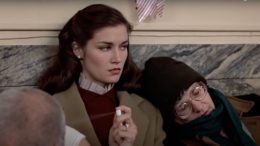
Image courtesy of the 1988 film “Mystic Pizza,” in which a married Yalie architect seduces his babysitter with wine, Mozart, and charmingly disheveled shirt collar. — CC

Digg TwitterFacebook StumbleUpon

GI Bill: Mr. Thomas and His Postwar Khakis

Fri 2 Oct 2009 - Filed under: 1990-present, Clothes, Film, Personae — Christian
Comments (7)

Bruce Boyer herein presents his first piece for Ivy-Style, an interview with Bill Thomas of Bill’s Khakis.

Khakis and jeans are the iconic American work pants, both having been around for over a century but coming into global status after World War II. The democratizing effect of these trousers — everyone from top CEOs and celebrities to road workers has at least a pair of each —  cannot be overestimated. Every clothing designer on the planet has these trousers as essential components of their creativity. Ralph Lauren is fond of wearing his jeans with a dinner jacket, while both Dolce and Gabbana wear wear their chinos black, low slung, and razor cut.

For U.S. soldiers returning from World War II, khakis were the all-purpose trouser. With the huge de-mobbing of soldiers after the war, coupled with the GI Bill for higher education, these durable tan cotton trousers became an essential part of the casual campus wardrobe. If a student had a pair or two of khakis, a Shetland sweater, a tweed jacket or blazer, and a few oxford-cloth buttondowns, he was pretty well set.

In the tie-dyed, flower-power 1960s and ’70s, the versatile tan trousers were largely replaced by patched and decorated denim. But khakis never disappeared, and started to make something of a resurgence in the ’80s, along with faint stirrings of a returned interest in Ivy League style. One can conveniently date this movement from the publication of The Official Preppy Handbook in 1980.

By this time Ralph Lauren had already been mining what he realized was a heavy lode promoting his Old WASP Look, with growing success, for 12 years. His Anglo-American Old Money Look included a substantial closet full of 1950s college staples, coupled with Savile Row and Oxford University classics. It was getting harder and harder to find The Real Thing in U.S. stores —  Brooks Brothers had capitulated, and campus clothing stores across the country were being converted to pizza shops — and Ralph knew it. In the face of one crazy trend after another, Lauren had the courage, sense and sensibility to stick to tradition. He copied the authentic Levis (jeans, shirts, and ranch jackets) because the Levi Strauss Co. had gone off making bell-bottomed cotton pants in sludge-toned colors. He also made buttondowns without polyester, and pastel-colored crewnecks. By the mid-’80s Polo was raking it in.

About this time a young college student named Bill Thomas discovered a pair of World War II khaki pants in an Army-Navy surplus store. I now turn the story over to him:

As a kid, I’d describe myself as the biggest kid who could still play sports. I was used to getting clothes in the “Husky” department. So I was also used to always feeling slightly restricted in my clothes. People who are just a little heavy will know that feeling, of clothes being just a little tight, perhaps a little inhibiting.

Anyway, one day I went with a few friends to an Army-Navy surplus store, and I tried on a pair of original World War II khaki pants, which you could still find in those days. It was something of an epiphany. The pants were actually comfortable, I couldn’t believe it. They were full in the leg and seat and crotch, the rise was high enough, and they were well made. I don’t want to make too much of this, but I felt somehow freer, more relaxed. I was able to move and not feel constricted, the trousers weren’t pulling at me. It was a revelation, and I was hooked on these old khakis. (Continue)

Digg TwitterFacebook StumbleUpon

Disco Revival: Whit Stillman on Life and Film

Wed 26 Aug 2009 - Filed under: 1990-present, Film — Christian
Comments (0)

Whit Stillman’s 1998 film “The Last Days of Disco” was released this week, the last of his three films to make it to DVD.

Several articles and interviews have hit the web as a result.

Time Out New York has a short interview with Stillman, in which he talks about why he hasn’t made a movie in 11 years.

Gothamist has a more extended conversation with the filmmaker.

Finally, The Village Voice has an essay on the man and his work, plus this interview.

And here’s an old interview I stumbled upon while looking for an image. In it Stillman explains his dislike of the terms “WASP” and “preppy,” preferring the term “UHB,” which is used for comic effect in his film “Metropolitan.” Stillman makes the interesting remark “It is more an anachronistic style adhered on to, than a class born into.” — CC

Digg TwitterFacebook StumbleUpon

Lemmon-tations of a Company Man

Thu 13 Aug 2009 - Filed under: 1960s, Film — Christian
Comments (0)

Our Jack Lemmon series concludes with a look at 1964’s “Good Neighbor Sam,” in which Lemmon plays a wholesome family man who works in San Francisco at — what else? — an advertising agency. He commutes over the Golden Gate Bridge from Marin County, which I too did for a while. Did you know the toll is $6 now?

Lemmon is weary of the boredom and conformity that comes with being a corporate drone. “Every day all the husbands we get up and take the same road into the same traffic jam,” he laments. “We even dress alike: We put on the same gray suit, the hat, the buttondown shirt and the tie — like sheep.”

His life gets a much-needed break from the mundane through a series of mix-ups that cause his neighbors and colleagues to believe he’s involved in wife-swapping.

Below is a taste of “Good Neighbor Sam,” in which Lemmon comes home fresh from a job promotion and instead of finding his wife in the shower, finds Romy Schneider. We should all be so lucky. — CC (Continue)

Digg TwitterFacebook StumbleUpon

Bow Ties and Bongos

Sat 8 Aug 2009 - Filed under: 1950s, 1960s, Film — Christian
Comments (1)

Our Jack Lemmon tribute continues with a look at two films in which he plays supporting roles.

In 1958’s “Bell, Book and Candle,” Lemmon stars as a warlock who plays bongos with a suit-clad jazz combo in a Greenwich Village beatnik club. Kim Novak is the female lead in one of the sexiest roles ever committed to film. She plays a witch who deals in primitive art, and the set design includes many sublime pieces.

James Stewart plays the hero and looks great in all his outfits, especially here, with collar pin and knit tie:

Five years later, in 1963’s “Under the Yum-Yum Tree,” Lemmon plays a lecherous landlord who only rents to attractive females. The opening scene is a vaguely Southern California version of “Take Ivy,” with students strolling an unnamed campus in slim high-water trousers and penny loafers.

The film’s premise, laughably absurd today, is that a young hormone-engorged couple will test their compatibility by living together without consummating their relationship. Says the idealistic virgin, played by Carol Lynley, “I want to marry you for love, not overstimulated glands.” If that sounds funny today, wait till you hear her next line: “I don’t want to be carried away by my own fermenting juices.”

The boyfriend, played by Dean Jones (pictured below), wears a fine Ivy-styled corduroy jacket with hooked vent, natural shoulders and patch-flap pockets. But he also wears a mod suit with padded shoulders, six-inch center vent and short drainpipe trousers, and a natural-shouldered but double-vented tweed sport coat with lapel tab. The one constant among his jackets is a two-button cuff.

Lemmon spends most of the film as a Hefnerian figure clad in scarlet-red cardigan with matching socks, ever trying to lure winsome females into his wired-for-seduction space-age bachelor pad. — CC

Digg TwitterFacebook StumbleUpon

Cocktails For Two

Sun 2 Aug 2009 - Filed under: 1960s, Film — Christian
Comments (4)

Our Jack Lemmon movie marathon commences with a retraction. When I did a post on the 50th anniversary of “Breakfast at Tiffany’s,” I wrote that director Blake Edwards never again reached such heights.

That may be true, but he certainly reached greater depths.

I’d always avoided “Days of Wine and Roses,” as I just never seemed to be in the mood for a searing drama about a couple of drunks.

Well I finally I found myself in just such a mood, and the 1962 Edwards pic, starring Lemmon and set in San Francisco, is riveting. Check it out if you haven’t, and if you have, consider another look.

Like Tony Randall, Lemmon was born to play men who wear natural-shouldered suits and work in advertising agencies. “Days of Wine and Roses” is full of understated, mid-century style. Lemmon is pictured above in sport coat with all the Ivy details — natural shoulder, 3/2roll, sack front, lapped seams — and for a twist, double vents. — CC

Digg TwitterFacebook StumbleUpon
Theme Easy White by st3fo - rUn3 Production