mettlersamerica.com


Ivy For The Masses: The h.i.s. Brand

Thu 20 Oct 2011 - Filed under: 1950s, 1960s, Clothes, Historic Images — Christian
Comments (19)

H.I.S Inc. may be the missing link between workwear and Ivy-styled clothing.

The company was originally founded as Honesdale manufacturing in 1923 by Henry I. Siegel. It specialized in workwear, including denim, and was a contract manufacturer for JC Penny and Montgomery Ward. The firm was headquartered in New York with manufacturing facilities in Tennessee. HIS continued its contract work through World War II, making field jackets for the war effort.

Upon Siegel’s death in 1949, his son Jesse, who was only 19 years old, took control of the company. A graduate of Columbia, Jesse Siegel decided to move the company into the fashion realm by making modifications to its existing lines. Among other things, he is credited with putting a buckle on the back of khakis, which started a campus fad.

In 1956 Siegel introduced the company’s first house brand. It was called h.i.s. and named after his father. The brand targeted the middle-market teenager and college student, and was very successful tapping postwar Baby Boomers. The company went from $9 million in sales 1949 to $18 million in 1956, and b 1964 the company was doing $42 million a year in sales.

The h.i.s product line included odd trousers, shorts, sportcoats and suits. As a mass-market Ivy-inspired brand, h.i.s was sold in stores like Irv Lewis, Morris’, and The Squire Shop in Ithaca, New York. A 1964 joint advertisement for the later two Cornell outfitters claimed, “They provide the classics — the ‘bread and butter’ — the uniform items in the curricula of college clothes.”

According to the advertisement, those other brands included Botany 500, Hathaway shirts, Keds, Alder socks, Pendleton and Viyella. — CHRISTOPHER SHARP (Continue)

Send to a Friend


Digg TwitterFacebook StumbleUpon
jackdonnellykhakis.com

Golden Years: New York Nightlife In The ’50s

Fri 14 Oct 2011 - Filed under: 1950s, The Golden Years by Richard Press — Christian
Comments (17)

During the Eisenhower years, Manhattan was an island of social, economic and cultural equanimity. The legal drinking age was 18, the bars stayed open until four in the morning, and the Biltmore Hotel advertised special student rates for Seven Sisters and Ivy Leaguers.

Here are some memories from those days of my misspent youth.

The hub was Under the Clock at the Biltmore, where everybody poured through the tunnel from Grand Central. The Palm Court was next to the hotel lobby and served convenient cocktails along with Emory Deutch and his violin, who serenaded a conspicuous and well groomed college crowd. On holiday weekends it took on the appearance of a freshman mixer in Northampton.

A couple of blocks away, social climbers patronized the Stork Club. Sherman Billingsley, a former prohibition bootlegger, was saloon keeper and arbiter of Cafe Society. He famously gifted samples of Sortilege, his signature perfume, and winked if your companion stashed a Stork Club ashtray into her handbag. For the price of a drink at the bar you gained entree to the plush Cub Room for a rhumba played by Payson Re’s orchestra. This was the upscale part of the evening. The nitty-gritty was at Jimmy Ryan’s.

Before Elvis or the twist, the popular sound of New York was Dixieland. The uptown headquarters was Jimmy Ryan’s, where Wilbur de Paris and his band turned 52nd Street into Rampart Street.

Ryan’s was a prep United Nations. The room was not restricted to the Ivy League, but was a democracy that also welcomed outliers from far-flung places like Rutgers, Lehigh, RPI or CCNY. The insiders knew when you bought intermission pianist Don Frye a drink; he never forgot and rewarded you at the door or even a trip to the men’s room with a six-step pianistic flourish.

Dixieland in the 1950s was a revival of the earlier Jazz Age chronicled by F. Scott Fitzgerald in “The Great Gatsby”:

All night the saxophones wailed the hopeless comment of The Beale Street Blues while a hundred pairs of golden and silver slippers shuffled the shining dust.

Dixieland clubs were all over town. Central Plaza Casino and Stuyvescent Casino were seedy second-floor union halls on Second Avenue with sawdust on the floor and spilled pitchers of beer. Bobby Hackett, Conrad Janis, Zutty Singleton and the regulars climaxed the evening strutting around the room while playing “When The Saints Go Marching In.”

Farther downtown, Nick’s specialty was Pee Wee Irwin in jam sessions. Eddie Condon’s provided the wayward horn of Wild Bill Davison, and the sotto voce tableside vocals of legendary trumpeter and proprietor Eddie Condon.

The marriage between Dixieland and Ivy was finally consummated at two sold-out concerts in Carnegie Hall during the 1955 Thanksgiving vacation. Princeton’s Tiger Town Five, led by clarinetist Stan Rubin (pictured above on a 1959 album), had appeared on Steve Allen’s “Tonight Show” and previously gigged at Jimmy Ryan’s. Their Friday-night concert also featured Eli’s Chosen Six, from Yale.

The Saturday-night concert began with Williams College Spring Street Stompers. The Indian Chiefs followed after intermission before a boisterous Dartmouth-loaded audience that prompted security to stop the show with a warning to the students to curb their enthusiasm.

The Broadway Musical was in its heyday during this decade. Orchestra seats on Broadway were reasonable, and we all went to the theatre and belted out the songs from “Damn Yankees,” “The Boy Friend” and “The Pajama Game” at parties. The Waverly Lounge at the Hotel Earle on Christopher Street was a great hangout for fans of the genre. Laurie Brewis, a fey bistro version of Noel Coward, was the featured pianist and lounge singer. He was accurately billed “The London Edition of Showtune Encyclopedia,” and made a specialty getting to know his college devotees on a first-name basis.

There was more on the fast New York track than the sound of music. Cerebral standup comedy was provided at the Blue Angel by Mort Sahl, who preceded Woody Allen in the hearts and minds of Ivy League Adlai Stevenson-type intellectuals.

At the other end of the spectrum, a $7 cover charge with a two-drink minimum was the price at the Copacabana for a bridge-and-tunnel spectacle of buxom chorus girls and comedian Joe E. Lewis in his drunken Damon Runyon act about bookies, barkeeps and broads. I can still remember the punchlines.

Last call and last dance, the morning sun peeking over the Queensboro Bridge, the goings on about town always closed with bagels, lox and eggs at Reuben’s. — RICHARD PRESS

Richard Press is the grandson of J. Press founder Jacobi Press. A graduate of Dartmouth, he worked at the family business from 1959-1991, ultimately serving as president. He also spent four years as president and CEO of FR Tripler. He lives in Connecticut.

Send to a Friend


Digg TwitterFacebook StumbleUpon

Princeton Yearbook, 1956

Thu 6 Oct 2011 - Filed under: 1950s, Historic Images — Christian
Comments (7)

The chaps at the Fine & Dandy Shop blog dug up these images from the 1956 Princeton yearbook. Say, is that Dickie Greenleaf’s graduating class? (Continue)

Send to a Friend


Digg TwitterFacebook StumbleUpon

Voice In The Dark: Richard Frede’s Entry E, 1958

Thu 22 Sep 2011 - Filed under: 1950s, Historic Texts, Lit — Christian
Comments (8)

“Entry E” is something of a pulp novel, telling a tale of Ivy League life in America that was considered startling on its release in 1958. But for all the adolescent angst and raucous action in this story, there is plenty of mid-century Ivy League style and quiet consideration of the “Ivy Man,” described in knowledgeable detail by the book’s author, Richard Frede, a Yale graduate.

Set in the residence hall Entry E at the fictitious Hayden University (an unconvincing alias for the real Entry E in Timothy Dwight College at Yale, where Frede resided during his time in New Haven), the novel follows Ed Bogard, an average student who becomes aware of an unsavory plan: A group of men in his entry are preparing to drug a visiting college girl over the weekend with grain alcohol and Benzedrine, rendering her defenceless to their advances. Will Bogard speak out, or will he be another example of America’s “silent generation”?

As Bogard wrestles with the typical challenge of discovering himself at college and finding his voice to speak out, there is the introduction of the “Slide Rule” and “Third Person,” imaginary entities that appear at times when Bogard feels most challenged, depressed or conflicted. But it is telling that the most interesting manifestation of his conscience, the Third Person, is a perfectly turned-out handsome man whom Bogard sees for the first time at a country club dance while at prep school:

In his mind Bogard stared at a handsome, patently omniscient paragon of a man; a man who had just stepped out of some mists Bogard had never before noticed in his mind a man dressed in a white dinner jacket and Bermuda shorts and a bow tie of the same brilliant yellow, orange, and red plaid; a man who grinned omnisciently back at Bogard and said, “The plaid of my ancestors, a warm and noble group, both emotional and adventurous, a trait which, I am afraid, you and your friends do not understand.” A man with a horrendously straight and cynical grin; a man who grinned omnisciently back at Bogard and patiently said once again, “Why don’t you go over and ask her for a date.”

Bogard doesn’t get the girl, and this love/hate relationship with the Third Person reaches its fever pitch upon enrolment at college, not least because this was Bogard’s chance to become just as well attired as his imaginary nemesis. (Continue)

Send to a Friend


Digg TwitterFacebook StumbleUpon

Buckle-Back Flannels and Cordovan Loafers, 1954

Sat 17 Sep 2011 - Filed under: 1950s, Clothes — Christian
Comments (9)

As a follow-up to this week’s earlier post about J. Press’ new cinch-back trousers, contributing writer Christopher Sharp sent in the above image showing buckle-back trousers in their original context.

The source: Gentry magazine
The year: 1954
The campus: University of North Carolina
The trousers: “Ivy League Narrows”
Paired with: Shell cordovan penny loafers

Note that the shoes and trousers are the same price. Today Alden’s Leisure Handsewn Moccasin in cordovan sells for $589.

Kind of makes the $375 J. Press trousers look like a steal. — CC

Send to a Friend


Digg TwitterFacebook StumbleUpon

It’s a Cinch: Buckle-Back Trousers at J. Press

Tue 13 Sep 2011 - Filed under: 1950s, 1990-present, Clothes — Christian
Comments (21)

Over two years ago I wrote an open letter to American retailers suggesting they put a buckle on the back of chinos, a craze among students circa 1956. With the PITA trend in full swing, I even asked readers to speculate what brand might be first to freshen up a pair of quotidian khakis with this small but distinguishing detail. I neglected to include J. Press as one of the contenders, however, and sure enough it’s come through this season with “cinch-back” trousers made by Martin Greenfield.

There are two versions, both with stiff tarifs: The cotton trouser will set you back $275, the charcoal worsted a whopping $375.

Chotto takai deshou?” ["a little expensive, don't you think?"], I said to J. Press’ Japanese general manager.

“More than chotto,” he replied. — CC

Send to a Friend


Digg TwitterFacebook StumbleUpon

Russell Lynes On The Shoe Hierarchy, Esquire 1953

Wed 7 Sep 2011 - Filed under: 1950s, Historic Texts — Christian
Comments (6)

Despite the fact that you’re supposed to be learning to think for yourself, college has always been a conformist environment. Those with an excess of individuality may be respected, but are rarely popular.

And even during the heyday of the Ivy League Look, not every student was a perfect example of the style. What became codified and remembered as the look was what the top echelon wore, the nonchalant moneyed types.

In short, the guys who were “shoe.”

What follows is an article entitled “How Shoe Can You Get?” by Russell Lynes, kindly provided by Esquire fashion director Nick Sullivan. In it, Lynes writes:

White Shoe applies primarily to the socially ambitious and the socially smug types who affect a good deal of worldly sophistication, run, ride and drink in rather small cliques, and look in on the second halves of football games when the weather is good. They try so hard not to be collegiate in the rah-rah (or, as they would say, “Midwestern”) sense of the term that they are probably the most “collegiate” types now in college.

Lynes wrote the book “The Tastemakers,” which I highly recommend to those interested in the sociology of taste. Ivy Style wrote about him here. — CC

* * *

How Shoe Can You Get?
By Russell Lynes
Esquire, September 1953

At Yale there is a system for pigeonholing the members of the college community which is based on the word “shoe.” Shoe bears some relation to the word chic, and when you say that a fellow is “terribly shoe” you mean that he is a crumb in the upper social crust of the college, though a more kindly metaphor might occur to you. You talk of a “shoe” fraternity or a “shoe” crowd, for example, but you can also describe a man’s manner of dress as “shoe.” The term derives, as you probably know, from the dirty white bucks which are the standard collegiate footwear (you can buy new ones already dirty in downtown New York to save you the embarrassment of looking as though you hadn’t had them all your life), but the system of pigeonholing by footwear does not stop there. It encompasses the entire community under the terms White Shoe, Brown Shoe, and Black Shoe.

White Shoe applies primarily to the socially ambitious and the socially smug types who affect a good deal of worldly sophistication, run, ride and drink in rather small cliques, and look in on the second halves of football games when the weather is good. They try so hard not to be collegiate in the rah-rah (or, as they would say, “Midwestern”) sense of the term that they are probably the most “collegiate” types now in college. Brown Shoe applies to the general run of those who are socially acceptable but above thinking that it really makes any difference. They constitute the general middle class of the college that overlaps somewhat into both White and Black; their ambition is to be the average citizen raised to the highest power compatible with being a cultured and relaxed gentleman. Black Shoe implies some of the attributes of the “grind” and is applied to those who participate a little too eagerly in seminars, literary teas, and discussions of life, literature, and the pursuit of philosophy. They are in college because they consider it primarily an educational and not a social institution; they mind their own business rather intensely, are probably in love with the girls they will eventually marry, and in many respects appear a good deal more sophisticated and  grown up than the White Shoe crowd.

The shoe categories obviously allow for a great deal more precise definition than this, as I have no doubt the first Yale man you meet will tell you. But pleasant as it is under the elms of New Haven, let us move into other groves of academe. We will have to take our “shoes” with us, however; the terminology may not be the same in all the colleges, but we will keep finding men whom the shoes will fit. (Continue)

Send to a Friend


Digg TwitterFacebook StumbleUpon

How The White-Shoe Law Firm Got Its Name

Tue 6 Sep 2011 - Filed under: 1950s, Clothes — Christian
Comments (13)

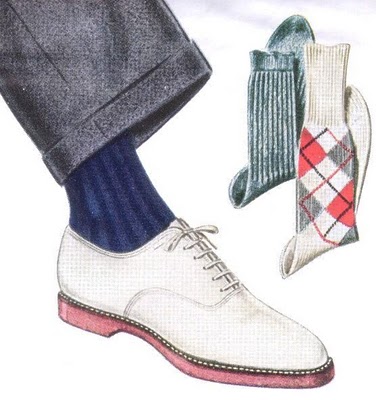
Now that summer is over and the punctilious will put away their white bucks until next Memorial Day, it’s time to honor the collegiate tradition of wearing scuffed-up white bucks in autumn, preferably with grey flannels.

The fashion gave birth to the term “white shoe,” usually applied to a law or financial firm that hired WASPy guys from elite universities and catered to an Old Money clientele.

In 1997, language expert William Safire wrote an essay in the New York Times on the origins of the term white shoe:

The source is white ”bucks,” the casual, carefully scuffed buckskin shoes with red rubber soles and heels worn by generations of college men at Ivy League schools. Many of these kids, supposedly never changing their beloved footgear, went on to become masters of the universe on Wall Street and in the best-known law firms.

In its early days, the adjective was used in an envious, resentful way by those with less-privileged backgrounds; now it is either a dispassionate description of elitism or a passionate derogation of old-fogeyism. However, some of the nouveau-riche derogators of the old-line firms are classed by a different and more expensive shoe, the loafer with a brass link ornament made by the Gucci firm in Italy. In Washington, K Street, where many lobbyists make their headquarters, is known as ”Gucci Gulch.”

The Economist has also examined the archaic term “white shoe,” noting:

I was tempted to put “white-shoe” on our journalese blacklist, but I’ll hold off, and just file it under frozen terms. There isn’t a great replacement for it. The term used to hint at WASPishness, the kind of place that didn’t promote Jews, but times have thankfully changed. Still, the term wraps up not just prestigious professional-service and financial firms, but big, old, east-coast and fairly traditional ones. It’s faster to write “white-shoe” than “big, old, east-coast and fairly traditional.” So despite the fact that you’re more likely to see casual-Friday khakis than a white pair of shoes on a man at a white-shoe firm, we’ll give “white shoe” a pass.

In “Franny and Zooey,” JD Salinger has a character speak this line, which Salinger wrote in 1957:

“Phooey, I say, on all white-shoe college boys who edit their campus literary magazines. Give me an honest con man any day.”

Tomorrow we’ll present an historic article, kindly provided by Esquire and herein digitized for the first time, that explores the broader use of the term “shoe,” which in the 1950s was slang for the coolness hierarchy on campus, with White Shoe at the top of the pecking order, Black Shoe at the bottom, and Brown Shoe somewhere in between. — CC

Send to a Friend


Digg TwitterFacebook StumbleUpon

Taft By Numbers: Peter Rawson III, 1952

Sat 3 Sep 2011 - Filed under: 1950s, Historic Images, Personae — Christian
Comments (4)

In 1952, LIFE Magazine ran a profile on the Taft family, one of America’s great political dynasties, having produced President William Howard Taft.

The family also produced a prep school — The Taft School in Watertown, CT — which was founded by William’s brother Horace Dutton Taft, an early Skull & Bones member.

Pictured above is Peter Rawson Taft III, great-nephew of the school’s founder. The kid is the epitome of ’50s preppy sportiness with his good looks, well worn school sweatshirt, and roman numeral after his name.

The LIFE profile on the family can be found here. — CC

Send to a Friend


Digg TwitterFacebook StumbleUpon

The $800 Lacoste x Brooks Brothers Collaboration

Thu 4 Aug 2011 - Filed under: 1950s, Clothes — Christian
Comments (18)

Yesterday an interesting auction ended on eBay: a polo shirt made by Lacoste for Brooks Brothers, putatively from the 1950s.

The shirt’s four-inch tails and artifact status, however, were not enough to motivate anyone to place a bid at the opening price of $499, and at the close of the week-long auction the shirt went unsold.

Lesson for the apparel industry: No matter how compelling your collaboration, price point trumps all. — CC (Continue)

Send to a Friend


Digg TwitterFacebook StumbleUpon
Theme Easy White by st3fo - rUn3 Production