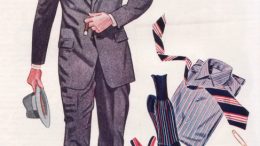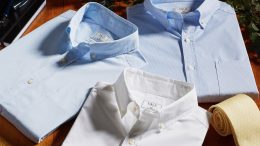
This morning I received a dispatch from Kamakura Shirts letting me know they’ve started an English-language Facebook page.
The company is progressing with its plans to offer global e-commerce capabilities with a target date of April, so soon you will be able to get its collar-rolling oxford shirts without having to journey all the way to Madison Avenue.
Like them on Facebook to stay updated. — CC

During the Ivy heyday, when the natural-shoulder style sold by Brooks Brothers and J. Press became known by the popular term “The Ivy League Look,” Main Street clothiers often used the term “Ivy” in their marketing copy, even naming products the “Ivy League” model, as in our recent Stetson hat post.
But that all seems quaint in comparison to today, in which the term “Ivy League” is thrown not onto department store knockoffs for suburban America, but to aspirational lifestyle brands in the rapidly growing markets of China and India.
Today the Indian website Fashion United announced that the brand 612 Ivy League, which makes clothes with a vague suggestion of something sort of quasi-preppy, is taking steps to become the number-one brand for preteen kids in India.
Meanwhile, the same thing is going on in China with Astor & Ivy, which combines clothing retail with test preparation.
As my colleague Daniel Cappello notes in his recent book on the Ancient Eight, there’s no more prestigious brand in the world than the Ivy League.
But can someone clue me in on what 612 stands for? I assumed it was for a campus area code, except there’s no Ivy school in Minneapolis. — CC

Our last post on William F. Buckley included an eyewitness account of a JC Penney label spied inside one of WFB’s suits.
Then yesterday, as I was exiting at Herald Square, one of the MTA’s more labyrinthine subway stations, I found myself taking an exit that led straight to a Penney’s escalator. Remembering the Buckley post, I decided to continue inside.
And it was good that I did, since among today’s junk mail was a sophisticated (by the department store’s standards) men’s catalog, produced under the stewardship of new menswear director Nick Wooster. It features a new collection called Stafford Prep, which I’d noticed whiled walking through the store. JC Penney’s American Living experiment is over, but undaunted the store has decided to continue offering prep-inspired basics at rock-bottom prices. (Continue)

According to the February issue of Free & Easy, Japan evidently never saw the 1979 “Are You a Preppie?” poster.
As has been discussed lately, it’s always interesting to hear foreigners’ take on American culture. It’s equally interesting to hear tales about guys in other countries trying to copy American style before the Information Age.
The Heavy Tweed Jacket blog has presented many scans from ’70s Japanese magazines documenting PITA style (that’s Preppy Ivy Trad Americana, for those not ITK). Despite that, according to Free & Easy, before the “Official Preppy Handbook” was translated into Japanese, there were several dark years during which the Japanese were eager to embrace preppy style, but weren’t exactly sure what the components were.
According to my translator, the above illustration shows a circa-1980 Japanese attempting to look preppy, contrasted with an actual American example of the type. The Japanese has mistakenly donned a bow tie (with polo shirt?), Baracuta jacket, tennis sweater, plaid pants and Top-Siders.
The real American prep, however, is wearing a pink candy-striped oxford over a kelly green polo, khakis, duck-motif belt, and LL Bean gumshoes sans socks.
It’s a kind of Japanese version of “Tu Vuo Fa L’Americano,” though given their obsession with period detail, it’s hard to imagine the Japanese ever getting something wrong.
Which reminds me, perhaps because I’m listening to Count Basie as I write this, of a night at the famous Derby nightclub in LA. There was a jump blues band playing and a Japanese guitarist I knew, who played in a well known rockabilly band back home, was invited on stage to sit in on a number. It was a standard blues progression, and when it came time for his solo, he played the solo from Bill Haley’s “Rock Around The Clock” note for note.
An American, of course, might have quoted the solo — ironically, if he was a sophisticated musician. But this guy played it straight-up. When I spoke with him about it afterwards, it was clear it would never have occurred to him to play it otherwise. — CC
Following a particularly gluttonous holiday season I reigned in my appetite and lost a spot of weight. Feeling healthy and trim, yesterday I set out in the blizzard’s aftermath to visit the newly opened J. Press York Street store and see if I could squeeze into anything.
I had fairly low expectations based on the images of the collection, and the neon signs in the store’s windows didn’t seem particularly promising. But I have to admit, I didn’t hate it. York Street is pleasant enough, with lots of ephemera and “mantiques” (a word that recently lodged itself in my vocabulary), comfortable leather couches, and a separate tailoring section in the rear.
One of the things that immediately jumped out was the number of jackets without darts, although the tailoring was obviously very slim fit. The sportcoats were on the short side, but the men I saw wearing them looked much better than the models in the promotional material. It seems that the models for the fashion show and website were given jackets a size too small for some reason, because the proportions didn’t seem as off in person.
Taken piecemeal, the sportsweat isn’t nearly as offensive, though some of the patterns and color schemes are puzzling. The ties could easily be fit into the normal J. Press collection, but are not surprisingly on the narrow side.
I appreciated the fact that, for the most part, items that could be made in America were. This contrasts with the fact that some of the tailored clothing just down the street at Black Fleece is now made in Thailand.
My overall impression was that if this project can avoid the pitfalls of Rugby (garish sportswear, over-styling) and perhaps come down in cost (which despite being inflated is still comparable to mainline J. Press, without sacrificing too much quality), it’s a positive development. It will offer something to young professionals who may in the future become regular J. Press customers.
That said, for my taste I would only purchase sweaters and ties from York Street, so I suppose I’m pleasantly surprised but not particularly interested. — DAN GREENWOOD
Daniel Calvert Greenwood is a New York-based classical singer specializing in Gilbert & Sullivan, Rossini, and drinking songs of the University of Pennsylvania (which he did not attend). He is a descendant of the Quaker preacher Thomas Brown, Maryland’s first governor Leonard Calvert, and the inventor Thomas Shaw, and is a neighbor of Christian Chensvold.

One thing’s for certain: You can’t accuse J. Press of being a sartorial mausoleum run by dinosaurs anymore. Like or dislike its new direction (and you can like it on Facebook), today J. Press took a bold step towards recapturing cultural and fashion relevance with the unveiling of a slick new website.
In addition to extremely upgraded e-commerce functionality and product copy that sounds like it was actually written by a native speaker of English, the site gives a prominent and separate identity to York Street, the new collection designed by the brothers behind Ovadia & Sons, which it proclaims “a daring new line.”
J. Press is late in the game when it comes to updated prep-with-a-twist. In fact, while the game isn’t actually over, some players have decided to leave the field. By a bizarre coincidence, York Street is making its debut precisely as Ralph Lauren’s Rugby line is shuttering.
The products will certainly raise the eyebrows of die-hard trad fuddy duddies, but that’s of little matter since it’s not aimed at them. To whom exactly it’s aimed I’m not entirely sure. (Continue)