On the first of this month I moved into a new apartment, which I promptly began decorating with a menswear vibe (grey flannel-colored walls, custom houndstooth curtains, Churchill dot throw pillow… ), but I wish I’d known about this Brooks chair before I started buying furniture so I could have begged them to sell me one.
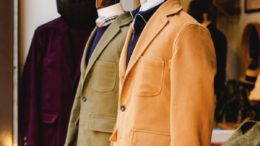
I spied it last evening on the fourth floor at 346 Madison, where I was checking out the spring sportcoats. There was a pair of them that looked great together. The material felt like doeskin, and the chair was button-tufted with brass Golden Fleece blazer buttons. The rep-striped pillow completed the blazer-and-tie look.
Perhaps Brooks should use its newly vacant space next door for a furniture store. — CC
Yesterday Gant took its Yale Co-op collection global. Released last year in the New Haven store, the collection is now available online and in Gant stores across Europe and Asia.
I saved this gem for you guys, however. Included among the digital ephemera is this 1968 article from the Yale Daily News. Evidently discount sales were a rare occurance back in the day, and given that oxford-cloth buttondowns were as basic a necessity to students as pencils and notebooks (though not for long), there was a mob scene at the annual Washington’s birthday sale unlike those wedding-gown warehouse sales where bridezillas claw each other to pieces. — CC
This weekend a minor kerfuffle erupted on Twitter. Although completely common in the apparel industry, the David and Goliath story hit close to home for those with preppy tastes and sensibilities, who also tend to be the same people who lament the decline in domestic manufacturing and steep rise in offshore production.
Newport-based Kiel James Patrick (disclaimer: an Ivy-Style.com advertiser) recently had a belt design of his surface in the collection of Lands’ End, the Sears-owned corporation with thousands of products in its inventory. What stings even more for many is that Kiel James Patrick is a small start-up that manufactures here in the US, while Lands’ End’s belt, like most of its products, is made in China.
Twitter users soon began spreading the news of what they considered a flagrant theft, often speaking directly to Lands’ End’s Twitter handle (LandsEndPR) in publicly viewable tweets and with some claiming they would never buy from the brand again.
In the company’s defense, it should be noted that fashion designs cannot be copyrighted, and being knocked off by a corporation is one of the risks of working in the clothing and accessories business.
Patrick sent Ivy Style the following statement (Lands’ End was also contacted but has not yet responded; theirs will gladly be added should they choose to remark):
The simplicity of nautical cord knot used in the Sailor bracelets has been a New England Summer staple as long as anyone can remember. As an accessories designer who spent many summers as a boy in the Cape, I began wondering early on why this beloved rope configuration hadn’t been adapted to what is now the Turk’s head knot style belt.
After doing some investigation I found two things: first, a 12-Line braid must be knotted by hand and thereby could not be replicated by machine. Next, the braid will stretch quite a bit over time, offering little support as a belt. After several months of trial and error I finally came up with solutions to these two problems. I hired a handful of Rhode Islanders who knew how to braid with an eye for detail and offered them work. To fix the rope from stretching, I reinforced the braids with a strong plaid backing, interfused with non-stretchable cotton tape.
Next, I needed to find someone who knew how to work with leather and could craft quality goods following my design specifications. After many months of searching I found leather craftsman Frank Clegg, who afforded me countless information with regard to offering leather products that were matched by none. Having full-grain, solid brass hardware, veggie-tanned leather and scrupulous stitching, these belts were something to behold.
I searched high and low for the best of the best in cotton rope manufacturing in order to acquire cord that Eagle Scouts and aged sailors could only have dreamt of. I finally found U.S. Coastguard retirey/Master Knotter Marty, who had developed a high-end cotton cord over the course of 10 years with a US-based mill and he knew exactly how to make what I was looking for.
It broke my heart to have customers, friends and family send me link after link this past week to Lands’ End’s e-commerce site. There was my creation being sold at a fraction of the cost simply by sacrificing quality, originality and integrity of local production. I couldn’t have felt more discouraged on my mission to continue designing original products and sustaining my American production. I design for myself and am not hired by corporate companies so that they may ship my ideas off to China carelessly in order to make a quick buck, all the meanwhile destroying the diminishing American spirit of industry, originality and entrepreneurship. The belt I created helps employ over 20 Americans. Lands’ End’s knock-off arrives to America in a box labeled “Made in China.”
Sound off in the comments section and let us know whether this is an everyday example of the free-market economy at work, or a low blow. — CHRISTIAN CHENSVOLD
This is Ivy Style’s 1,000th post x .50. In honor of the occasion, I bribed longtime friend and colleague Michael Mattis, who’s been at my side since I first started blogging on style in 2004, to write some moderately kind words. This was the best he could do. — CC
I must confess I have never been much of Ivy trend watcher. But since Christian Chensvold started Ivy-Style.com some 500 posts ago I have become a dedicated follower of Ivy fashion.
In fact, I’m still unsure precisely how the arithmetic is calculated among Ivy, Preppy and Trad. I take it that a Preppy probably pops his polo collar, while an Ivy stylist is less inclined to. Meanwhile, the Trad wears the classic American “sack suit,” whatever that is. Or something like that, anyway.
You can chalk up my general ignorance — and sometimes jaundiced lack of interest — to the irascible bores who dominate certain men’s style fora here on these Interwebs. My aim has always been to look good, and I don’t really care if coteries of small-minded bomb-throwers think what I’m wearing isn’t “pure” enough to meet their niggling standards.
That’s one reason why Ivy-Style.com has become one of my sartorial, sociological and philosophical lodestars since Chensvold launched it on October 1, 2008. It informs, but it doesn’t bother to niggle. I’ve learned so much from my daily dose of Ivy that it’s hard to know where to begin.
As the Managing Editor of Dandyism.net, a website Chensvold started back in 2004 (and recently ceded to your correspondent) devoted to the backstory of masculine elegance from Beau Brummell to the present, I’ve always maintained that at the heart of modern men’s style lies in simplicity, defenestrated of the effeminate gewgaws of the Ancien Régime.
And no contemporary — and uniquely American — style is more defenestrated of same than Ivy Style as it is expressed in these pages. What’s unique about Ivy-Style.com is that, unlike other style websites and fora, it does not provide either a set prescription for what to wear or proscriptions against what not to.
A flap in comments section of the recent post, “Slim Fit Shirts Ain’t Trad?” provides an illustration. One purist threatened to cancel his Ivy-Style.com “subscription,” saying, “I really don’t want to read a blog read by people who think that slim-cut shirts anything is Ivy, Trad, whatever. Gentlemen wear full-cut shirts, jackets, etc…”
Really? If the measure of a gentleman rests in the cut of his jacket rather than the cut of his jib, then the complainer above hasn’t taken much from the pages of Ivy-Style.com. That’s too bad. But maybe he wasn’t paying enough attention.
Rather, Ivy-Style.com provides assiduously researched historical context and, moreover, inspiration (rather than advice) on how we, its gentle readers, can carefully work classic, nuanced Ivy looks into your daily wear in this modern world of ours, in order to look sharp for all occasions.
Along the way I’ve been introduced to a remarkable cast of characters, people who helped make the Ivy style, well, into a timeless style. People like Richard Press, whose well-written columns provide a personal backdrop for the classically tailored stage on which he has lived. Then there’s G. Bruce Boyer, a crossover hit in both Tradsville and Dandyland, who imbues the site with a kind of sartorial gravitas.
With such a carefully curated slate of content combined with these and other fascinating personalities, it’s no wonder that Ivy-Style.com has become such a success for its followers — and anathema to its few detractors. It is a never-ending source of amazement to me just how easy Chensvold has made this complex thing look.
Well done, sir. We will see you again at posts 1,000, 5,000 and 10,000. — MICHAEL MATTIS
March Madras continues with this updated post with two more sartorial jump balls.
In the first, J. Press squares off against Gant.
Wearing an almost blinding uniform, J. Press offers a traditional madras sportcoat priced at $495. But shouldn’t this guy have graduated by now?
In contrast to Press’ perennial classic, Gant offers classic-with-a-twist. Its madras jacket comes with elbow patches, a slim fit and short length (according to the description), and a price tag of $675.
In the next bracket, it’s O’Connells versus Ben Silver:
O’Connell’s sends out this US-made $495 offering, but is its patchwork design and bright colors a buzzer-beating Hail Mary that will make you the king of the lawn party, or a flagrant foul against good taste?
In contrast, Ben Silver presents a muted olive jacket that would pair great with charcoal gabardines and a navy knit tie; it’s also also last year’s model and is half off its original $645 price. Good deal, but late to the game with 2012’s lineup.
So who takes home the trophy?
* * *
It may only be March, but summer’s favorite fabric is already available from the usual suspects. And given that choosing the right madras sportcoat isn’t easy, with the countless possibilities, you might as well start pondering now what you’ll want to wear come June.
In this madras toss-up, Brooks Brothers squares off against Ralph Lauren. Ralph’s team has the bigger payroll but lacks the height advantage (the coach is a size 37 short). Brooks is old school, while Polo is new. And then there’s the possibility that white men can’t jump.
On the blue team is a classic easy-to-match offering from Brooks; not yet online, according to the spring catalog the jacket is priced at $398. The buttons are white instead of RL’s gray, and the jacket is also three-button and undarted. But are the working buttonholes a slam dunk or technical foul?
Sound off and let us know who wins this sartorial jump ball. — CHRISTIAN CHENSVOLD
“I want a funky multicultural world with everyone in no socks and Weejuns grooving along to Jimmy McGriff. It’s a new hippydom based on proper shoulder line, half an inch of oxford cloth at the cuff and real selvedge 501s.” — Toffeeman
Though Brooks Brothers is the definitive Ivy League clothier and Princeton arguably the most stylish campus back in the day (which gets Charlie Davidson’s vote? Yale — and Charlie works in Harvard Square), the company has never operated a store in Princeton — until now.
Brooks has just signed a lease in Palmer Square and will take over a space formerly occupied by Banana Republic. The store is scheduled to open later this fall. — CC
Yesterday I rode up to the sixth floor at 346 Madison Avenue for a preview of Brooks’ next season. The spokesmen admitted the company hasn’t been playing up their heritage quite as well as it could, and the fall 2012 collection full of clever self-referencing. (Continue)
Since launching this website, the more I delved into the topic the more I found that nearly all of the Ivy League haberdashers were Jewish. So when I got around to interviewing Richard Press last year, I ended our hours of conversation with the following:
IS: Except for Brooks Brothers, nearly all the brands, stores and haberdasheries associated with the Ivy League Look were Jewish. Do you think the contributions Jews have made to WASP style have not been sufficiently acknowledged?
RP: You’re editorializing, but I think you’re right. A lot of the retail history of America is Jewish history.
Since then Mr. Press has become a columnist for the site and has shared more insight on the history of Jewish clothiers, and of course recently and notoriously Ivy Style became the first WASPy site to wish the world Happy Hanukkah.
I’m pleased to have helped increase the recognition of the Jewish contribution to the Ivy League Look, and the torch was recently taken up by writer Jason Diamond, who, after contacting Ivy Style, has written a story for Tablet, which dubs itself “a new read on Jewish life,” about the many Jewish clothiers centered around New Haven.
With its story lead about Valentino and fashion week, the article is awkwardly pegged to say the least. Perhaps the author could not get permission from his editor to just write what he wanted, and was forced to contrive a news angle.
But the heart of the piece includes some notable historic passages:
David Weinreich started the tradition in 1896 by opening Weinreich’s, a shop in New Haven, Ct., that sold custom suits. Two years later, Arthur M. Rosenberg opened Rosenberg’s, where “Rosie” would reign as the original Jewish King of the Custom Made Suits in New Haven well into the Roaring Twenties. In 1902, Jacobi Press opened his own store on Yale University’s campus, where he perfected his three-button sack suit jacket and inspired a dozen imitators that catered to the Ivy League’s finest.
By the 1920s, J. Press had become the choice tailor for everyone from Duke Ellington to Cary Grant. Even though F. Scott Fitzgerald is said to have shown up to military training wearing a Brooks Brothers suit, Press says the man responsible for one of America’s greatest novels was, in fact, a customer of his grandfather in the 1920s, and in a 1936 letter to his then-15-year-old daughter, Scotty, Fitzgerald cautioned the teenager to “beware of the wolves in their J. Pressed tweed.”
And:
The Jewish pedigree of this quintessentially American style is undeniable. If you surveyed the Princeton campus on a spring day in 1962 and saw a student from a well-to-do Southern family strolling in a pair of madras shorts with a blue oxford shirt, there was a good chance that shirt was the product of Marty and Elliot Gant: former J. Press stock boys, and the sons of a Ukrainian-Jewish immigrant. The real Ivy League alumni Mad Men who ran the advertising world of New York City wore suits with the Chipp logo from Sidney Winston (another former J. Press employee) on the inside of the jacket. President Kennedy supposedly made the switch to exclusively wearing suits made by New Haven custom tailor Fenn-Feinstein because he admired the ones worn by then Secretary of Health, Education, and Welfare Abraham Ribicoff, who would become Connecticut’s first and only Jewish governor.
Yet another suitmaker of President Kennedy? The guy must have had a lot of suits.