castawayclothing.com


Bay Rum, The Scent Of Madison Avenue

Thu 3 May 2012 - Filed under: 1950s,1960s — Christian
Comments (13)

Nearly three years ago I wrote a story for The Rake on bay rum — they’ve been sitting on it ever since.

I was reminded of it this week when Valet posted a piece on the classic fragrance, and got the mag’s permission to post the text here. Enjoy. — CC

• • •

Between 1957 and 1963, fueled by growing sales, St. John’s Bay Rum was a regular advertiser in the pages of The New Yorker. Concurrently, in 1960 Brooks Brothers began carrying a line of fragrances — including bay rum — made by Royall Lyme Bermuda Limited.

If the Atomic Age Madison Avenue man had a scent — that is, besides the smoke of Lucky Strikes embedded in his grey-flannel suit and the three-martini lunch on his breath — bay rum was probably it. Of the countless concoctions man has created to mask his natural odor — from citrus to musk, lavender to leather — one in particular has thrived for 175 years. Bay rum, a combination of bay leaves, spices and caribbean rum, might just be what civilized man was destined to smell like. And the fact that it was invented by island natives is an irony almost as piquant as bay rum’s unmistakable scent.

Perhaps it’s the word rum (sometimes spelled “rhum”) in the name, with its connotations of maritime adventure, that accounts for bay rum’s longstanding popularity. Or perhaps women adore it. They must, or else bay rum would have been selected for extinction long ago. But compared to the luxury brands whose scents fill the pages of glossy magazines, bay rum seems made for the man who frankly doesn’t give a damn. He wears it because he knows he owes good hygiene both to his fellow man and himself, not for a direct payoff in the mating game. Bay rum is what men think a man should smell like. It’s not for the man who orders a bottled pheromone, discretely billed, that’s guaranteed to aid seduction.

The origins of bay rum begin in 1838, when Danish chemist Albert Heinrich Riise arrived on St. Thomas in the Virgin Islands. He found that natives  mixed rum with the leaves of the bay tree to create an emollient used to treat sunburn, sore muscles and joints, fever and headache. Riise began experimenting with distillation processes, eventually perfecting the technique, and sold his bay rum under the name A.H. Riise Apothecary.

The fragrance flourished throughout the 19th century. Later, during Prohibition, imports of bay rum were outlawed as Americans desperate for a drink took to imbibing the cologne. World War II brought a further blow to the various manufacturers as cargo space on ships was reserved for war efforts.

In 1946, American John Webb settled on St Thomas and saw the opportunity to reintroduce the fragrance. Webb founded The West Indies Bay Company and began producing St Johns Bay Rum, which he distinctively packaged in bottles hand-wrapped by natives with tyre palm fronds. Fueled by the postwar fascination with island exotica (Rodgers and Hammerstein’s “South Pacific” hit Broadway in 1949, Hollywood in 1958), St. John’s Bay Rum was soon distributed to every major US city and most college towns.

While St. John’s and Royall Lyme Limited (which, nearly 50 years later, is still sold at Brooks Brothers) have storied connections to midcentury America, the English fragrance houses Taylor of Old Bond Street and Geo. F. Trumper have both offered bay rum for over a hundred years. Yet the most intriguing maker of bay rum today is Bonny Doon Farm, a small California upstart in Santa Cruz, 75 miles south of San Francisco, that makes, according to owner G. Edward Meehan, “the gold standard of the bay rum cologne world.”

Ingredients, Meehan says, are key. Bonny Doon Farm starts with pure, costly Virgin Islands Bay Oil directly from the source, adding fine aromatic cane spirits and Bulgarian Rose Water, “a major part of the compound dictated by the original Danish formula two centuries ago and exclusive to us,” says Meehan. The formula is then blended in small batches and cellar stored. No artificial colors are added, giving Bonny Doon’s bay rum a golden as opposed to amber hue.

Bay rums come in varying degrees of sweetness and potency. Most are considered after-shave grade and can quickly fade (Ogallala offers a “special reserve double strength” to help stay rummy all day). Experiment until you find the right rum suited to your taste, by which we mean your nose, not your palate. — CHRISTIAN CHENSVOLD

Digg TwitterFacebook StumbleUpon
southerntide.com

Gant Takes Yale Co-op Collection Global

Tue 27 Mar 2012 - Filed under: 1960s,1990-present,Clothes — Christian
Comments (7)

Yesterday Gant took its Yale Co-op collection global. Released last year in the New Haven store, the collection is now available online and in Gant stores across Europe and Asia.

The release is backed by a hefty marketing campaign that includes photos of current Yale students and faculty, as well as vintage images such as the one above. For more images from past and present, click on over to the Quest blog, where I put up an extended post yesterday.

I saved this gem for you guys, however. Included among the digital ephemera is this 1968 article from the Yale Daily News. Evidently discount sales were a rare occurance back in the day, and given that oxford-cloth buttondowns were as basic a necessity to students as pencils and notebooks (though not for long), there was a mob scene at the annual Washington’s birthday sale unlike those wedding-gown warehouse sales where bridezillas claw each other to pieces. — CC

Digg TwitterFacebook StumbleUpon

Spring Fling: 1960s Bermuda College Week Footage

Fri 23 Mar 2012 - Filed under: 1960s,Historic Images — Christian
Comments (3)

Looking to regain a foothold in the Spring Break market, The Bermuda Department of Tourism dedicated themselves last year to relaunching College Week in the form of Bermuda Spring Break 2012.

Taking a page from the old College Week, students were given a pass for all sponsored events, complimentary food, free public transportation and discounted moped rentals. Students were also treated to cheap hotel rates, just under $80 a night, and a whirlwind of parties. This new spring break was promoted with social media and a bounty was offered to college-age Bermudians who could persuade ten friends to come home with them over break. The Bermuda Board of Tourism Reports that island business were happy to receive the off season business and the two hundred students enjoyed themselves.

The original College Week crowd was not forgotten either. The Island reached out to the young at heart with a three-day College Weeks Reunion, inviting the original spring breakers from the decades of the ’60s-’80s to come back to Bermuda. The event ran from March 15-17 with attractive hotel packages starting at $597 per person, including the event pass. Graying College Week enthusiasts enjoyed events such as poolside cocktail parties, a nostalgic booze cruise, and French cuisine while contemplating a view of Hamilton Harbor. The musical highlight was British invasion singer Billy J. Kramer who performed on the 17th at the Fairmont Southampton Beach Club. Kramer, a Liverpool musician, was discovered by Beatles manager Brain Epstein.   Kramer originally backed by the Dakotas had hits with “Bad to Me”, “Little Child,” “I’ll Keep You Satisfied,” and “Do You Want to Know a Secret?”

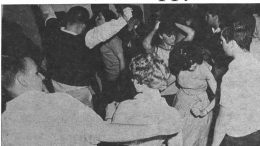
The film above (in two parts) was made in the mid-’60s and was a product of the Bermuda Trade and Development Board. It opens with the mating ritual of the North American WASP: voiced over a black screen you can hear a Wellesly girl chating up a Harvard man. Other highlights include a diving board serenade by the Yale Whiffenpoofs, and an appearance by Harvard’s Hasting Pudding Club. This film includes beach parties, co-eds, mopeds, beer, booze, cigarettes, madras jackets and knit ties — basically paradise.

The narrator seems to capture it all when he says, “You will depart in time from Bermuda and this oldest College Week in all the Western Hemisphere. So will you depart from college days themselves. There will come a time when you take attaché case in hand and go out and fight the dragon, as it were and soon you will probe for slogans or molecules, cavorting in dead earnest. Now, however you cavort with pleasure.”

The film ends in a climax of dancing the twist to a frenetic jazz soundtrack. The narrator says, ”And so they pass one into another these days of College Week. You have come to Bermuda and are better for it. So indeed is Bermuda, this tiny Eden that can use a nudge or two to make the year-round garden party jump just a little more.” — CHRISTOPHER SHARP

Digg TwitterFacebook StumbleUpon

For Pete’s Sake: March “Mad”-ness Continues

Thu 22 Mar 2012 - Filed under: 1960s,Film — Christian
Comments (6)

March Madras carries on, but now it’s back to madness — mad as in “Mad Men,” which returns to TV this Sunday night after a 17-month hiatus.

The setting is now 1965, so the clock is ticking in the closets of these Ivy-clad* Madison Avenue guys.

Pictured above is a still from the new season and features the character Pete Campbell in a swell madras jacket.

“Mad Men” kicks off a 9 pm with a two-hour season premiere on the AMC channel. — CC

* Or at least supposed to be.

Digg TwitterFacebook StumbleUpon

Bass From The Past

Thu 1 Mar 2012 - Filed under: 1950s,1960s,Clothes,Historic Images — Christian
Comments (16)

This is our third post based on vintage Bass advertisements, which have now been consolidated into this one post. A walks through American history in the footsteps of one of its singular shoes. — CC (Continue)

Digg TwitterFacebook StumbleUpon

George Frazier & Lord Of New York

Fri 17 Feb 2012 - Filed under: 1960s,Personae — Christian
Comments (9)

Lord Of New York may sound like a comic-book villain, but it’s actually a lesser-known Ivy haberdasher.

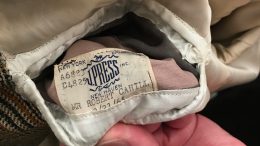
It came up in conversation at a Paul Stuart event recently with a fellow who sells menswear on eBay under the username mack11211. Mack told me about a few bespoke Lord suits made in 1963 he has for sale.

The firm is mentioned in George Frazier’s seminal essay “The Art of Wearing Clothes.” Here’s a passage that explains the origins of Lord Of New York as well as serving as a kind of family tree of Ivy haberdashers:

Lord of New York is brash, explorative, and highly disorganized. Chronologically, Lord of New York is a branch of a genealogy that goes all the way back to 1835 and Brooks Brothers’ natural-shoulder — or, as it is precisely known, No. 1-sack suit. Around the turn of the century, Arthur Rosenberg, then the foremost tailor in New Haven, began to exploit this style among Yale undergraduates, and, not long afterwards, J. Press, also of New Haven, fell into line. Eventually, two Rosenberg employees, Sam Rosenthal and Moe Maretz, went out on their own as Rosenthal-Maretz; then Bill Fenn and Jack Feinstein left David T. Langrock to form Fenn-Feinstein (now associated with Frank Brothers). Somewhat later on, Mort Sill and (a year later) Jonas Arnold quit Press and opened a shop in Harvard Square, Cambridge, which they called Chipp. Then, with his partner’s departure to form Sill (New York and Harvard Square), Jonas Arnold entered into an agreement whereby two former Press employees — Sid Winston and the late Lou Prager — were permitted to use Chipp as the name of the shop they were about to open in New York. Arnold, who closed his Cambridge store several years ago, is still a partner in the New York Chipp’s. In 1952, Lord of New York was begat by Chipp — or, more accurately, by three of its former employees, Ken Frank, Mike Fers, and Peter D’Annunzio. Lord charges $195 and up for a two-piece hand-stitched suit lined with tie silk. Unlike Chipp, it neither charges extra for open buttonholes on jacket sleeves nor does it line coat collars with foulard. Unlike J. Press, it resists such gimmicks as lining the breast pocket of a jacket with foulard that can be turned inside-out to serve as a handkerchief.

And while we’re at it, here’s Frazier on Norman Hilton, The Andover Shop, and Brooks Brothers:

It could hardly have been otherwise, for nowadays even the smallest town has a men’s shop that carries the same suits and haberdashery that are on sale at, say Madison Avenue and Forty-fifth Street in New York. New Bedford, Massachusetts, for example, has Marty Sullivan’s, a store so attuned to the fickleness of fashion that it has its buyers and designers spend part of their Manhattan visitations in such bars-and-grills as P. J. Clarke’s, which attracts an extremely creatively-dressed Ivy League clientele. Furthermore, shops like Sullivan’s-Eddie Jacobs’ in Baltimore; Dick Carroll’s in Los Angeles; and, in New York, Casual-aire, Paul Stuart’s, Phil’s, to name a few — are far from expensive. What’s more, at their best-Atkinson’s in Los Angeles and Pasadena, California, and the Andover Shops in Cambridge and Andover, Massachusetts, which derive much of their appeal from the superb workmanship of Frank Spade, the head tailor, and the creativeness of co-owner, Charles Davidson — they are superlatively tasteful. Even in 1960, however, not all ready-made suits are low-priced. Oxxford, for example, turns out a suit that costs $235 and up, is impeccably tailored, and has a following among affluent men who are either too impatient to hold still for custom fittings or dislike investing in a garment without knowing how it will look when finished. From the point of view of style, the best ready-made American suit is turned out by Norman Hilton, a young, enterprising, and discerning Princeton alumnus who, among other things, makes blazers and sports coats for Brooks Brothers. (Contrary to prevalent opinion, Brooks Brothers does not manufacture all its wares, but has certain items made to its specifications and on its own models. Only the label “Brooks Brothers Makers” means a Brooks-manufactured garment.)

Although Brooks Brothers (which also goes in for custom clothes) can no longer be regarded as the unique pace-setter it was prior to the recent renaissance of interest in men’s clothes, it still carries come matchless items, notably its neckwear and shirts, particularly its white buttondown in Pima broadcloth, which costs $8.50 and, among ready-made shirts, is in a class by itself.

The final word comes from our columnist Richard Press:

Lord was run by Ken Cohen, former Chipp road traveler, and Pete D’Annunzio, former fitter at Chipp. They were situated in the same building upstairs from J. Press in NYC and had a small but significant Racquet Club-type of following, similar to custom tailors Morty Sills and Rosenthal-Maretz.

Richard, incidentally, will be answering reader questions in a special post going up on Monday, souse the weekend to imagine what you’d like to ask the grandson of J. Press, who worked at the company during the good old days. — CC

Digg TwitterFacebook StumbleUpon
Theme Easy White by st3fo - rUn3 Production