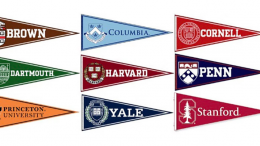
The Museum of the Fashion Institute of Technology has released a video of Richard Press leading a tour of the “Ivy Style” exhibit. Click here to check it out. — CC
At the recent “Ivy Style” symposium at the MFIT I had the chance to meet “Reggie Darling,” the man behind one of the more charming blogs written by a fiftysomething nostalgic for his vanished youth.
I’d told Reggie that I’d admired his reflections on the exhibit and thought many of his memories worth presenting to Ivy-Style.com readers. He said he’d be honored, so here are his reminiscences on being a social and sartorial traditionalist adrift in the post-heyday ’70s. — CC
* * *
While I certainly enjoyed attending the “Ivy Style” exhibit, I had the eerie feeling while doing so that I was spending my time there staring at my own navel. It was all very familiar to me, and much of the clothing on display could have come from the closets and cupboards of the men in my own family. My roots in the Ivy League go back a number of generations, mostly at Yale, where my grandfather, father, brother and I were all fortunate to attend as undergraduates.
It was at Yale that I came to fully understand the true allure and iconographic significance of the Ivy style of dressing. While my prep school experience at St. Grottlesex prepared me for Yale in many ways, it was only upon my arrival in New Haven that I came to truly appreciate the splendor of traditional Ivy League dressing. I came to Yale as a boy, and I left it as a man.
When my father was an undergraduate at Yale in the early 1940s, he was clothing obsessed. Letters written at the time to his parents in Grosse Pointe (which my grandparents saved and which I read many years later) were full of entreaties from him for yet more funds to purchase the clothing and sartorial accessories he felt were imperative in order to fit in with the smart crowd with which he ran at Yale. (Continue)
In 1950, when I was 12 years old, Grandpa Press took me to Brooks Brothers for my Bar Mitzvah suit. He brought it back to J. Press for alterations and the first thing he did was rip off the Brooks Brothers label and replace it with one of ours.
Grandpa Press’ dismemberment of a Brooks Brothers label from my size 16 grey flannel suit followed the protocol established on York Street at the turn of the century: namely, copying Brooks Brothers.
All the players alongside the Yale campus — Langrock, Fenn-Feinstein, White’s, Isenberg, the Yale Coop — all “followed suit” when it came to Brooks Brothers. And when LIFE Magazine proclaimed the coast-to-coast explosion of the Ivy League Look, mainstream retailers got into the act by mimicking the 1901 Brooks Brothers Number One Sack Suit, not to mention the buttondown shirt, rep tie, seersucker, Indian Madras, the polo coat, and many other items.
However, in a memoir of his days at Yale, Episcopal Archbishop of New York Paul Moore, Jr. credited Jacobi Press with doing more than anyone else to establish the Ivy Look. “His tweeds were a a little softer and flashier than Brooks Brothers tweed,” Moore writes, “his ties a little brighter.”
Soon his sons Irving and Paul used the Brooks text to devise their own curriculum, which included a flap pocket on the buttondown shirt, a hook vent on jackets, and a raised notch on lapels.
Manufacturers and retailers together joined in the conspiracy to clone the Golden Fleece, including Gant and Sero in New Haven, Hathaway Shirts from Waterville, Maine. Norman Hilton at Princeton, Julie Hertling in Brooklyn, Hickey Freeman in Rochester, H. Freeman in Philadelphia, Haspel Brothers in New Orleans. Meanwhile, Southwick produced many of the “346” suits for Brooks Brothers in addition to Paul Stuart, which earned the nickname “the poor man’s Brooks Brothers.” Current Paul Stuart pricing has certainly eliminated that perception.
Brooks Brothers bought Southwick in 2008 and relocated its deteriorating plant to a new and technically innovative facility in nearby Haverhill, MA. The move saved more than 200 jobs, a cornerstone for a famously depressed New England industry.
The “Ivy Style” seminar at FIT ended with a dialogue between Claudio Del Vecchio and Museum Deputy Director Patricia Mears. Del Vecchio mapped out the encyclopedia of change he has orchestrated to adapt the good old days to fit the requirements of an emerging domestic and international customer base in the digital age. Wherever it goes in the future, it will always be the one who started it all. — RICHARD PRESS
The state of New Hampshire has lost one of its most celebrated congressman, the feisty Republican Warren Rudman, often described as a crotchety New Englander, and the people of American have lost yet another exemplar of the patrician charm of a well rolled buttondown and rep tie worn slightly askew. — CC
This may look like a penny loafer graveyard, but the Dexter shoe is apparently alive and well (sort of). Though the company doesn’t have much of an online presence, there’s a 1957 collection, named for the year of its founding, available from Shoeline.com.
The above ad is from 1965. Below is one from 1966, which features some handsome tassel moccasins as well as those ghastly Venetian loafers, which are like a face with the eyes, nose and mouth missing: (Continue)
O’Connell’s recently gave its website a much-needed upgrade (in fact, so have The Andover Shop and Ben Silver).
We asked owner Ethan Huber for any inight on the new e-commerce interface, and here’s what he had to say:
Some of the biggest pluses a user will get are much speedier load times, new categorical breakdowns (hopefully easier to use), the ability to use manufacturer categories, and a ‘Just In’ category to help return customers see new items. Also the layout and the product pictures are improved.
The New Old Stock area, an old favorite, will return in full and we hope to get all of the products that were shown on the old site alive on the new site. Another benefit with the site is a streamlined connection to our in-store inventory. Now when a product comes through the door it is updated online. No more “I’m sorry but that just sold out.”
We are pouring product into the site, so customers will continue to see new things pop up as well as seeing their old favorites reemerge. Our last site had 3,900 items, the new one has about 1,700 right now. We’ll be over 4,000 in about two months, and we have no plans to cease until 10,000-15,000 items are listed.
O’Connell’s was founded in 1959 and is based in Buffalo, NY. — CC