Brooks Brothers’ Buttoned-Down Radicalism

Sun 15 Jan 2012 - Filed under: Clothes — Christian
Comments (29)

This weekend I received an email from Brooks Brothers with a surprisingly terse subject line. No long-winded winter sale announcements, such as “plus free shipping on orders over $200.” This one simply said “Be Radical.”

Was Brooks introducing a line of X-Games-inspired athleticwear? I opened the message and found that the mailer was a plug fior the brand’s iconic buttondown shirts. The ad outlines the shirt’s origins — English polo players — with a gentle reminder about how Brooks made this (a different kind of athleticwear) the quintessentially American business shirt. Paul Winston has called the Brooks Brothers oxford “The single greatest invention in the history of menswear.”

Yeah they don’t make them like they used to, as the lined collars don’t roll (as seen in the image above) like in the old days. Of course I wasn’t around then so it doesn’t really bother me.

Still, when I mentioned to friend and colleague Bruce Boyer that I was looking into getting a couple of custom shirts, unable to find Bengal-stripe types with a slim fit, no non-iron chemical treatment, and a straight collar for use with a collar pin, Bruce suggested I try the legendary Tom Davis, who’s headed up Brooks’ made-to-measure shirt program for decades (and where you can get unlined buttondowns). He’s been on the Ivy Style editorial calendar for three years now, so I think it’s time I finally sit down with the guy and soak up some anecdotes. Stay tuned.

Finally, speaking of Brooks and radicalism, on the same day that I received the shirt email, Brooks showed up in a Google Alert. It was another one of those cliché-dependent newspaper reporters using “Brooks Brothers” as cultural shorthand for conservative and establishment (in this case, referring to Mitt Romney’s entourage).

Of course, these associations have dogged — or boosted — Brooks since the prosperity of the Eisenhower era, the rise in college admissions and the proliferation of corporate America. In 1950’s “Guys And Dolls,” Frank Loesser writes of “the breakfast-eating Brooks Brothers type,” exactly what the heroine is looking for.

Or thinks she’s looking for. — CC

Send to a Friend


Digg TwitterFacebook StumbleUpon

Preppy Forever? Choate On Prep

Fri 13 Jan 2012 - Filed under: Clothes — Christian
Comments (24)

How do prep-school students view clothes in a post-preppy world? Here’s an example recently published in the school newspaper of Choate Rosemary Hall — the school that gave us the navy pinstripe/yellow socks/ribbon belt/bow tie look — sent to Ivy Style by Doria de La Chapelle, co-author of the recent preppy book.

Last Thursday marked the annual “Dress like Deerfield Day” at Choate. The layered pastels and out-of-season white pants reminded me of the “preppy” style boarding schools are well known for. Brightly colored polos, popped collars, blazers, cashmere sweaters, madras, and plaid ensembles dominated Choate dress, mocking the tradition of “preppy” dress that we somewhat ignorantly disregard has not disappeared from schools, including our own.

This look that we mock is not only present at Deerfield but rather has developed and morphed into a modern version of prep. There has been a growing presence of preppy style as the ’50s and ’60s Ivy League clothing comes back into popularity within America. Looking back on the classic Ivy League, preppy style of the ’50s and ’60s it was a time of obsession with detail as men worried about, according to “Preppy: Cultivating Ivy Style” by Jeffrey Banks and Doria De La Chapelle, “the roll of a collar, the width of a lapel, the vent of a jacket, and the vital question of whether a shift cuff should possess one button or two and a sport coat two buttons or three.” Men had a relaxed, nonchalant elegance that is now lacking in the age of sweatpants and t-shirts. The women of the same time, like Grace Kelly, Katherine Hepburn, and Jacqueline Kennedy, also oozed self-confidence and elegance.

While “preppy” usually referred to white, WASP-y, wealthy, American families, the evolving style has become inclusive, multi-racial, multi-ethnic, and multi-religious. Japanese fashion especially has taken great interest in the “preppy” style revitalizing old, preppy American brands such as Woolrich or Gant. While classic brands such as Ralph Lauren and Tommy Hilfiger have maintained their original styles, they have also modernized their brands. For example, Tommy Hilfiger created a new form of the old duck boot by adding five-inch heels to the boot bringing it the level of runway shoes. The brand’s Fall 2010 campaign portrayed a multi-ethnic, fictional, fun, and extremely preppy family displaying the new essence prep style brings to the world.

Brands incorporate elements of preppy style and elements of simple elegance into edgy, glamorous pieces. For instance, Balenciaga has designed double-breasted boyfriend blazers that have a hard edge with their sharp padded shoulders and overly emphasized details that effectively combine rocker glam with preppy chic. Rugby has also branded a style influenced by the prep trend. However, Rugby has veered away from the classics and towards a younger, hipper, more modern interpretation. Band of Outsiders has incorporated the Ivy-League, preppy, men’s style into an amazing, stylish, sophisticated brand for women.

The Ivy-League style that John F. Kennedy made global began to slowly disappear and was almost completely gone by 1968. As Ivy League schools began to accept a more diverse student body, the tweed jackets, khakis, and sports coats began to die out and much of the preppy style was replaced with the counter-culture, hippie movement of long hair, beads, bell-bottoms, loose clothing, and nonconformance that opposed the classic conservative roots of prep. However, the preppy style never completely disappeared and is at present springing up in new, unconventional ways that allow the classic, simple style to live on. — ELIZABETH MELLGARD

Send to a Friend


Digg TwitterFacebook StumbleUpon

Whit Stillman Hosts Online Metropolitan Screening

Tue 10 Jan 2012 - Filed under: Film — Christian
Comments (8)

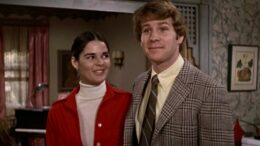
On Thursday evening writer-director Whit Stillman, auteur of the Preppydämmerung film “Metropolitan,” will host a screening at “online movie theater” Constellation.tv.

Through online chat the fillmmaker will answer viewer questions and will also present the trailer from his upcoming movie “Damsels In Distress.”

The viewing costs $3.99 and the Wall Street Journal has this handy write-up of what Constellation online screenings are like. See you in the back row. — CC

Send to a Friend


Digg TwitterFacebook StumbleUpon

Father Knows Best: Free & Easy Dad’s Style Issue

Sun 8 Jan 2012 - Filed under: Personae — Christian
Comments (38)

The February issue of Japanese magazine Free & Easy is devoted to “dad’s style,” another term for trad, and includes a profile on me. Two correspondents from the magazine spent several days documenting me and a selection of my worldly possessions to the tune of eight pages.

Previously I’ve written in praise of the small wardrobe, and I’m constantly purging my closet of things that seemed adequate at one point but no longer cut the mustard. Following an unusually brisk December of acquisitions and purges, there’s stuff profiled that I know longer have and new things that would’ve made nice additions.

Of course no one in Japan knows me, but you guys do, so now I have to write all sorts of disclaimers about the stuff pictured. Where shall I begin? (Continue)

Send to a Friend


Digg TwitterFacebook StumbleUpon

Measure For Measure: H. Freeman MTM Sportcoat

Thu 5 Jan 2012 - Filed under: Clothes — Christian
Comments (31)

We all have our dealbreakers when it comes to tailored jackets, and over the past couple of years I’ve settled on mine: I need a natural shoulder and a three-inch lapel. Everything else is negotiable. Of course a center vent is kind of required, since I mostly wear buttondown collars and believe they’re best paired with a single vent, but those aren’t tough to find. And darted versus undarted doesn’t really matter to me.

The problem I’ve come up against is that there’s very little off the rack that fits this criteria. I can get a narrow lapel though not with a natural shoulder, and I can get a natural shoulder but not with a narrow lapel.

The only source I’ve found for both — not to mention bonuses such as patch pockets, lapped seams and a 3/2 roll — is Polo Ralph Lauren, but these jackets tend to run about $1,500. I’ve been lucky to find three on eBay at a fraction of that, and these Italian-made jackets are terrific. Another option is the new Norman Hilton, where you don’t get patch pockets but you do get a hook vent, and the shoulder is natural and the lapel is three inches. Unfortunately fabrics are limited.

But at Bruce Boyer’s recent book-signing party at Leffot, I spent a long time talking shop with a bunch of hardcore clotheshorses who suggested I try LS Clothiers on West 45th between Fifth and Sixth. The result is my first made-to-measure sportcoat, and it certainly won’t be the last.

The jacket was manufactured by H. Freeman, originally founded in Philadelphia a century ago but now operating out of Maryland. I selected one of their fabrics, a simple mid-weight charcoal herringbone, and offered up my physique to the tape measure. About a month later the jacket arrived, and it’s a peach. The comfort factor is amazing due to the balance of how the jacket hangs from my shoulders. But just as compelling as comfort is the ability to choose all the details.

Jacket details include a full canvas lining with plenty of handwork, a 3/2 roll, lapped seams, edge stitching and 8.5-inch hook vent. The chest is undarted but has some mild shaping through the sides. The two-button cuffs feature working buttonholes, and I provided the English horn buttons myself. And of course you get your name sewn in the lining, which is kind of cool the first time you see it.

For the next one I’ll bring in some Holland & Sherry cloth and maybe scoop up the last of Paul Winston’s Kama Sutra lining.

You’re probably wondering about the price. With tax and working buttonholes (a $38 surcharge), the jacket came out to $640, quite a bargain considering you’re getting exactly what you want and a perfect fit.

Inside the breast pocket there’s a little card to remind you where your money went. Thanks, Mary. — CC

Send to a Friend


Digg TwitterFacebook StumbleUpon

Picture Show: Hollywood And The Ivy Look

Mon 2 Jan 2012 - Filed under: 1950s, 1960s, Clothes, Historic Images — Christian
Comments (56)

As the editor of Tradsville’s news gazette for the past three years, I’ve been obliged to work my beat with at least some attempt at assiduity. That includes keeping an unjaundiced eye on the discourse at Talk Ivy, a discussion forum hosted at filmnoirbuff.com whose members are mostly from the UK and Continental Europe.

From their discourse I’ve received the general impression that English Ivy fans are a kind of retro style-tribe subculture with a fanaticism for the music and clothing from 1955-1965. This fuels them with a tireless drive to dig up forgotten historical documents such as photos, films, record albums and advertisements. When it comes to putting these things into historical and social context, however, the English are severely hampered by two things: the need to see history in a way that fits their subculture’s sensibility, and the fact that they don’t live in America.

Their “talk,” then, is primarily fandom threads about favorite clothing items, records and movies, while their analysis of the Ivy heyday is speculative and interpreted rather than fact-based and reported.

I’ve previously written about the English following the publication of “The Ivy Look” by Graham Marsh and JP Gaul, a book almost baffling in its inability to articulate — a couple of sentences would have sufficed — where the Ivy League Look comes from, how it got its name, and other such basic information in what was intended as an introductory guide. And yet it’s not hard to see why this is squeamish territory: for London style-tribe scenesters, nothing could be more unhip than the thought of dressing in the clothing style whose original arbiters were the East Coast establishment.

Combined with an avoidance of the origins of the Ivy League Look and its chief merchants (who, outside of New York, were nearly all located in the communities serving Yale, Harvard and Princeton), was the curious inclusion of all sorts of randomalia, such as Zippo lighters, Porsche speedsters and French New Wave cinema, which may share the historical timeline as the Ivy League Look’s heyday but bear no direct relation except in the imagination of tribal members.

Perhaps opting to play it safe this time, the authors’ new follow-up tome, “Hollywood And The Ivy Look,” has minimal text. And in Marsh’s one-page introduction, England’s resident Ivy expert now sounds so confused he’s resorted to a wishy-washy cop-out when it comes to addressing his readers with the topic at hand:

There is a strong case to be made that the “Ivy League Look” was, in essence, pure Brooks Brothers and did not emanate from the eight East Coast universities. The jury is out as to the final decision and probably always will be. But now, back to Hollywood and the Ivy Look…

As Marsh returns to his comfort zone with an ellipsis, the book’s real content — rare photos — are fantastic and gathering them is something to be lauded. Though the second half, as in “The Ivy Look,” falls into the same trap of including many photos, films and TV shows that feel merely contemporary to the years 1955-1965 rather than expressions of the Ivy League Look, the book is a tremendous photographic documentation of the brief time when Ivy was popular and entertainers dressed with restrained good taste.

The text’s peccadilloes are largely confined to instances of scenester-geek chumminess (”kings of the buttondown,” “our man Perkins”) and calls to style-icon mimicry and tribal initiation (”wear this outfit and you’re guaranteed a passport to the Ivy Look”). There’s also a reference to Ivy as an “aesthetic,” but perhaps I’m the only one who finds that word pompous.

But as a counter to the many fusty dullards who have kept Ivy clothiers in business over the decades, the English provide a useful reminder that American natural-shouldered clothing can, in additional to being traditional and correct, also be cool. — CHRISTIAN CHENSVOLD

Send to a Friend


Digg TwitterFacebook StumbleUpon

Genuine Authentic: Franklin & Marshall Collegiate Gear

Sat 31 Dec 2011 - Filed under: 1950s, 1990-present, Clothes, Historic Images — Christian
Comments (13)

The Daily Mail recently reported on Franklin & Marshall — no, not the liberal arts college founded in Lancaster, PA in 1787, the Italian fashion brand.

Seems a couple of designers found an old college t-shirt, and, without bothering to research its origins, decided it would make a cool name for a logo-driven sportswear brand.

This year the company grossed $61 million.

The college eventually got wind of the name appropriation, and though initially miffed, ultimately decided to let the brand continue, since when you’re a school no one has heard of innocuous buzz is better than no buzz.

The tragic irony, however, is that the fake collegiate Franklin & Marshall sweatshirt (right), designed in Italy, looks more handsome and collegiate than the generic one sold in the real Franklin & Marshall bookstore (left):

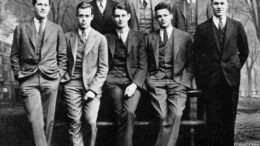
Pictured at top are F&M students from 1956 wearing dirty white bucks. — CC

Send to a Friend


Digg TwitterFacebook StumbleUpon

A Comprehensive Guide To Haircuts

Mon 26 Dec 2011 - Filed under: Clothes — Christian
Comments (16)

Send to a Friend


Digg TwitterFacebook StumbleUpon

Golden Years: Christmas During World War II

Thu 22 Dec 2011 - Filed under: 1920s-'40s, The Golden Years by Richard Press — Christian
Comments (7)

As a follow-up to Christian’s Hanukkah post, Richard Press authors this year’s Christmas post.

During World War II, Yale professors still wore tweeds, but the boys they taught would soon graduate into khaki. Behind Woolsey Hall are the many rows of names of the boys who never came back.

My father, Paul Press, was a riveter who made M-70 rifles at the Winchester factory on Dixwell Avenue in New Haven. His brother Irving ran the PX store at Camp Ritchie, Maryland. My grandfather assisted the war effort overseeing custom-tailored uniform orders for candidates at the Officer’s Training School at Yale. J. Press was on a wartime footing along with the rest of America. The Princeton store was closed in 1942 when the entire staff joined the army. Civilian business necessarily diminished with shortages of inventory and customers during the war years.

My prescient grandfather prepared for the European conflict in the late ’30s and loaded up all available English goods before the start of war in September, 1939. Cases of Welch, Margretson shirts and ties, Twin Steeples hosiery, Druhmohr Shetland sweaters and Locke hats occupied all the space in the basement.

I was six years old in 1944 when grandfather Jacobi set up chairs and blankets for us to watch the Christmas Day Parade on the balcony in front of his office of the J. Press store on York Street. The wartime spectacle offered a key spot to view the brigades of Sherman tanks and armored vehicles clanking their treads towards the rally downtown for speeches and songs later on the New Haven Green. Soldiers, Sailors and Marines blared their bugles and beat the drums in military cadence to “The Caissons Go Rolling Along.” The back of the parade featured All-America Yale Football Captain Paul Walker, the Dink Stover and Frank Merriwell of his time, riding on top of a Ford truck garbed in a Santa Claus suit and beard, both a part of and yet removed from the instuments of war. He directed his Winston Churchiil “V for Victory” salute right to me on the balcony.

Spiffed up in the army uniform my grandfather gave me for Christmas, I returned the salute standing stiffly at attention until the grand old flag finally passed me by. When I got home I couldn’t wait to turn on the Victrola to play my favorite Spike Jones record: “When The Fuhrer Says He Is The Master Race, Sieg Heil (flatulate), Sieg Heil (flatulate), Right In The Fuehrer’s Face!” — RICHARD PRESS

Send to a Friend


Digg TwitterFacebook StumbleUpon

Happy Hanukkah From Ivy Style

Tue 20 Dec 2011 - Filed under: WASPdom — Christian
Comments (35)

On this, the first day of Hanukkah, Ivy-Style.com sends glad tidings to the unsung heroes of the Ivy League Look: the many Jewish clothiers that catered to the Protestant Establishment and taught generations of young men the virtues of a natural shoulder and how to dress like an American gentleman.

Despite the popular admonition “Dress British, think Yiddish,” these haberdashers helped put the America in our Anglo-American national style, and preppy dress is all the richer for their creativity and innovation.

Not to belabor the point, but save for Brooks Brothers, essentially every Ivy League clothier was Jewish. And so our holiday wishes go out to:

J. Press
Chipp
Paul Stuart
Eddie Jacobs
Gant
Sero
Langrock
White’s
Fenn-Feinstein
Barrie’s Shoes
Arthur M. Rosenberg
Rosenthal & Moretz
Arthur Adler

And extra-special Hanukkah wishes to Ralph Lauren for keeping alive the taste for WASP style just as the tribe was beginning to crumble. — CHRISTIAN CHENSVOLD

Send to a Friend


Digg TwitterFacebook StumbleUpon
Theme Easy White by st3fo - rUn3 Production