
Daniel Covell is a Professor of Sport Management at Western New England University and a contributing writer for Ivy Style.
I’ve always been amused by the various cross-cultural interpretations of what constitutes Japanese to Americans and American to the Japanese. Most of these observations come from American films and television shows. On my favorites is a Season 10 episode of “The Simpsons,” when the Simpson family travels to Japan and Homer’s profligacy forces Marge to get the family to appear as contestants on a local game show so they might win airline tickets to return to Springfield, U.S.A. Before the contest begins, however, the show’s host warns the family that Japanese game shows are different from those in America. “Your shows reward knowledge,” says the host. “We punish ignorance.” When Homer responds, “Ignor-what?”, flames shoot out of the microphone in front of him, singeing his already diminished hairline, causing the studio audience to laugh heartily. The family ultimately earns their tickets home by retrieving them from a rickety bridge crossing the mouth of an active volcano. Spoiler alert: The lava turns out to be an orange drink made by the show’s sponsor, the Osaka Orange-Aid Concern.

As far as the Japanese take on American traditions and customs, we Ivy Stylers likely would count the book Take Ivy, equal parts photo study / travelogue / fashion primer / cultural ethnography, originally published in Japan in 1965, as the most instructive and entertaining example of how that culture interprets a particularly American phenomenon. While lacking The Simpsons’ characteristic slapstick charm and snark, Take Ivy, with text in Japanese written by Shosuke Ishizu, Toshiyuki Kurosu, and Hajime (Paul) Hasegawa, and color and black-and-white photographs by Teruyoshi Hayashida, is a both a vivid pictorial time capsule of campus-based and urban mid-1960’s Ivy Style, as well as a primer on the nuts and bolts of what the authors perceived as the cultural mores of the Ivy ethos. If you haven’t seen the book – the version I own is an all-English 2015 reprint from PowerHouse Books of Brooklyn – imagine a 9.5” x 7.25” glossy The Official Preppy Handbook written by a collection of Japanese Lisa Birnbaums, with all photos rather than photos and drawings.
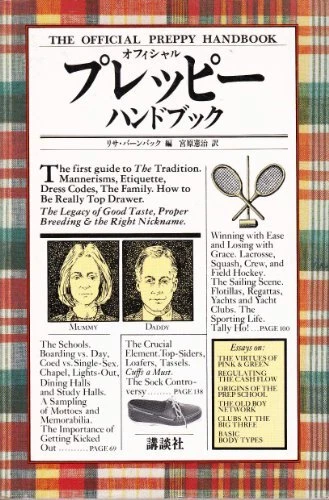
Much like the TOPH, Take Ivy serves as a handy field guide for devotees and novices alike, and as the dustjacket of my edition tells it, the book set off “an explosion of American-influenced ‘Ivy Style’ fashion among students in the trendy Ginza shopping district of Tokyo … Take Ivy is now considered a definitive document of this particular style.” The reprint’s summation is that the book “is an essential object for anyone interested in the history of future of fashion.”

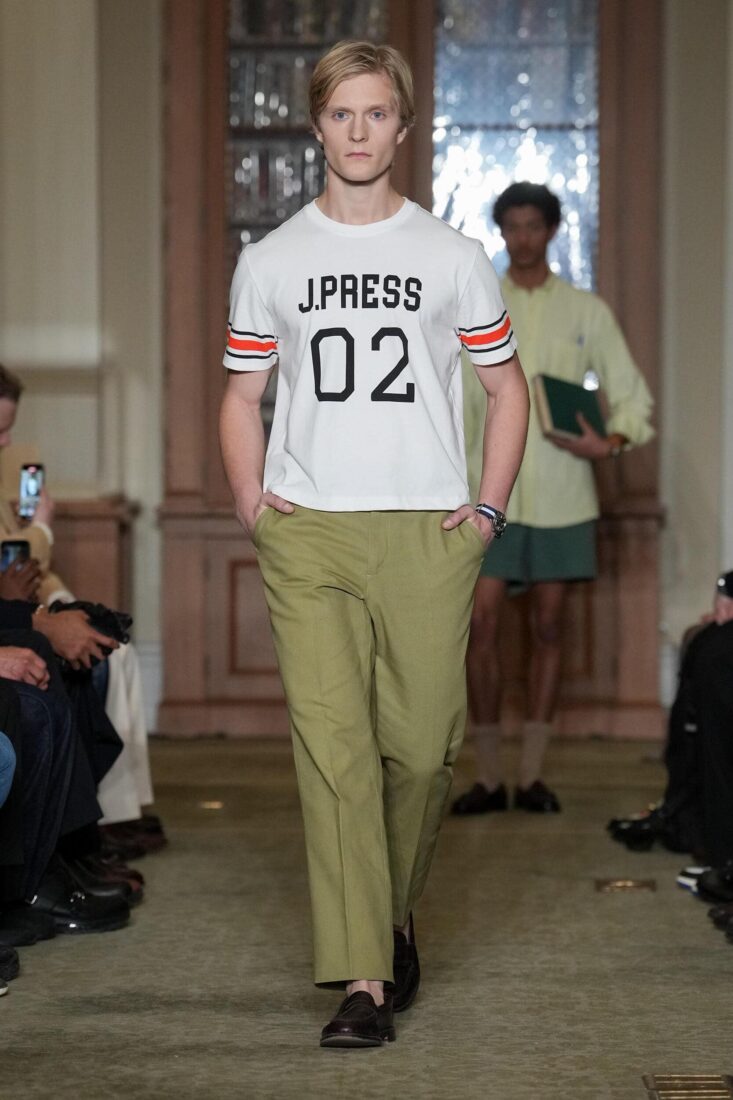
That 2015 blurb proved prophetic, as the during the recently completed New York Fashion Week, the folks at J. Press built their entire Spring 2026 runway show around classic shots from Take Ivy, and even introduced some new products based on some notable photos from the book, including a J. Press version of a white Princeton graduation year t-shirt, complete with black and orange stripes on the sleeves. I had a three-quarters sleeve version of this, reading “Cornell 78”, obtained during my sister’s time studying and playing hockey far above Cayuga’s waters.
The 140-page volume is divided into four sections – three populated with photography, entitled “College Life,” “College Fashion, and “Elements of ‘Ivy’,” and the last, entitled “Take Ivy,” which provides readers important data, accompanied with some opinion, on the campus goings-on in the Ancient Eight. This includes important sports (lacrosse, crew and ‘American football’), favored music (Dave Brubeck, Paul Winter and The Brothers Four – this list seems way off to me), choice of automobiles (MGs and Triumphs), and even a geography lesson regarding what the authors call “Ivy League neighborhoods.” It is here the authors report that New England residents are stereotyped as “conservative and stubborn.” “I could be wrong,” concludes the author, “but the people of New England seemed to be flattered by such a reputation.”

This last section of the book also observed that “upon graduation, a much awaited, glorious new life begins in New York … Once the Ivy Leaguer starts working, the way they dress changes dramatically. They are no longer allowed to stroll around in their old cotton trousers and sneakers. Instead, they have to wear dark suits and can no longer act like carefree students.” Life in New York,” state the authors, conjuring images of the famous 1831 woodcut “The Great Wave off Kanagawa” by Ukiyo-e artist Hokusi, means that Ivy Leaguers are “released from their previous cocooned student life” and “mercilessly thrown int the raging waves of the ‘real world’ before growing up to be full-fledged Ivy league alumni.”

The section concludes with more handy data, including a Yale University 20-Article Dress Code, and “The Ivy Wardrobe Directory,” reprinted from a source attributed as Men’s Wear. The Men’s Wear checklist shows required quantities with some added specifics, e.g.,
- Two suits, “one dark, one light, selected from the following: a herringbone in dark or medium gray, worsted in navy or olive green, shark skin or flannel in gray.”
- Ties, 12 is the suggested total, with Rep ties “in regimental stripes. Select a few from wool ties with a fine pattern, silk ties in classic patterns, etc. A black, knit tie is a must. All of them should be slightly wide.”
- Four pair of shoes: “Cordovan plain toe or saddle shoes in black and brown, classic loafers, boat shoes or sneakers, brown boots.”
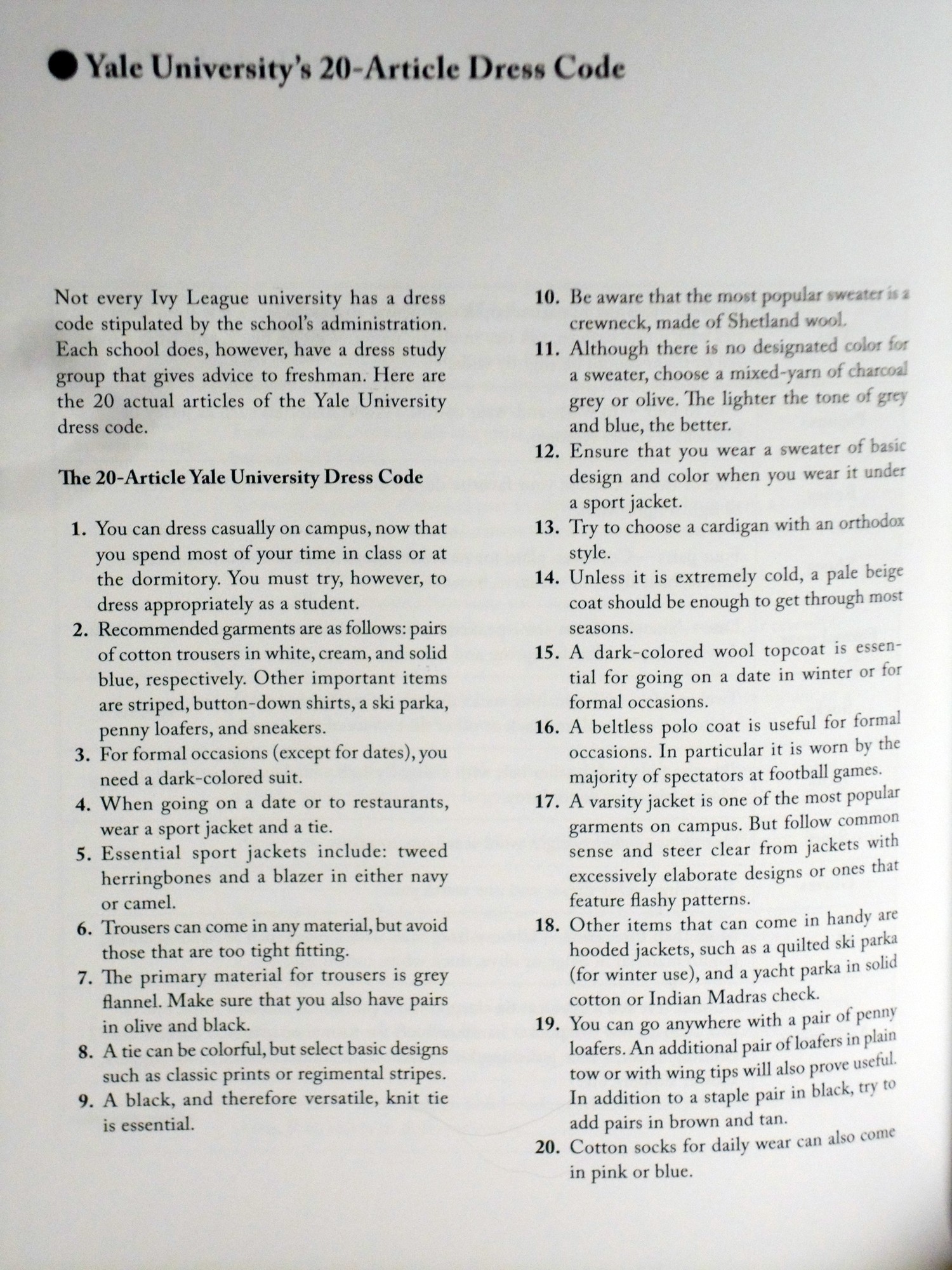
The Yale Code’s article expands on this wardrobe count by providing salient advice on the hows, whens and wheres, e.g.:
- Article 4: When going on a date or to restaurants, wear a sports jacket and tie.
- Article 10: Be aware that the most popular sweater is a crewneck, made of Shetland wool.
- Article 13: Try to choose a cardigan with an orthodox style.
- Article 19: You can go anywhere with a pair of penny loafers. An additional pair of loafers in plain toe or with wing tips will also prove useful. In addition, to a staple pair in black, try to add pairs in brown and tan.
As many others have written, and with which I agree, while seemingly restrictive, such guides actually provide a measure of freedom, especially to those who did not come to Yale or other Ivy campuses from private or boarding schools with a strict dress code. Just get these and do this, the codes transmit, and you’ll be all set. You won’t have to worry about what clothes further. You’ll be fine.
Take Ivy is best known, however, for its photographs. Hayashida’s campus photos are mostly snapped at Dartmouth and Princeton, with a few at Brown and Yale mixed in, giving the book the feel of a mid-’60 college yearbook, minus the team pictures and senior portrait pics. Interspersed with the fashion-focused candids are incredibly telling campus atmosphere pics – intramural softball games, rows of card catalog cabinets in a library, the ride board (for those of you who were born after 1980, that’s the bulletin board on campus where anyone seeking a ride or riders to share trips to spots off-campus for breaks would post their requests). The time of captured is either late spring term or early fall term, as the trees and, yes, the ivy, are in full leaf, and the grass is high and lush. With the publication date of 1965, one can assume that the campus visits happened in in either late ’64 or early ‘65, providing the authors with the great good fortune of capturing arguably the high-water mark of Ivy Style on these, the Ivy-est of campuses, just a whisper before the effects of counterculture hippie style would make its presence felt in force.
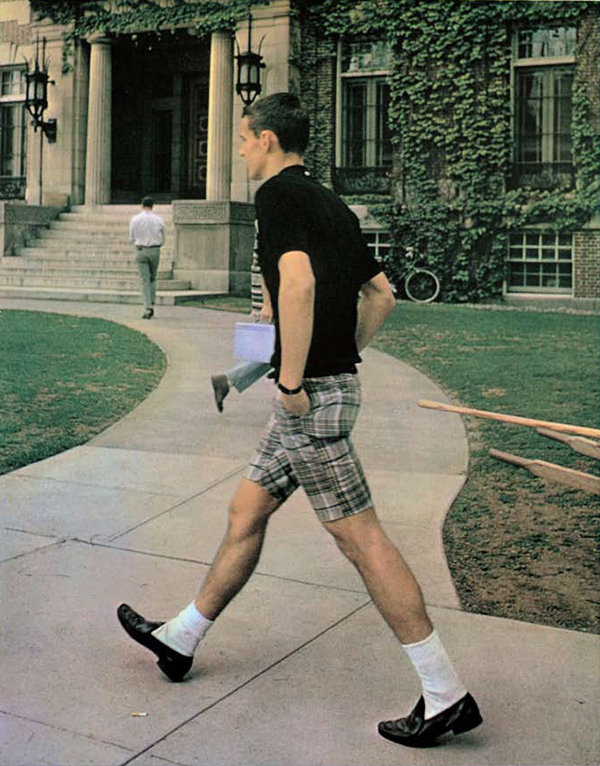
The photos are accompanied by captions that provide brief synopses of the subject’s attire, often with an accompanying assessment of the propriety of the ensemble. Others offer a bit more that style assessment. Of a shot showing a long-striding student in black loafers with mid-calf white crew socks, snug green and black madras shorts and a black polo shirt, the caption warns: “Simply slipping into a pair of Bermuda shorts is no guarantee you will look stylish. Strut in a brisk and confident way to complete your style.”
Another, above a photo of three Dartmouth students, one with a Zeta Psi frat t-shirt, off-white chinos and black low-cut Chuck Taylor sneakers, opines that “rational-minded Ivy Leaguers don’t bother looking neat for classes. They feel that they can get away dressing casually as long as they don’t look too shabby.”
Most of the Yale shots are taken in from of the campus bookstore on Broadway, just up the block and across the street from the current J. Press location. The then-brand-new edifice, designed by Eero Saarinen, is noteworthy for its brutalist take on Yale’s predominate Campus Gothic architecture, contiguous to Ezra Stiles and Morse colleges. In a side-by side full-page color layout of two male students there – one with a squash racquet about to jump on his battered single-gear bicycle – the caption reads “What can a man wear that is superior to the combination of an Oxford button-down shirt and a pair of check, Indian Madras Bermuda shorts? Wearing shoes without socks and untucking your shirt can be overlooked only because the students are on campus.”
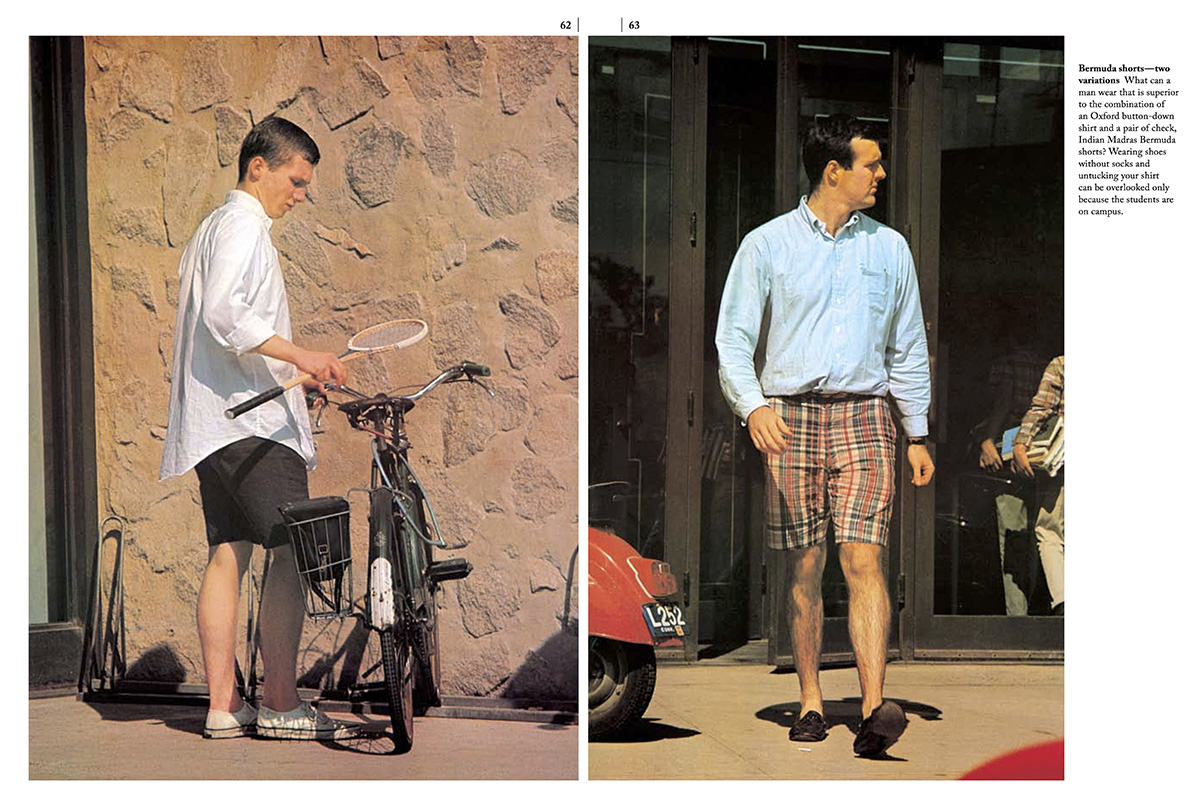
While it’s hard to find a counter to the question posed, the caption implies a sense of propriety which is likely an author’s bias more than what’s driving the clothing choices of the students. Other captions share this tone, with an occasional declaration that seems to have lost something in translation. Several captions use the word “rough” or “uncouth” to describe the more casual clothing choices of subjects. In the book’s final section, the authors explain an appreciation for this approach, noting that something similar occurred in Japan. “I was delightfully pleased to discover that there was a similar trend in a gloriously modern country like the U.S.A. student proudly wearing a sweater with holes, one in a prized pair of shabby sneakers, one with a bumbershoot (yes, you read that correctly, their word choice) so worn-out to the point it is see-through … Mind you, they don’t appear pathetic and miserable. Rather they seemed to have that style by choice, and are enjoying it.” Thus the authors have uncovered two basic tenets regarding monetary policies outlined in the OPH (pp. 32-33), 1.) “Be alternatively spendthrift and parsimonious. Spend a lot of money on a bottle of Scotch and good cigars, but save subway fare by walking to work,” and 2.) Never replace anything until you have exhausted all possibility of repair, restoration, or rehabilitation. No matter what it is, they don’t make it as well as they used to.”

As a college prof, I was particularly piqued to read the authors’ observations on what they observed on the dressing habit of the professors of the day. “During their college careers, students look to professors as living examples of how a working person should dress. It is only normal that professors wear either a dark suit or sport coat, since they consider the campus their workplace. On many older professors, a bow tie adds a traditional yet appropriate touch to the scene… On the other hand, I caught sight of a professor wearing a bright colored sport jacket in Madras check. You never know, he might be the trend setter for the coming years in American campus fashion.” The last line was heartwarming indeed for someone who both wears bow ties and Madras jackets to class, in large part because I like to signal the importance of our shared academic experience, in part to signal just such messages about how a grown-up and serious professional might look.

While the photos are what many find most striking about Take Ivy, I would suggest that authors’ confessional in the “College Fashion” section of the final segment of the book is equally compelling. “As a Japanese man, I struggle to conceive of ‘campus wear’ or college fashion.’ It is because we Japanese have been put under the spell of having to wear school uniforms. Japanese students are confined to wearing a stand-up collar jacket, day in and day out for many years … During our trip, the sheer variety of Ivy Leaguer’s spontaneous fashion never ceased to intrigue us … Students do have an unwritten dress code that they faithfully observe, despite the seemingly disorderly manner in which they dress.” After noting that students mostly dress casually on campus but follow more “universally accepted fashion requirements” when “out in society.” “Come to think of it,” the authors summarize, “this means that a completely opposite dressing theory is applied to Japanese students. In the Japanese academic regime, students are not granted an opportunity to learn what dressing through life is all about.”

To me, this seems to be the crux of the book – the fascination with not the specific elements of what constitutes Ivy Style, but the fact that the subjects seemed to have the freedom to figure it how to apply it on their own. As noted above, in reality, many of the book’s pictorial subjects likely had come from school settings with very strict and specific dress codes (and subsequent penalties for failing to meet the set standards), so were familiar with the differences with what had to be worn, and what could be worn, and where and when to do so. The residential campus nature of the American college system, as opposed to those in Europe and elsewhere, provided a laboratory for experimentation and expression.

Ultimately, what Take Ivy shows and tells us is that few things are more powerful in cultural expression than clothing, and little else can be more fascinating to ponder to those both within and without. But after all this, I’m still left wondering what the title of the book meant? I thought perhaps the word “take” had a relevant meaning in Japanese, but all my Google searching could reveal is that “take” is the Japanese word for “bamboo.” That didn’t seem to be it. Was it about the taking of the many pictures that gives the book its iconic standing over 60 years later? Or was it about how cultures take from each other, interpreting things in their own ways, and giving them back in new and imaginative ways. Ivy Style had done that with fashion from England. So to may it be with Japan. This is especially intriguing to consider given the fact that it was a Japanese company, Kashiyama, that purchased J. Press in 1986, and has been instrumental in shepherding the brand back to its current position of preeminence in the Ivy Style retailing universe. So it is that in 1965, three writers and a photographer made a pilgrimage from Japan to learn about the trapping of Ivy Style, documented their findings and reported them back home, sparking an ongoing fascination with something uniquely American. Two decades later, a company from Japan returned to the U.S. and solidified an Ivy Style icon. A cross-cultural give-and-take if ever there was one, and we Ivy Stylers are all the better for it.







About the title of Take Ivy: it’s a reference to “Take Five” by Dave Brubeck. The pun doesn’t work in English and I’m not sure if it really works in Japanese, but that’s all it means, “this is cool like jazz”. I believe W.D. Marx touches on this in Ametora, which certainly covers a great deal of the background of the book … such as how Take Ivy had to change its message to favor the casual, and even then engage in generous cherry picking, as tastes had changed from the 30s-50s Ivy the authors had heard about to when they finally got to the States.
Excellent look at a fun book. According to the Ametora by W. David Marx (which has a great few pages about the somewhat chaotic making of Take Ivy), Take Ivy was meant as a play on Dave Brubeck’s Take Five
And thanks to google, I now know that Take Five is a reference to the song’s unusual 5/4 time and taking a five-minute break.
Button-downed Heyday Ivy is definitely a particular, well-defined, even boundaried, look. If not “rules,” then certainly edicts and maxims. A polity, of sorts. This is why it serves as such a steadfast, relentless counterpoint to the excesses of 21st century athleisure, suburban bohemianism, and (horribile dictu) “updated traditional,” which is now ubiquitous. Fingers crossed that modern-day J. Press perseveres in the excavation of the yesteryear cut(s) and cloth — a rejoinder to the five pocket pant/quarter zip/spread collar universe.
Great stuff! More from Daniel, please.
Perhaps we should meet.
I had no idea about this book was a favorite in Japan and appreciate this story. I like too how this account captures collegiate fashion just before the eruption of hippiedom. Another terrific essay from Mr. Covell (my Dad once said that “mister” is the right appellation for a professor at a “good school” because “the doctorate is assumed”) I am a little concerned, however, that the Volvo wagon appears to be a newer model than one from the Take Ivy era. I could be wrong of course and often am.
The original photo of the Volvo wagon was simply to illustrate understated taste. It was not intended to represent the Take Ivy era.
To avoid confusion that photo has been replaced with a vintage advertisement for Indian madras. This connects directly to the text that follows.
Love the Volvos. More pics the better. Madras, too.
Cautionary tale: once “preppy” spirals downward into a Fauntleroyish, Merchant Ivory kitsch, there’s no recovery. Best to err toward the subtle and tasteful, constantly mindful of how easily the marketed takes on “preppy” and “Ivy” can descend to the cheesy and even vulgar. To repeat: kitschy.