“To this day, when I dress to go out to an old-fashioned luncheon party in Washington, I do my best to suggest a Morgan partner of 1928.”
– Joseph Alsop, The Wasp Ascendancy, November 9, 1989
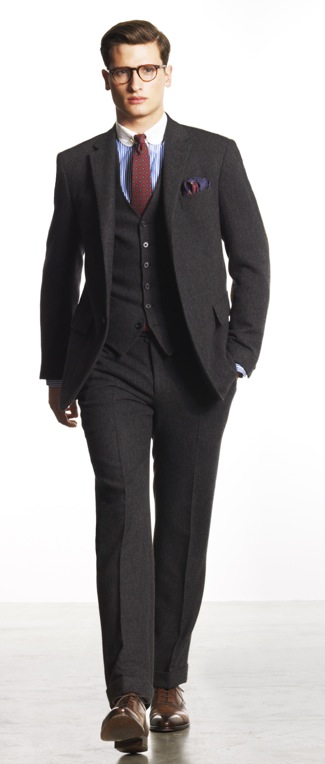
I am going to start off with a bold statement, and one that is likely to cause a stir among readers. The great age of Ivy Style – its heyday, if you will – is not the 1960s of Take Ivy nor is it the 1980s of The Official Preppy Handbook. In my opinion, the Golden Age for Ivy Style is the time period between the beginning of First World War in 1914 and the beginning of the Second World War in 1939. This quarter century represents the apex of elegance for menswear and the peak of popularity for the most attractive component of a gentleman’s wardrobe: the three-piece suit.
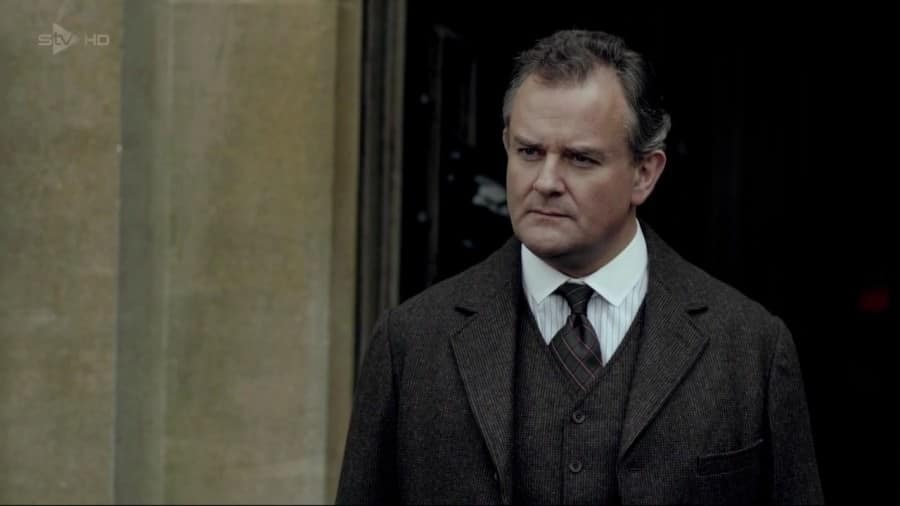
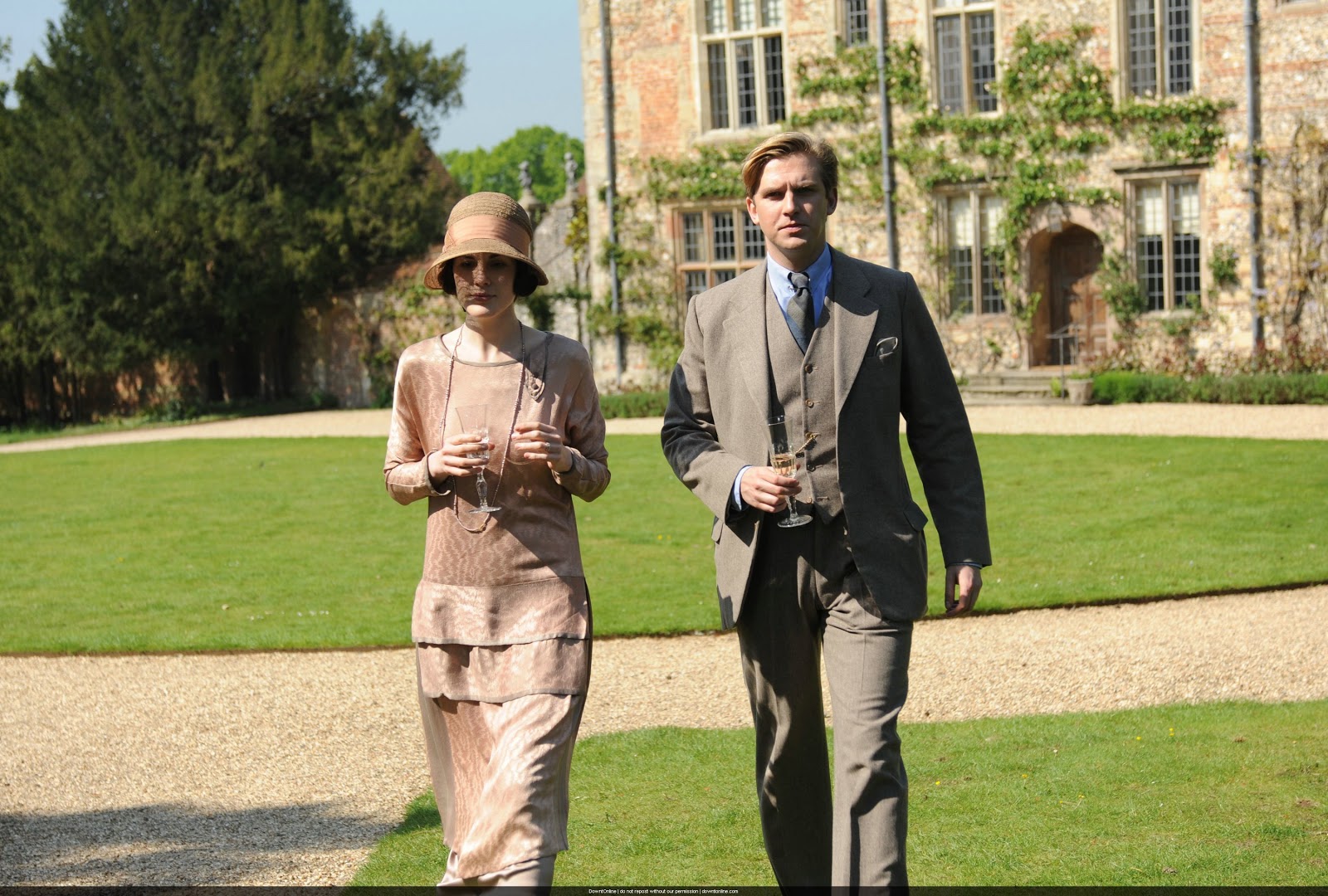
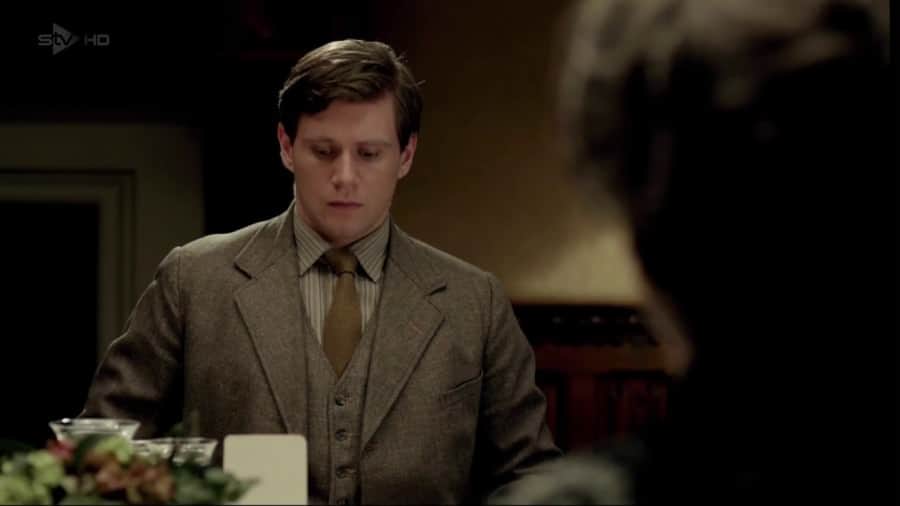
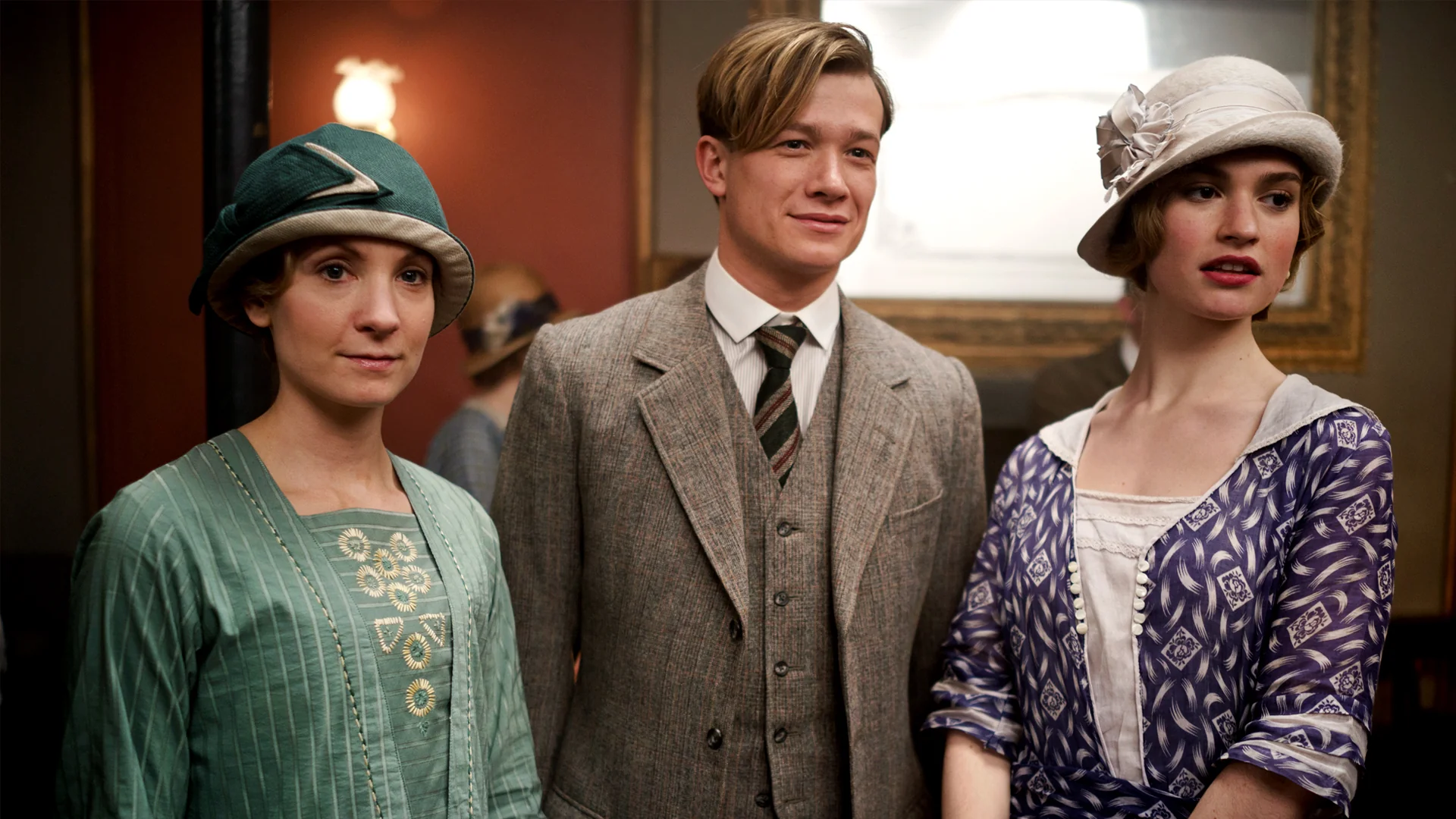
If you need convincing that the three-piece suit represents the pinnacle of sartorial elegance, watch Downton Abbey. Style transcends class boundaries as all of the men are beautifully attired. The series begins its first season with the sinking of the Titanic in 1912 and ends with The Grande Finale movie set in 1930. The upper class male characters who are “upstairs” – Lord Grantham, Matthew Crawley, etc. – all wear three-piece suits as do the household staff “downstairs” – Mr. Carson, Mr. Bates, etc.
The history of the three-piece suit has a long, storied tradition dating back to a 17th century British King. The story is told by Maude Bass-Kreuger, Associate Professor of Fashion and Museum Studies at Ghent University. In an article on the history of the three-piece suit for Vogue Singapore, Professor Bass-Kreuger writes:
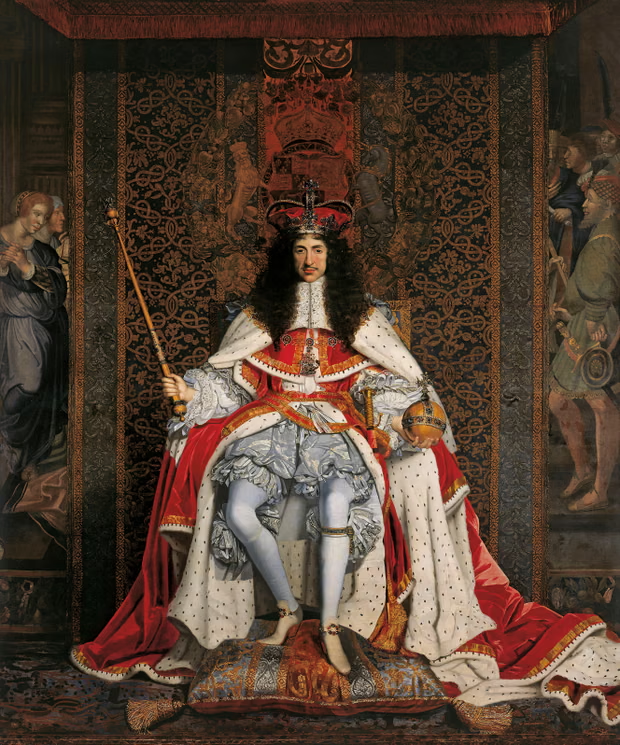
The three-piece suit (a jacket, trousers and waistcoat) was first introduced to Britain by King Charles II in 1666. Men had long worn variations of trousers and jackets, but the ‘Merry Monarch’, as the king was known, introduced a third element—the vest—to boost the English wool trade and force noblemen to abandon French fashion.
Charles II, c1676 by John Michael Wright. Photograph: Royal Collection Trust
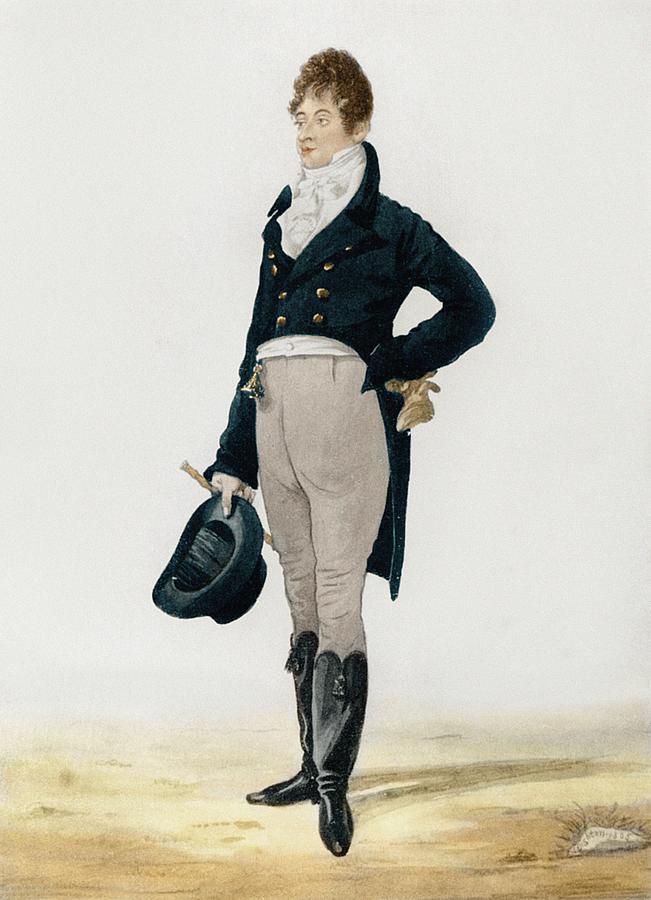
By the 19th century, the position of the vest as an article of men’s style was reinforced by George Bryan “Beau” Brummell (1778-1840), the arbiter of British’s men’s fashion and the preeminent example of a dandy. Brummell, a graduate of Eton College and Oxford University, befriended George IV (1762-1830), the Prince of Wales. George took an active interest in matters of style and taste, and his associates such as Brummell and the architect John Nash (1752-1835) created the Regency style, exemplified by the Regency terraces of Regent’s Park and Regent Street. Brummell favored understated trousers, white waistcoats, and dark jackets with tails.
Caricature of Beau Brummell by Robert Dighton (1805)
Over the course of the 19th century, the three-piece suit as we know it today would eventually come into existence. A true three-piece suit consists of a jacket, trousers (pants), and waistcoat (vest), all cut from the same cloth. According to Professor Bass-Kreuger:
By the end of the 19th century, the men’s three-piece suit had become even more sober, representing seriousness and rationality as opposed to the exuberant women’s versions, which were deemed frivolous and irrational. At the start of the century, waistcoats were made out of a different fabric and colour than the coat, but over time it became fashionable to have a suit cut from the same fabric.
By the beginning of the 20th century, the well-established three-piece suit was a staple of wardrobes for English and American gentlemen alike. Richard Press, grandson of J. Press founder Jacobi Press, describes this in an article for Ivy Style titled Golden Years: An Apologist For Tradition:
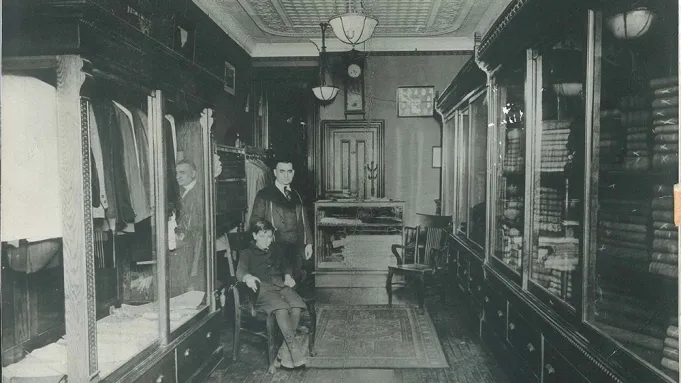
Before World War I, York Street in New Haven was lined by custom tailors who also dabbled in furnishings to meet the requirements of the students and faculty they served. My grandfather, Jacobi Press, tailored three-piece tweed, flannel and worsted suits for them, always searching for new resources in the British Isles to distinguish his fare from the competition. Suits were the order of the day. Single-breasted blue blazers were the only unmatched jackets he offered, usually accompanied by grey flannel trousers, whipcords or white duck trousers, the singular uniform for resort wear.
J. Press in the early 20th century
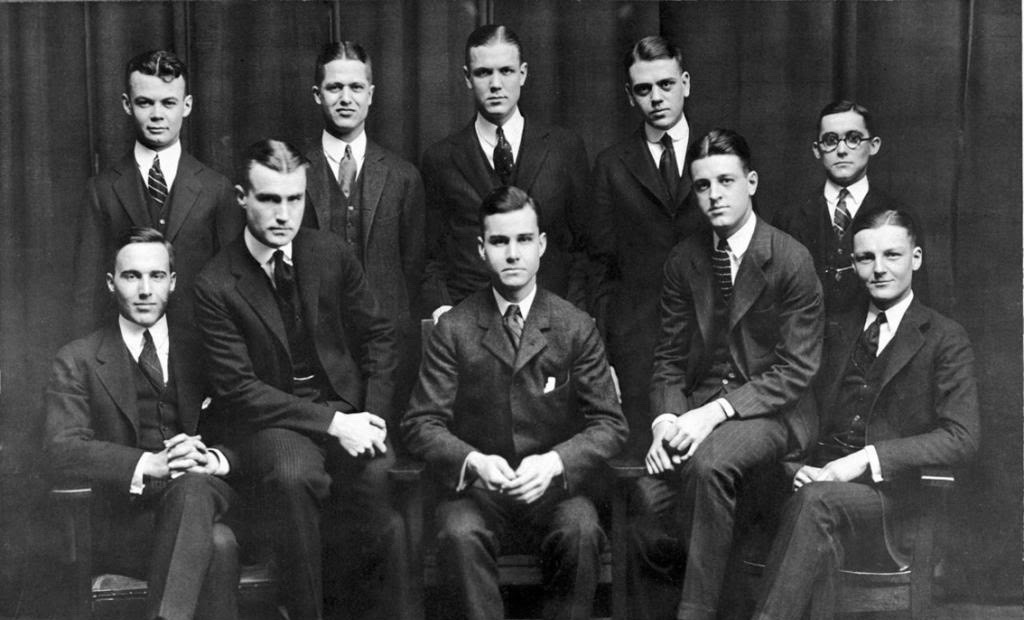
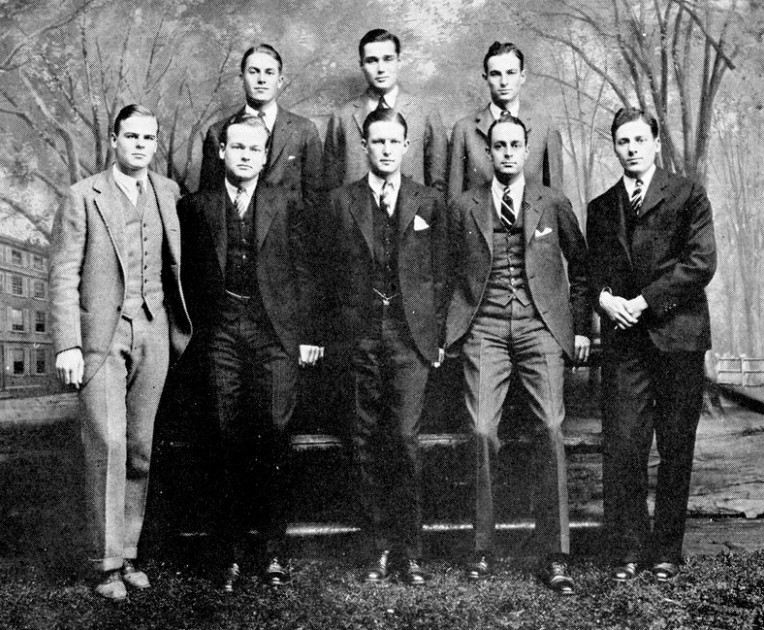
A three-piece suit, custom tailored in tweed from the British Isles, made an Ivy Leaguer virtually indistinguishable from his contemporaries at Oxbridge. If you peruse any Ivy League yearbook from the early 20th century, you will find students and faculty members consistently dressed the same way. They are wearing an early version of the sack suit with natural shoulders and a 3/2 roll, similar to the later iterations of this same look on these campuses decades later. The key difference: these suits include a waistcoat, or vest.
The Yale Whiffenpoofs of 1927
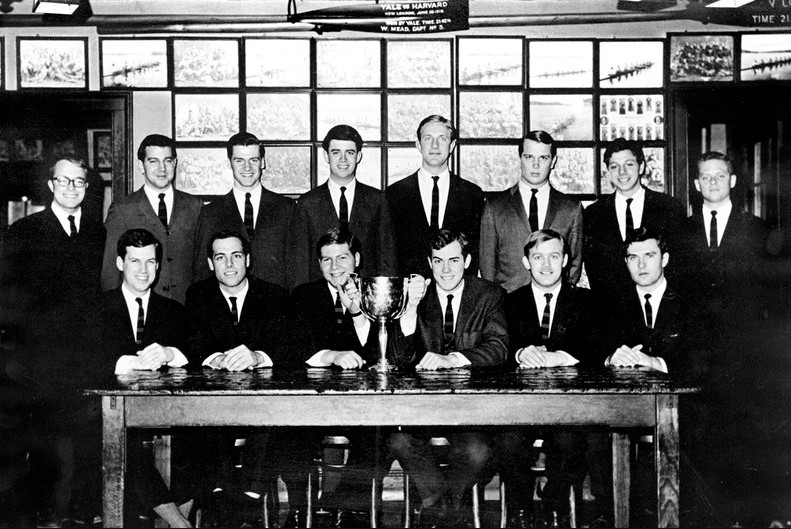
In post-World War II yearbooks, this third piece began to disappear and the two-piece suit gradually became the norm. By the time of the publication of Take Ivy in 1965, the “odd jacket” – or sport coat – had largely replaced the suit. Ivy League style, for better or worse, had become casual.
The Yale Whiffenpoofs of 1965
In 2012-2013, The Museum at FIT in New York City presented an exhibition titled Ivy Style and curated by Patricia Mears which examined the history and influence of the Ivy League on collegiate menswear from the 1900s to the 1980s. The exhibition featured descriptions of Brooks Brothers, J. Press, Chipp, and Ralph Lauren – all major contributors to the development of Ivy Style. The exhibition also makes it clear that Ivy Style is rooted in the early 20th century:
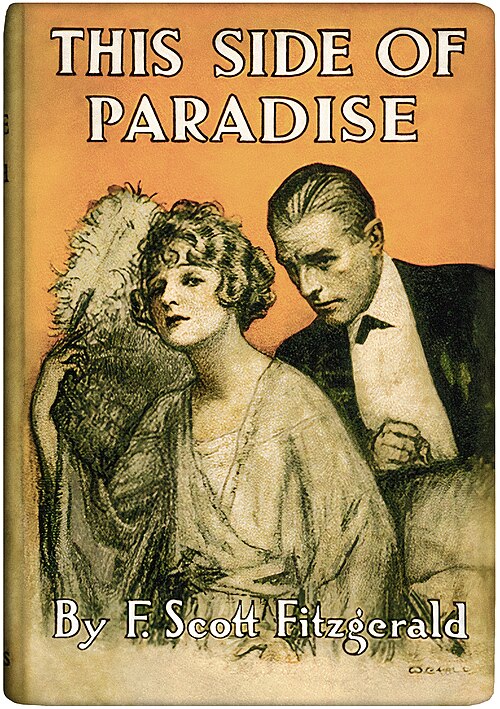
“Ivy style is often thought of as a phenomenon of the 1940s and 50s. However, many of its elements were incorporated into the wardrobes of young men decades earlier . . . So prevalent was the influence of Brooks Brothers on stylish Ivy Leaguers that the firm was lauded in literary works, such as F. Scott Fitzgerald’s first novel, This Side of Paradise. A fictional account of Fitzgerald’s undergraduate years at Princeton, the novel accurately recounts the many elements that constituted the school’s unique cultural environment—including clothing, especially clothing from Brooks Brothers.”
The Side of Paradise (1920)
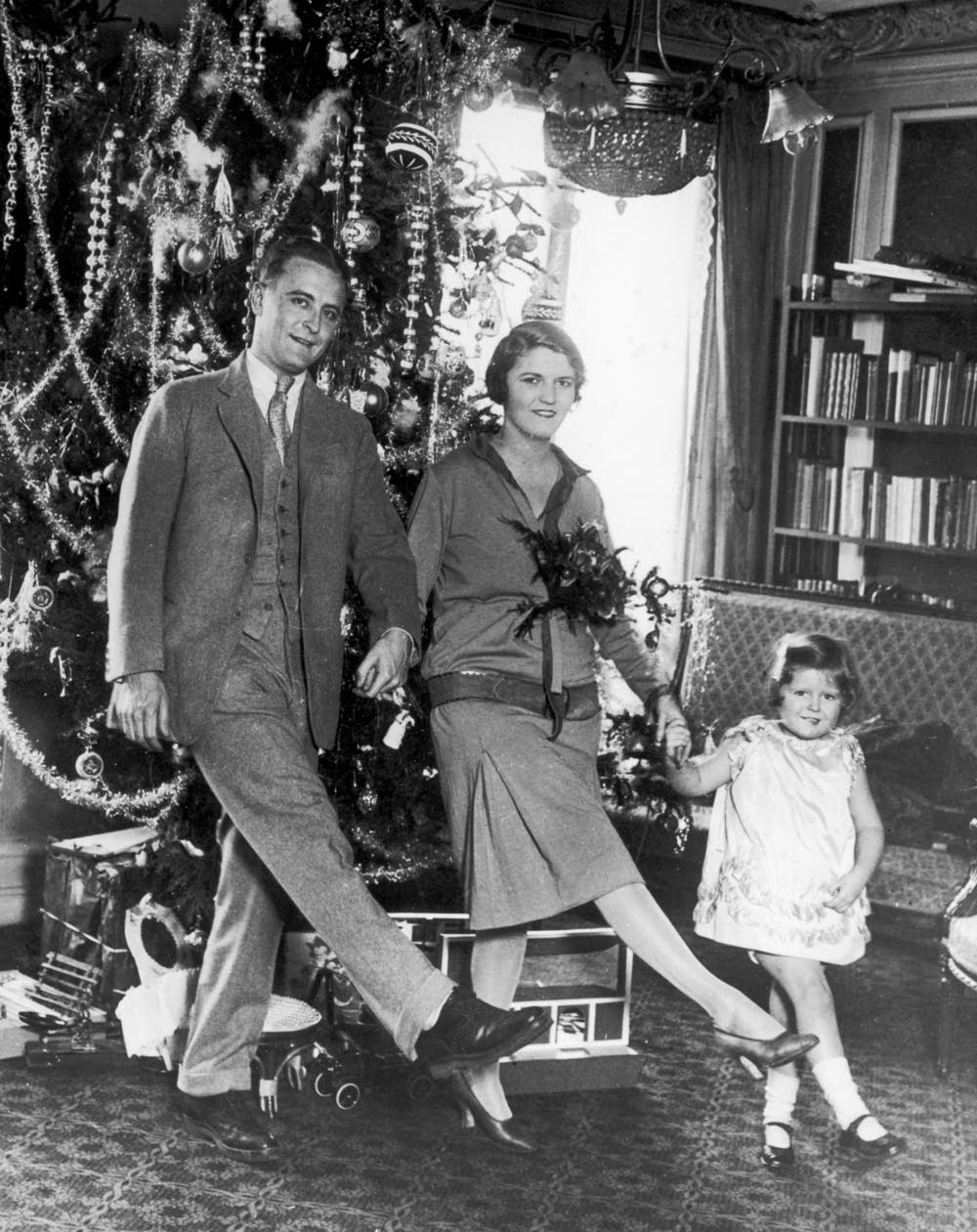
F. Scott Fitzgerald (1896-1940) dressed impeccably and featured rich descriptions of clothing in his writings. Fitzgerald was 18 when the First World War began and 43 when the Second World War began. In his first novel, This Side of Paradise (1920), the protagonist Amory Blaine’s mother, Beatrice, advises him to visit Brooks Brothers to update his wardrobe to dress appropriately for Princeton, stating “You must go to Brooks’ and get some really nice suits.” Fitzgerald writes in a 1936 letter to his daughter, Scottie – then an undergraduate at Vassar – to “Beware of the Yale wolves in their J. Press tweeds.” It is safe to say that the Brooks Brothers and J. Press apparel referenced by Fitzgerald when describing Ivy Leaguers – both fictional and real – are three-piece suits.
F. Scott Fitzgerald dances with his wife Zelda Fitzgerald and daughter Frances (“Scottie”) in front of the Christmas tree in Paris. (Photo by Hulton Archive/Getty Images)
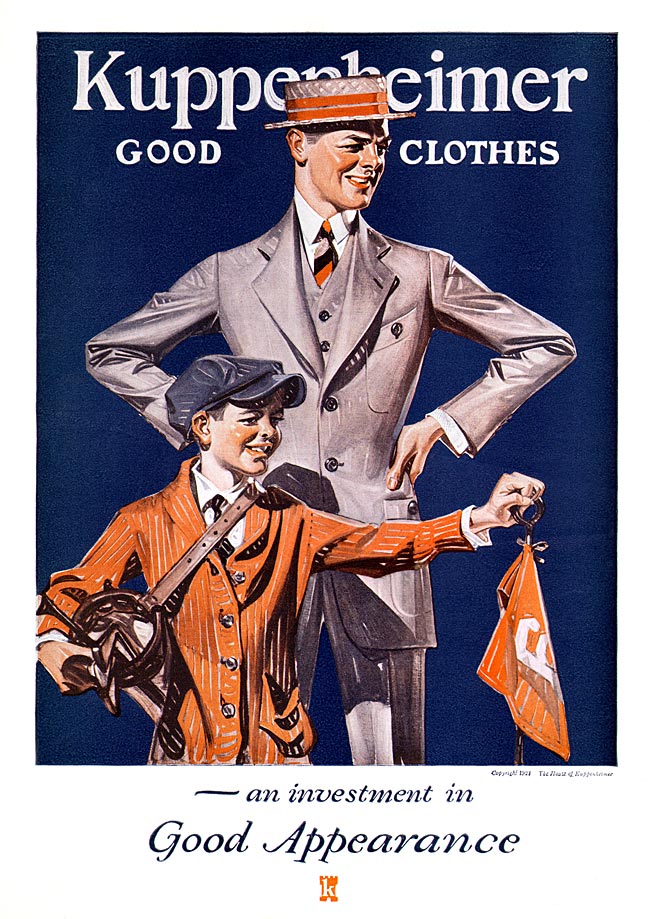
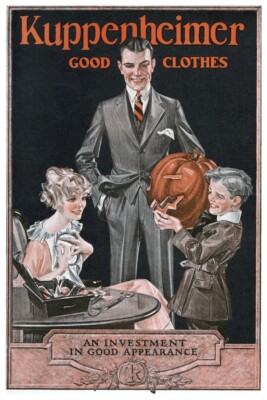
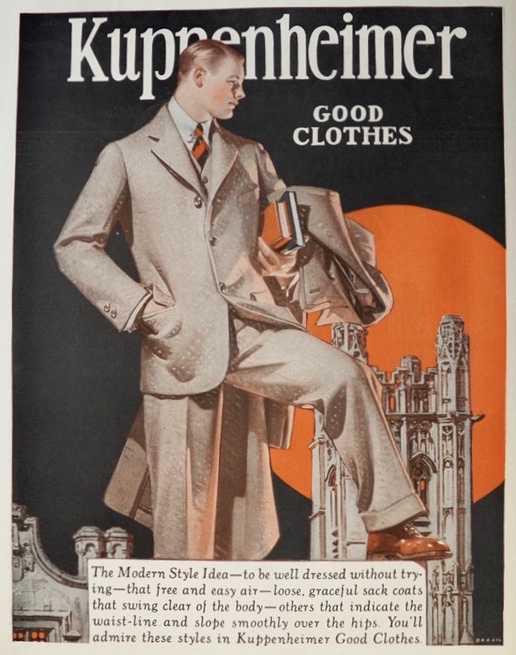
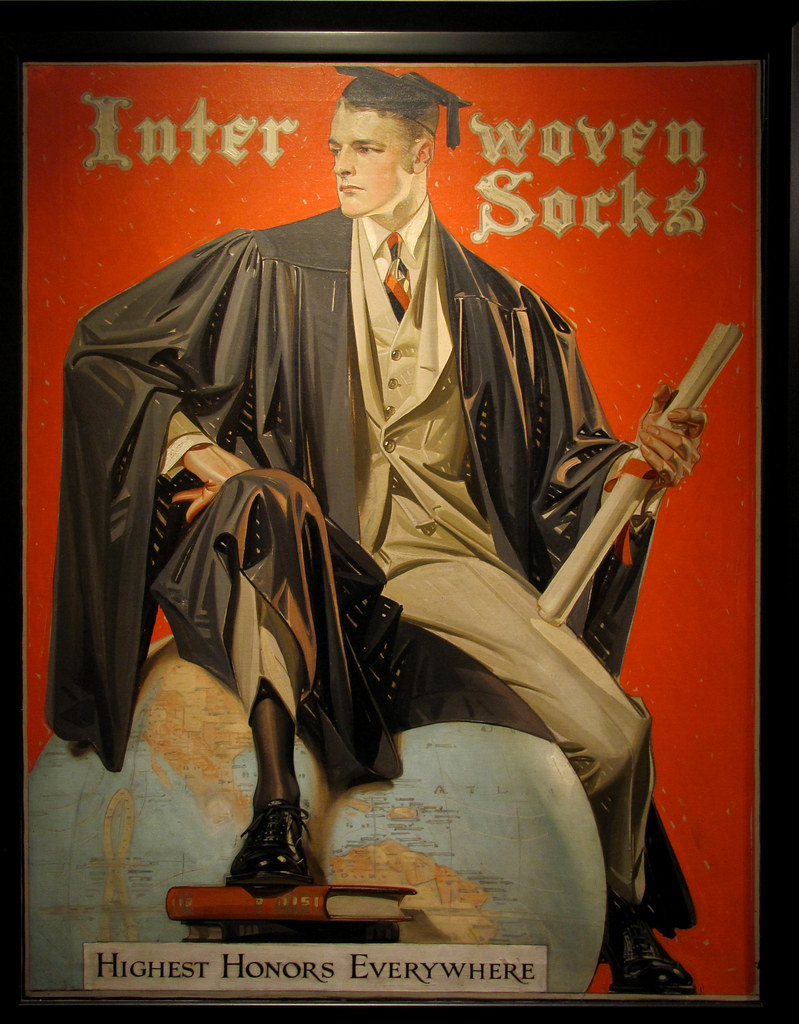
J. C. Leyendecker (1874-1951) illustrated covers for The Saturday Evening Post and Collier’s Weekly, in addition to his advertising work for brands like Arrow and Kuppenheimer. Leyendecker is clearly the illustrator that Fitzgerald had in mind in The Great Gatsby (1925). Fitzgerald uses the “Arrow Collar Man”— a popular 1920s advertising icon designed by Leyendecker—as a symbol of Jay Gatsby’s meticulously crafted, polished persona. Daisy Buchanan explicitly compares Gatsby to this handsome, well-dressed ideal when she compliments him stating, “You always look so cool . . . You resemble the advertisement of the man . . .” Many of Leyendecker’s illustrations feature clean cut collegians dressed stylishly in three-piece suits.
Kuppenheimer advertisement illustrated by J. C. Leyendecker (1921)Kuppenheimer advertisement illustrated by J. C. Leyendecker (1922)Kuppenheimer advertisement illustrated by J. C. Leyendecker (1925)Interwoven Socks advertisement illustrated by J. C. Leyendecker (1929)
In an article for Genteman’s Gazette, Jack Collins asks the proverbial question: Why Did Men Stop Wearing Three-Piece Suits? The answer: “Three-piece suits started to lose their ubiquity around the 1940s. While sportier styles gained popularity throughout the 1910s-1930s, they officially became less common during and after World War II. While they are still seen, even today, they are far less common than they used to be.”
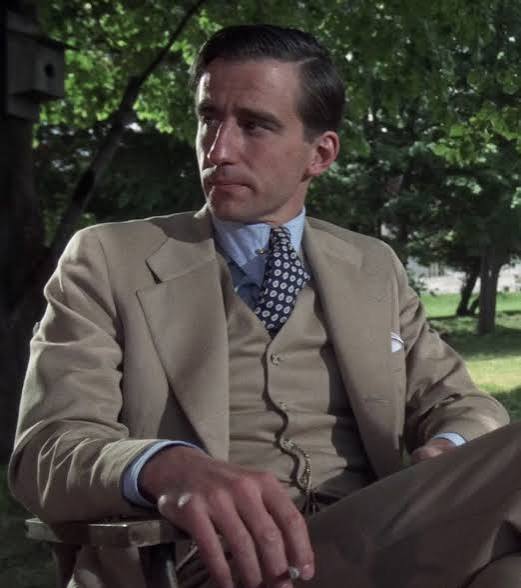
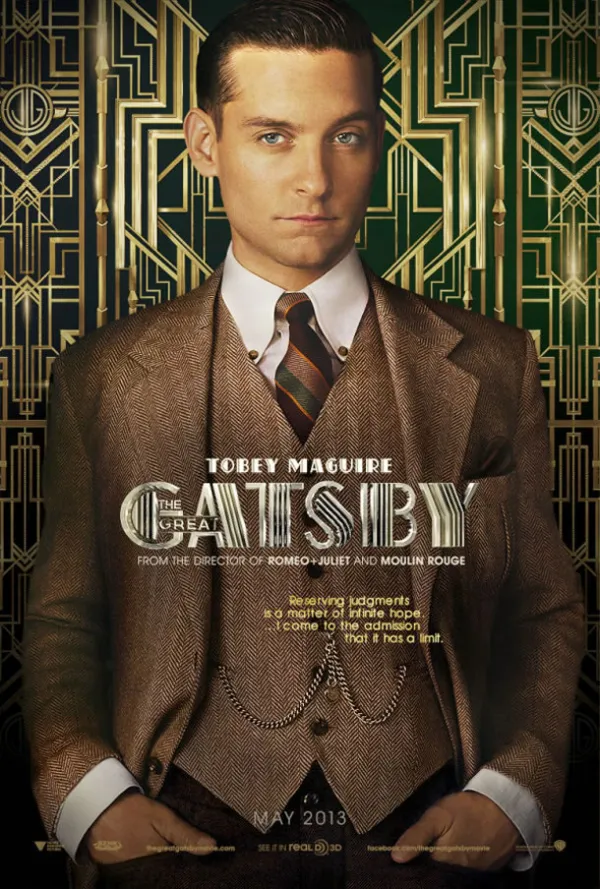
Sam Waterston as Nick Carraway in The Great Gatsby (1977)Toby Maguire as Nick Carraway in The Great Gatsby (2013)
After the Second World War, three-piece suits experienced a significant decline in popularity, transitioning from standard everyday attire to a less common, more formal choice. While the 1940s began with austerity rationing that abolished waistcoats, the post-war 1950s saw a shift toward two-piece suits, casualization, and a preference for comfort, though the three-piece remained a hallmark of conservative tailoring.
Collins offers the key reasons the three-piece suit fell out of favor:
Central Heating Made Them Less Practical – shedding layers when overheated is inconvenient
Wartime Cloth Rationing – during World War II, fabric rationing encouraged simpler clothing
Shifting Social Norms – during the Victorian Era, shirts had been considered undergarments
The Formality Factor – the full three-piece can be intimidatingly formal
The Rise of Patterns and Shirts – waistcoats cover statement pieces
Casualization and the Sport Coat – sport coats and odd jackets became popular alternatives
Three-piece suits have never disappeared altogether. Rather, they have become something of a novelty. Like bow ties, three-piece suits have an old fashioned or vintage quality. However, unlike bow ties which are still widely available at traditional clothiers, three-piece suits are a rare find. Off the rack suits – even at very Ivy Style places like J. Press, The Andover Shop, etc. – are of the two-piece variety.
About two decades ago, I bought a beautiful three-piece suit at Brooks Brothers. It was made of a heather brown Donegal tweed. The jacket was a 3/2 roll natural shoulder sack. The trousers were plain front with 1 1/4” cuffs. The waistcoat had lapels. This three-piece suit was, in a word – perfect.
Regrettably, the trousers got badly slashed, beyond repair. By the time this occurred, I could not find a way to replace them. Unsatisfied to have two pieces without the third, I eventually gave up on the suit entirely. Perhaps some day I will find another three-piece suit, just as idyllic.
Where to shop for three-piece suits? If one is open to British clothiers, options are abundant. However, if Ivy Style details like a 3/2 roll sack jacket are a requirement, the possibilities are more limited. Custom-tailoring or a vintage suit from a secondhand shop may be the best options.
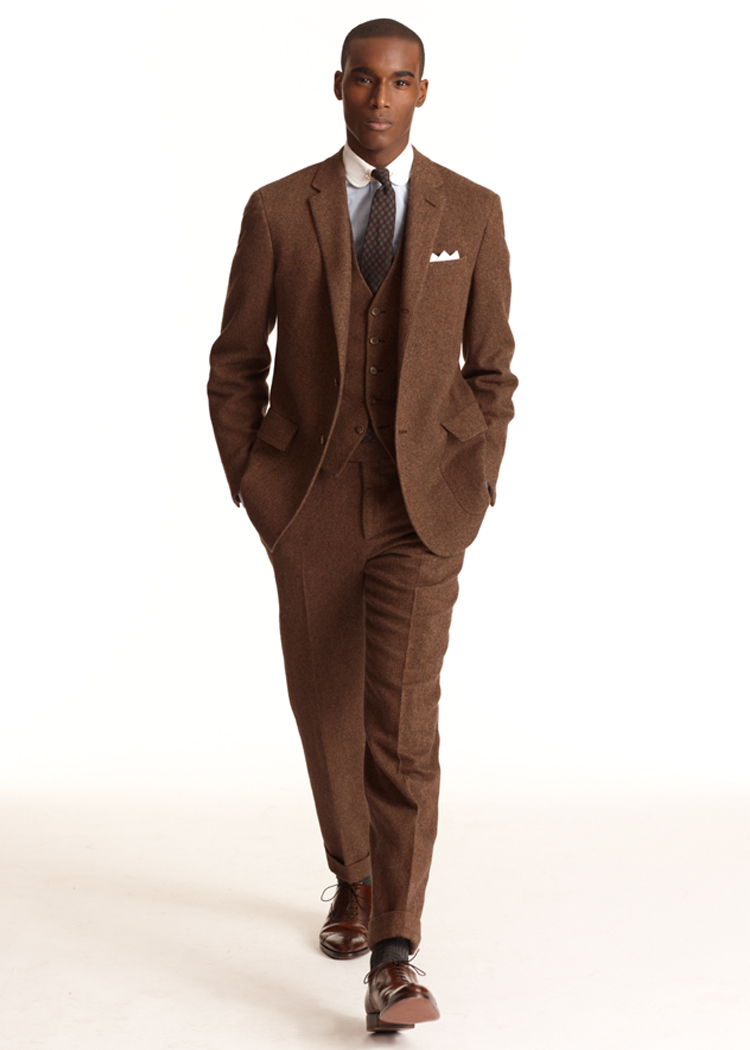
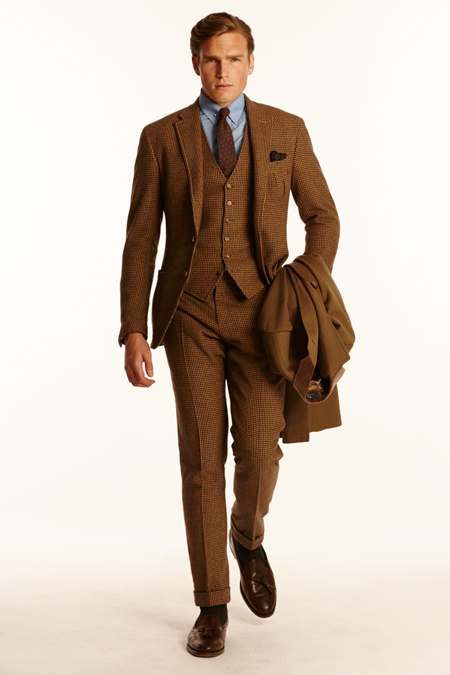
Ralph Lauren – who has done more than anyone as the keeper of the flame for traditional Anglo-American gentlemanly attire – continues to celebrate the three-piece suit, but with less frequency than in years past. Over the years, Ivy Style featured some stellar examples of suits from Ralph Lauren.
According to trend watchers in the media, we are in the midst of a revival for clothing styles popular in the past. And of course, there is the old adage that everything good eventually comes back into fashion. If these sentiments are correct, let’s hope we can bring back the three-piece suit.
I hadn’t thought of the early 1900’s as Ivy until reading this. Thanks for teaching an old dog some new tricks.
If I were to buy a three-piece, I’d get a jaunty tweed. They are old school in every way. Alas, it would be comfortable in Austin, Texas only 30 or so days a year.
A very good read! However, it’s not so easy post-Covid to find a quality 3 piece suits in Britain. High Street brands, Marks & Spencer and department stores sell suits with fused jackets. For RTW/OTR half-canvass construction at a reasonable price, I recommend Ede & Ravenscroft for business suits and Cordings for tweed suits.
Matthew: Good article, well researched. I remember my grandfather wearing Kuppenheimer suits and Florsheim shoes. I do not think he wore a vest because it got pretty hot where we lived. But even after he retired, he would get up every morning and shave, put on a shirt and tie and the pants from one of his suits. In the colder months, he would don a cardigan sweater. Then, he would sit in the living room and read the Chattanooga Times, a magazine or the Bible. He also enjoyed watching the game shows on TV. I once asked him why he wore a tie just to sit around the house. His answer was, “I might have to go out afterwhile.” My grandmother used to make beautiful white linen handkerchiefs with hand-stitched trim around the edges in various colors. My grandfather always wore one as a pocket square in his suit coat, and the trim color always complemented his tie. This would have been in the early 1950’s. Obviously, those were different times.
I apologize for not having the wherewithal to wade through this extremely lengthy post.
I will nonetheless say this: for many of us, the three-piece suit, despite its fabled history and putative merits, was ruined, irredeemably and forever, by its most unfortunate revival in the 1970s. I could not in good conscience go anywhere near one.
As dearly as I love three piece suits, especially flannel or cheviot, on chilly days, Collins’s point number six argues for the three piece suit being something outside the bounds of the Ivy phenomenon, which arrived a bit after the zenith of the three piece suit. It was what the fathers of those in the first Ivy generation wore and was pretty much what they were rebelling against, along with the starched collars in that first photo. As with most earlier generations, upon release from school and entry into the workforce, there is a tendency to become like our fathers in many respects.
When I lived in Dallas briefly in 1976, three piece suits in tropical worsted were all the rage even into triple digit days. By the late seventies that madness had begun to subside. It vanished without a trace.
Very nice article, Matthew, and the pictures are delightful. I have long loved three-piece suits, but at this point only 2 remain in my closet – a gray nailhead that I bought at the Polo Store on Madison Ave. around 2000, and a circa 1970s navy blue serge sack from Brooks, that I found on eBay. I also occasionally wear an odd vest with a suit or tweed sport coat. Admittedly, it increasingly seems like costume these days when fleece vests and low-waisted, no-iron chinos seem to be the outer limits of formality for most men.
Mr. Grant – Your grandfather sounds like my father. Do you know the song “Grandpa was a Carpenter” by the late John Prine?
Grandpa wore his suit to dinner
Nearly every day.
No particular reason,
He just dressed that way.
Brown necktie, matching vest
And both his wingtip shoes.
He built a closet on our back porch
And put a penny in a burned out fuse.
Charlottesville – Nice to hear from you again. No, I cannot honestly say I am familiar with that one. My grandfather had a depression era mentality. He was very frugal and could not stand to waste anything. If he had finished his meal and there was a roll left in the basket, he would eat it just so it would not go to waste. Like me, he was impervious to fashion. He bought good quality suits and clothes and kept them forever. He just couldn’t stand to part with them as long as they were in wearable condition. I fear that I am somewhat the same way. I wore a tie last Sunday that I bought in the fall semester of 1966. It is getting threadbare but still looks great with a blue OCBD. Looks like my Vols will be playing UVA in March Madness. May the best team win. Regards, JHG
In the Northeast red and tattersall vests are still popular around xmas time with a navy blue blazer and red corduroy or grey flannel pants. Little dresser than a sweater.
My Grandfather was a blue-collar worker. Like many men of the 1920’s and 30’s, he went to work for the railroad. Building and repairing bridges was steady work and paid well, thanks to his Union. He would work four 10-hour days, many of them quite some distance from home; he was away during the week. His uniform was overalls, denim workshirts, and heavy boots. Yet I will always remember that when he left for work, carpooling from home, and returned on Friday, he always wore a pair of wool pants, a button-down Oxford shirt, a fedora, and the above-mentioned Florsheim shoes.
Thank you for your thoughts on this, Matthew. I have two three-piece suits, one charcoal flannel, one gray/black herringbone tweed, both from J. Press. The older one, the flannel, is from the fall of 2000. The tweed is from the fall of 2014. While I wear them weekly in the winter months, it did take me awhile to settle in to them. Some suggestions: First, a contrast collar shirt or a patterned shirt helps break up the monochromatic effect of the three-piece suit. The extra visual interest from the shirt is helpful. Two of the Ralph Lauren photos that you posted illustrate this point. Second, definitely wear suspenders (braces), rather than a belt, with a three-piece suit. This prevents a belt buckle from being visible under the waistcoat, and helps reduce bulk at the waist. Just as I would match the color of my belt to my shoes, I also match the color of my leather ends of my suspenders to my shoes. I have been pleasantly surprised at how comfortable the suspenders are.
Charlottesville, I enjoy that song, too. Thank you for recalling it to me.
The circa 2010/11 PoloRL sack was the Russell (Patch / Flap). Exceptional and short lived. Nowadays PoloRL uses Ferrara (NYC) for the tailoring of their version of the natural shoulder, dartless, 3-button sack.
I have a Cordings 3 piece (plus cap/breeks) in a country tweed that I’ll be wearing in a few weeks in Scotland. I did have a dark gray pinstripe Oxxford 3 piece but it got little wear; a little too formal and warm.
I, too, have a Cordings(Firley herringbone tweed) three-piece suit.
Beautifully made, though I find rare occasion to wear it— it is exceptionally warm on its own and I find myself leaving out the waistcoat more often than not.
I think central air has narrowed the range of temperatures we find comfortable. I have a friend who starts to become uncomfortable when the temperature strays more than 10 degrees above or below 70. If I’m right (what are the odds?), that could help explain the 3-piece decline.
As a Brit, I would say wearing a 3-P suit would be incredibly challenging today.
You leave your centrally heated home, enter into your air conditioned car and end up in your office with sealed windows. There is simply no need for heavier cloths or waistcoats these days.
Even my local tailor who specialises in formal bullet-proof suits for Barristers is seeing a change in what they order.
I’ve done the 3-P Ralph look and had a lighter weight pinstripe made by them. I hardly ever wore the waistcoat.
The other item I don’t wear so often are tweed overcoats. Some 40 years ago they were essential to see you through the winter months. With climate change British winters are increasingly warmer but a lot wetter and usually start in October!
Here in New Hampshire, Old Man Winter isstill holding on. I wish I’d had my three piece tweed suit on at Mass! I had my heavy tweed overcoat over my shetland tweed odd jacket and covert cloth trousers—wishing for another later beneath in our chilly church.
What a coincidence! As I ironed a button-down collar shirt mid-afternoon for tomorrow (Monday), it occurred to me to pair it with a three-piece flannel number that I haven’t worn since December or January. Temperatures are still quite cool here (Mid-Michigan) in late March. Imagine my surprise to discover this latest Ivy Style piece during the 30 minutes or so of idle time before the evening meal.
I have a couple of flannel three-piece suits that appear several times each October-April and routinely combine odd waistcoats with tweed jackets (and one tween suit) as well as navy blazers during the same span of time. Costume in 2026? Doesn’t matter. I enjoy it. And yes, it is hard to dress presentably these days without standing out. A social faux pas I am more than willing to make.
When I began shopping at Brooks Brothers in the mid 1960’s all of the fall and winter weight suits had vests. The coats were fully cut to make ample room for the vests, and the dress shirts had no pockets. Shirt pockets are superfluous if one is wearing a vest.
J. Press broke ground with what amounted to a decisive move to/toward the two piece (jacket and pants) suit, evidenced by the innovation of the substantial flap pocketed shirt (which is pointless and even ridiculous with a vest). Note the circa late 1950s pics of the New Haven team — nary a vest to be found. That said, I own three vested suite and wear them often.
SCJ David Souter managed the dark grey and navy flannel suits (worsted flannel?) naturally — with noteworthy aplomb. A Calvinist demeanor and two Harvard degrees are a boon to the look. Otherwise it can feel costume-ish, foppish, and/or “instagram menswear dude.” All of which are TBA.
Cheers, indeed. Well done, Matthew! It appears that you are on the mend. I know that all readers wish you nothing but the very best.
Every gentleman should have at least one three-piece suit in their wardrobe. “You might very well think that…” Francis Urquhart wears it well. He deserves an honourable mention.
I am returning to the UK immediately following Easter. Cordings and Savile Row, Tally-ho!
~ Living it up authentically. With grace, style, and aplomb. ~
Some of us still wear three-piece suits (or separates), routinely.
In some ways, as the wearing of a 2pc suit and tie becomes increasingly rare, the 3pc, bow ties, etc. are comparatively less unconventional.



I hadn’t thought of the early 1900’s as Ivy until reading this. Thanks for teaching an old dog some new tricks.
If I were to buy a three-piece, I’d get a jaunty tweed. They are old school in every way. Alas, it would be comfortable in Austin, Texas only 30 or so days a year.
A very good read! However, it’s not so easy post-Covid to find a quality 3 piece suits in Britain. High Street brands, Marks & Spencer and department stores sell suits with fused jackets. For RTW/OTR half-canvass construction at a reasonable price, I recommend Ede & Ravenscroft for business suits and Cordings for tweed suits.
I second Cordings.
Matthew: Good article, well researched. I remember my grandfather wearing Kuppenheimer suits and Florsheim shoes. I do not think he wore a vest because it got pretty hot where we lived. But even after he retired, he would get up every morning and shave, put on a shirt and tie and the pants from one of his suits. In the colder months, he would don a cardigan sweater. Then, he would sit in the living room and read the Chattanooga Times, a magazine or the Bible. He also enjoyed watching the game shows on TV. I once asked him why he wore a tie just to sit around the house. His answer was, “I might have to go out afterwhile.” My grandmother used to make beautiful white linen handkerchiefs with hand-stitched trim around the edges in various colors. My grandfather always wore one as a pocket square in his suit coat, and the trim color always complemented his tie. This would have been in the early 1950’s. Obviously, those were different times.
I apologize for not having the wherewithal to wade through this extremely lengthy post.
I will nonetheless say this: for many of us, the three-piece suit, despite its fabled history and putative merits, was ruined, irredeemably and forever, by its most unfortunate revival in the 1970s. I could not in good conscience go anywhere near one.
As dearly as I love three piece suits, especially flannel or cheviot, on chilly days, Collins’s point number six argues for the three piece suit being something outside the bounds of the Ivy phenomenon, which arrived a bit after the zenith of the three piece suit. It was what the fathers of those in the first Ivy generation wore and was pretty much what they were rebelling against, along with the starched collars in that first photo. As with most earlier generations, upon release from school and entry into the workforce, there is a tendency to become like our fathers in many respects.
When I lived in Dallas briefly in 1976, three piece suits in tropical worsted were all the rage even into triple digit days. By the late seventies that madness had begun to subside. It vanished without a trace.
Very nice article, Matthew, and the pictures are delightful. I have long loved three-piece suits, but at this point only 2 remain in my closet – a gray nailhead that I bought at the Polo Store on Madison Ave. around 2000, and a circa 1970s navy blue serge sack from Brooks, that I found on eBay. I also occasionally wear an odd vest with a suit or tweed sport coat. Admittedly, it increasingly seems like costume these days when fleece vests and low-waisted, no-iron chinos seem to be the outer limits of formality for most men.
Mr. Grant – Your grandfather sounds like my father. Do you know the song “Grandpa was a Carpenter” by the late John Prine?
Grandpa wore his suit to dinner
Nearly every day.
No particular reason,
He just dressed that way.
Brown necktie, matching vest
And both his wingtip shoes.
He built a closet on our back porch
And put a penny in a burned out fuse.
Charlottesville – Nice to hear from you again. No, I cannot honestly say I am familiar with that one. My grandfather had a depression era mentality. He was very frugal and could not stand to waste anything. If he had finished his meal and there was a roll left in the basket, he would eat it just so it would not go to waste. Like me, he was impervious to fashion. He bought good quality suits and clothes and kept them forever. He just couldn’t stand to part with them as long as they were in wearable condition. I fear that I am somewhat the same way. I wore a tie last Sunday that I bought in the fall semester of 1966. It is getting threadbare but still looks great with a blue OCBD. Looks like my Vols will be playing UVA in March Madness. May the best team win. Regards, JHG
In the Northeast red and tattersall vests are still popular around xmas time with a navy blue blazer and red corduroy or grey flannel pants. Little dresser than a sweater.
My Grandfather was a blue-collar worker. Like many men of the 1920’s and 30’s, he went to work for the railroad. Building and repairing bridges was steady work and paid well, thanks to his Union. He would work four 10-hour days, many of them quite some distance from home; he was away during the week. His uniform was overalls, denim workshirts, and heavy boots. Yet I will always remember that when he left for work, carpooling from home, and returned on Friday, he always wore a pair of wool pants, a button-down Oxford shirt, a fedora, and the above-mentioned Florsheim shoes.
Thank you for your thoughts on this, Matthew. I have two three-piece suits, one charcoal flannel, one gray/black herringbone tweed, both from J. Press. The older one, the flannel, is from the fall of 2000. The tweed is from the fall of 2014. While I wear them weekly in the winter months, it did take me awhile to settle in to them. Some suggestions: First, a contrast collar shirt or a patterned shirt helps break up the monochromatic effect of the three-piece suit. The extra visual interest from the shirt is helpful. Two of the Ralph Lauren photos that you posted illustrate this point. Second, definitely wear suspenders (braces), rather than a belt, with a three-piece suit. This prevents a belt buckle from being visible under the waistcoat, and helps reduce bulk at the waist. Just as I would match the color of my belt to my shoes, I also match the color of my leather ends of my suspenders to my shoes. I have been pleasantly surprised at how comfortable the suspenders are.
Charlottesville, I enjoy that song, too. Thank you for recalling it to me.
The circa 2010/11 PoloRL sack was the Russell (Patch / Flap). Exceptional and short lived. Nowadays PoloRL uses Ferrara (NYC) for the tailoring of their version of the natural shoulder, dartless, 3-button sack.
I have a Cordings 3 piece (plus cap/breeks) in a country tweed that I’ll be wearing in a few weeks in Scotland. I did have a dark gray pinstripe Oxxford 3 piece but it got little wear; a little too formal and warm.
I, too, have a Cordings(Firley herringbone tweed) three-piece suit.
Beautifully made, though I find rare occasion to wear it— it is exceptionally warm on its own and I find myself leaving out the waistcoat more often than not.
I think central air has narrowed the range of temperatures we find comfortable. I have a friend who starts to become uncomfortable when the temperature strays more than 10 degrees above or below 70. If I’m right (what are the odds?), that could help explain the 3-piece decline.
I wore an off-the-rack grey flannel 3PS during the mid 80s winters. In those days, 40S. That didn’t last long.
I also vaguely remember a Kuppenheimer factory/store??? in town during the mid-70s.
Nice writing. Loved the article and the comments. Especially the ones about dads and grandads.
As a Brit, I would say wearing a 3-P suit would be incredibly challenging today.
You leave your centrally heated home, enter into your air conditioned car and end up in your office with sealed windows. There is simply no need for heavier cloths or waistcoats these days.
Even my local tailor who specialises in formal bullet-proof suits for Barristers is seeing a change in what they order.
I’ve done the 3-P Ralph look and had a lighter weight pinstripe made by them. I hardly ever wore the waistcoat.
The other item I don’t wear so often are tweed overcoats. Some 40 years ago they were essential to see you through the winter months. With climate change British winters are increasingly warmer but a lot wetter and usually start in October!
Here in New Hampshire, Old Man Winter isstill holding on. I wish I’d had my three piece tweed suit on at Mass! I had my heavy tweed overcoat over my shetland tweed odd jacket and covert cloth trousers—wishing for another later beneath in our chilly church.
What a coincidence! As I ironed a button-down collar shirt mid-afternoon for tomorrow (Monday), it occurred to me to pair it with a three-piece flannel number that I haven’t worn since December or January. Temperatures are still quite cool here (Mid-Michigan) in late March. Imagine my surprise to discover this latest Ivy Style piece during the 30 minutes or so of idle time before the evening meal.
I have a couple of flannel three-piece suits that appear several times each October-April and routinely combine odd waistcoats with tweed jackets (and one tween suit) as well as navy blazers during the same span of time. Costume in 2026? Doesn’t matter. I enjoy it. And yes, it is hard to dress presentably these days without standing out. A social faux pas I am more than willing to make.
Kind Sunday Evening Regards,
Heinz-Ulrich
‘Tweed’ (not tween) suit. I’m not perpetually 11 years old. Grrr.
H-U
When I began shopping at Brooks Brothers in the mid 1960’s all of the fall and winter weight suits had vests. The coats were fully cut to make ample room for the vests, and the dress shirts had no pockets. Shirt pockets are superfluous if one is wearing a vest.
J. Press broke ground with what amounted to a decisive move to/toward the two piece (jacket and pants) suit, evidenced by the innovation of the substantial flap pocketed shirt (which is pointless and even ridiculous with a vest). Note the circa late 1950s pics of the New Haven team — nary a vest to be found. That said, I own three vested suite and wear them often.
* suits
SCJ David Souter managed the dark grey and navy flannel suits (worsted flannel?) naturally — with noteworthy aplomb. A Calvinist demeanor and two Harvard degrees are a boon to the look. Otherwise it can feel costume-ish, foppish, and/or “instagram menswear dude.” All of which are TBA.
Cheers, indeed. Well done, Matthew! It appears that you are on the mend. I know that all readers wish you nothing but the very best.
Every gentleman should have at least one three-piece suit in their wardrobe. “You might very well think that…” Francis Urquhart wears it well. He deserves an honourable mention.
I am returning to the UK immediately following Easter. Cordings and Savile Row, Tally-ho!
~ Living it up authentically. With grace, style, and aplomb. ~
Some of us still wear three-piece suits (or separates), routinely.
In some ways, as the wearing of a 2pc suit and tie becomes increasingly rare, the 3pc, bow ties, etc. are comparatively less unconventional.