When I was in the U.S. Air Force during the years 1967-1971, one of my tours of duty was at Royal Air Force Chicksands, in Bedfordshire, England. RAF Chicksands was an interesting assignment. Although it was an air force base, it had no runway, no hangars, no control tower and no aircraft of any kind. Even though it was called RAF Chicksands, there were no Royal Air Force personnel. The U.S. Air Force leased the base from the British Ministry of Defense.
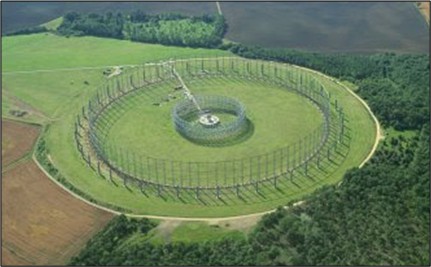
The base’s primary mission was communications intelligence. To facilitate that endeavor, Chicksands had a 440 meter diameter circular antenna array designated AN-FLR-9. We called it the “Flare-9”, but it was known locally as the “elephant cage.” (And to my knowledge, not one elephant ever escaped from that cage during my tour of duty at Chicksands.)
AN-FLR-9 Antenna, RAF Chicksands, England
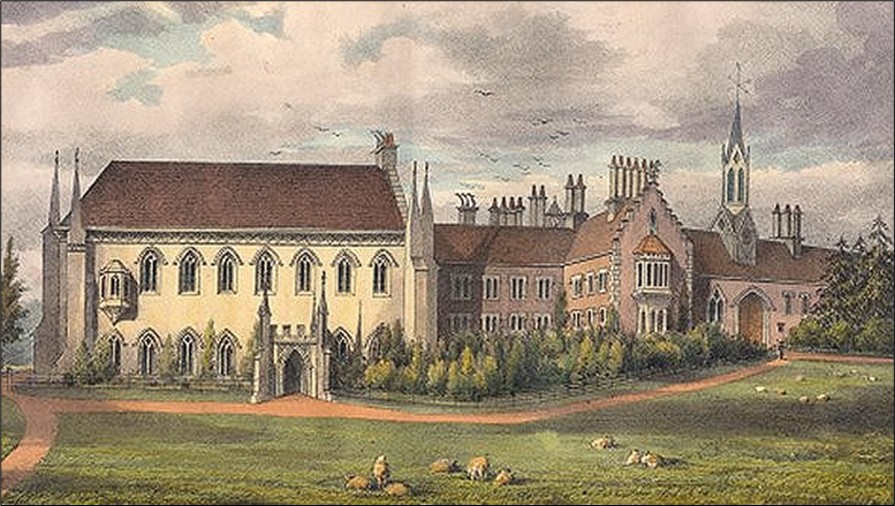
The antenna was undoubtedly the base’s most conspicuous feature, but Chicksands was also home to what remained of a significant Gilbertine priory, portions of which dated to the 12th century. The ruins of the old priory were actually enclosed within the walls of 18th and 19th century additions to the structure. But Chicksands was much older than that. It was listed as Chichisana in the Domesday Book (1086), a survey of the holdings of William the Conqueror, the first Norman King of England. During my stay at Chicksands, the old priory served as the officer’s club and bachelor officer’s quarters.
Chicksands Priory, near Shefford, Bedfordshire
A tour of duty at Chicksands was considered one of the best overseas assignments in the Air Force. And considering that my previous assignment was on the remote island of Shemya, a mere dot on a map at the far end of the Aleutian Islands, 1500 miles west of Anchorage, Alaska, RAF Chicksands was heaven on earth. (The island of Shemya was about two miles wide by four miles long. It was situated in the North Pacific Ocean, about 200 miles east of Medny, in the Komandorsky Islands of the former Soviet Union.)
Shortly after I arrived in England, I went downtown to Bedford to see if I could find a men’s clothing store that sold Cox-Moore knitwear. Cox-Moore was my “go to” brand for V-neck sweaters. I knew the company was located in Nottingham, England. A local gentleman directed me to J.&A. Beagley Ltd., which was situated near the boys’ school and the Bedford Blues Rugby Union football pitch.
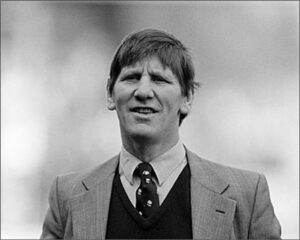
Coincidentally, the Captain of the All-England Rugby Union team, Derek “Budge” Rogers OBE (Officer of the Order of the British Empire), played for the Bedford Blues. His parents were proprietors of the King William public house in nearby Kempston, where I had occasion to visit more than once.
Derek “Budge” Rogers OBE, Bedford Blues, ca. 1975
(In Britain, there are two types of rugby football – Rugby League and Rugby Union. Rugby League is played by working class ruffians, known for their brutality and a lack of civility. Rugby Union, on the other hand, is played by gentlemen who just play like ruffians.)
When I walked into Beagley’s, an older gentleman greeted me. That was unusual. In most retail establishments in England at that time, customers were rarely greeted or even acknowledged by the staff. If you needed assistance, you usually asked for help.
The gentleman was Mr. Howes. That initial meeting turned out to be the beginning of a cordial mercantile friendship that lasted during my entire tour of duty in England. Over the course of almost three years, I ordered half a dozen Cox-Moore V-neck lambswool or cashmere sweaters (known in England as jumpers), one bespoke suit, two tweed sport coats, and an overcoat, all from Mr. Howes. That sounds like a lot of money, but I think the tweed sport coats were about the equivalent of $79.00 and a Cox-Moore lambswool V-neck sweater was about $12.00. And believe it or not, I was still wearing one or two of those sweaters well into the 1990’s.
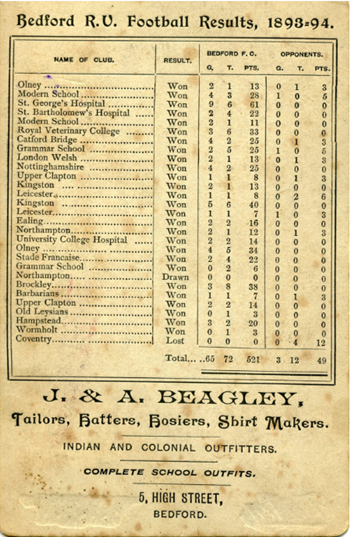
Handbill Advertisement for J.&A. Beagley Ltd., ca. 1894
Mr. Howes taught me some of the vagaries of British clothing and dress. And I showed him my favorite tweed sport coat and tried to explain the essential elements of the 3/2 sack style with no darts, natural shoulder, center hook vent, and flap pockets.
Admittedly, the tailor at Beagley’s never quite mastered the natural shoulder thing, but otherwise, the bespoke garments I ordered were top-notch. (The British tend to over-pad the shoulders, which in my view, diminishes the sloping, natural look of the Ivy League style. I guess the tailor thought my skinny shoulders needed a little beefing up.) But all in all, they did a great job. Beagley’s had a fantastic selection of fabrics, particularly Scottish tweeds.
Their shirts and ties left a lot to be desired, but all the merchandise was good quality. They represented Viyella shirts and always had a good range of tattersalls, but they did not have a size that would accommodate my 35” sleeve length. And of course, they did not have button down collars. I was not about to have bespoke shirts made when my mother could send me my standard GANT OCBD from time to time.
An old, faded advertisement from 1915 hung on the wall near the men’s overcoats:
“J & A Beagley, Tailors, Hatters, Hosiers and Gentlemen’s Mercers, Indian & Colonial Outfitters, Complete School Outfits – Christmas Presents for the Troops at the Front: Warm Socks, Woollen Wraps, Wool Jackets, Gloves, Wool Pants and Vests, Flannel Shirts, Balaclava Caps: J & A Beagley, Civil and Military Tailors, 5 High Street and 41 St. Peter’s Street, Bedford”
Mr. Howes was a nice gentleman, and I wanted to give him my custom whenever possible. Monday was his day off, so I always went to Beagley’s when he would normally be there. If he was with another customer, I waited. If the store was going to have a sale, Mr. Howes sent me a letter addressed: “Staff Serjeant J. Grant, Esq., 6950th Security Group, RAF Chicksands, nr. Shefford, Beds.” In the store, he always called me Sergeant Grant, although I told him on several occasions that he could call me James. By today’s standards, their sales were “no great shakes” – usually 5-10% off. But it’s the thought that counts – right?
Mr. Howes’ letters to me were always brief and businesslike, and signed simply “W. Howes.” I doubt that the Duke of Bedford, or his son, the Marquis of Tavistock, who were also customers of Mr. Howes, received any better service than a 24-year-old Air Force sergeant from a small rural community in southwest Virginia. On second thought, His Grace and His Lordship were probably treated with a little more deference, but I always felt like my business was important to Beagley’s and Mr. Howes treated me with the utmost respect.
During my tour of duty at RAF Chicksands, I had an opportunity to accept a temporary assignment at another U.S. base at San Vito dei Normanni, near Brindisi, in southern Italy. I was gone about four months. When I returned to England, one of my first stops was to J.&A. Beagley Ltd. Mr. Howes was happy to see me. He said he thought I might have completed my assignment in England and gone home to America. I assured him that I would not return to the states without at least saying goodbye. And as it turned out, in May 1971, Mr. Howes and Mr. Manelli, my barber, were the last two of my British acquaintances I spoke to before I left England. Several days later, I returned to McGuire Air Force Base in New Jersey, where I was honorably discharged from active duty in the service of my country.
All my dealings with Mr. Howes were conducted in a cordial, businesslike fashion. I am sure he appreciated me stopping in to bid him farewell and I am glad I did. I considered Mr. Howes a friend, although I never knew his first name.
PJC – Thanks for sending this. Frankly, I thought it was hilarious. I never saw this when I was in England. We got plenty of briefings about NOT being “Ugly Americans” and how we should behave when we went off base. Most of us knew how to behave and had English friends. We were generally well-liked in the community, especially by the local girls. One of the highlights of the year was the annual 4th of July fete. Hundreds of people from the communities around Chicksands showed up and had a good time — particularly in the beer tent. — JHG
Excellent question! Believe it or not, I was near the bottom of my class in copying Morse Code. I did great in all the other classes, but Morse just did not come easily for me. After I got to Shemya, I did well and was actually promoted to Staff Sergeant in England after only 37 months in the service. Everything worked out with the Shemya tour. The work was interesting and when it was time to pick my next assignment, I put in for Darmstadt, Germany, and RAF Chicksands. I got Chicksands, which has to be the luckiest break of my life — except for meeting my wife. James H. Grant
Very enjoyable story. I must admit that I am a bit envious that you had the opportunity to be a customer at a store with such quality products and tailoring at affordable prices. This experience is no longer available.
A 5-10% off “sale” is an indicator that the original asking price is not outrageously marked up. The menswear business today is self defeating. Not even the target market will spend full retail price for something so silly looking and poorly constructed.
Hardbopper: Good point. Much has changed in the world of merchandising & marketing in the last half century. Today, retailers generally jack up the retail prices so they can offer them at a “higher discount.” They have trained the consumer that any item less than 30-40% off is not a good value. Basically, the consumer just has to ask the time-honored question, “Is this item worth that much to me?” And the answer is either yes or no.
In 1992 after Desert Storm a small group of young officers were tasked with showing our British counterparts around town during their short tour in the US. They were very polite and much fun. So, after dinner we were smoking and joking when one of them pulled out his pack of Benson & Hedges. We traded. It was instantly noticeable that the English tobacco was clearly better. So much better tasting and so delightfully aromatic. I shopped around and the only comparable terbacky was, at the time, unfiltered Chesterfields. Shortly thereafter, they, too became unavailable.
Unfortunately, I could never secure a peacetime overseas tour.
I did manage to pick up some Irish whiskey and crystal glasses upon redeployment.





This is an interesting BBC special from 1969 about the USAF in England. https://www.youtube.com/watch?v=JJpQvE_aN_4&t=175s
PJC – Thanks for sending this. Frankly, I thought it was hilarious. I never saw this when I was in England. We got plenty of briefings about NOT being “Ugly Americans” and how we should behave when we went off base. Most of us knew how to behave and had English friends. We were generally well-liked in the community, especially by the local girls. One of the highlights of the year was the annual 4th of July fete. Hundreds of people from the communities around Chicksands showed up and had a good time — particularly in the beer tent. — JHG
Your welcome. It sounds like it was a wonderful place to be stationed.
As a USAF brat, I have to ask: What transgression got you assigned to Shemya and how did you escape to Chicksands and San Vito dei Normanni?
Excellent question! Believe it or not, I was near the bottom of my class in copying Morse Code. I did great in all the other classes, but Morse just did not come easily for me. After I got to Shemya, I did well and was actually promoted to Staff Sergeant in England after only 37 months in the service. Everything worked out with the Shemya tour. The work was interesting and when it was time to pick my next assignment, I put in for Darmstadt, Germany, and RAF Chicksands. I got Chicksands, which has to be the luckiest break of my life — except for meeting my wife. James H. Grant
Perfect.
Nice story.
Matthew,
Since comments are closed on the previous post, allow me to welcome you back here..
Every post is a dose of civilization, hence a breath of fresh air.
Thank you for sharing this light, anecdotal tale. It provided some nice imagery to my brain-box. Thank you, additionally, for your service.
Thanks, James, that was a pleasure to read.
What a lovely reminiscence, Mr. Grant. Thank you for writing it, and thank you Matthew for posting it here.
Matthew – I hope your recovery is going well.
Very enjoyable story. I must admit that I am a bit envious that you had the opportunity to be a customer at a store with such quality products and tailoring at affordable prices. This experience is no longer available.
A 5-10% off “sale” is an indicator that the original asking price is not outrageously marked up. The menswear business today is self defeating. Not even the target market will spend full retail price for something so silly looking and poorly constructed.
Hardbopper: Good point. Much has changed in the world of merchandising & marketing in the last half century. Today, retailers generally jack up the retail prices so they can offer them at a “higher discount.” They have trained the consumer that any item less than 30-40% off is not a good value. Basically, the consumer just has to ask the time-honored question, “Is this item worth that much to me?” And the answer is either yes or no.
I’ll echo previous commenters. . . A wonderful account and memory. Thank you.
Kind Regards,
H-U
In 1992 after Desert Storm a small group of young officers were tasked with showing our British counterparts around town during their short tour in the US. They were very polite and much fun. So, after dinner we were smoking and joking when one of them pulled out his pack of Benson & Hedges. We traded. It was instantly noticeable that the English tobacco was clearly better. So much better tasting and so delightfully aromatic. I shopped around and the only comparable terbacky was, at the time, unfiltered Chesterfields. Shortly thereafter, they, too became unavailable.
Unfortunately, I could never secure a peacetime overseas tour.
I did manage to pick up some Irish whiskey and crystal glasses upon redeployment.