
By James H. Grant
The following is an addendum to the article titled A Sergeant and His Clothier.
When I enlisted in the U.S. Air Force in November 1966, I knew there was a good chance that I might spend one year of my four year enlistment in the Republic of Vietnam. It did not really occur to me at that time that I might eventually be one of the 58,000+ American soldiers, sailors, airmen and marines who would lose their lives in that forlorn country.
As it turned out, the Air Force had other plans for me. Because of some proficiency I had acquired during my first assignment at Shemya Island, Alaska, and a rather focused skill set I developed as a communications intelligence operator, there was little chance I would ever be going to Vietnam.
Although the preceding memoir of my time in England has received a number of favorable comments from Ivy Style readers, I am sure there were some who considered the article self-serving, inappropriate or even trivial – particularly those approaching my age who remember with clarity the anguish and remorse caused by the conflict in Vietnam. I get that.
Why was I chosen to enjoy a wonderful tour of duty in England – shopping for sweaters at J&A Beagleys, going to the horse races at Newmarket, seeing Eric Clapton at the Royal Albert Hall, watching Manchester United play Tottenham Hotspur at old White Hart Lane, and driving my new Volkswagen to the highlands of Scotland to see the ruins of Castle Grant and tour the clan lands of my Scottish forebears?

Why did I get to have those wonderful experiences when 58,000 of my fellow countrymen – mostly young men and women before their prime – lost their lives in the war torn country of Vietnam? That is a question I have asked myself thousands of times over the last fifty-five years since I was honorably discharged from the Air Force.
There is no question that the job I was doing in England was important. Viewers of the nightly news never saw or even knew about what the National Security Agency was doing in Alaska, England, Italy or at dozens of other sites around the world. But they certainly saw the carnage which was Vietnam – the casualties, the body counts, the ambushes, the inhumane realities of war in all its horror, not to mention the protests on the campuses and in the streets of America. It was a horrible time in our country. Nevertheless, I went to work every day in a comfortable secure compound in Bedfordshire, England, protected by two chain-link fences topped with concertina wire, insulated from the outside world by armed guards who carefully inspected our security badges and briefcases as we arrived and departed each day. Hardly anyone in the United States had a clue what we were doing or why we were there?
The simple answer is this. Ho Chi Minh and the Vietnam People’s Army could ambush American patrols and rain terror on our makeshift camps and bunkers in the South. They could kill and maim with impunity and create the havoc that was dividing our country back home. But even with their stiff resolve and their incessant attacks on our troops, they did not have ICBM’s (intercontinental ballistic missiles) with nuclear warheads, which could be launched into orbit hundreds of miles above the Earth, and then brought back to attack our wonderful country at a time and place of their choosing. The Union of Soviet Socialist Republics had that capability. And that is why I was in England and my friend, Maxie Williams was hunkered down in a bunker in Vietnam.
Even still, hardly a week passes that I do not ask myself, “Why did I get to go to England?”
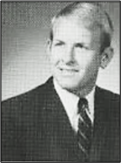
“Think where Man’s glory most begins and ends,
and say my glory was I had such friends.”
– William Butler Yeats







You should not devote an ounce of energy to justifying your assignments. Fate and the Air Force picked them, not you. Regardless of whether you decoded messages in England or spent a year with my dad at Nakhom Phanom, you served your country well and that’s all that matters.
Hooah! for your dad!
A classic case of survivor’s guilt. For a man with a functioning conscience, there is likely no real cure for it. It’s pretty clear that current events are triggering you. That’s why they do what they do. It’s called demoralization. So, don’t let the sunza be-she’s get you down.
Do what you know. Get a little physical training (PT) everyday, eat right, maintain good physical hygiene, look sharp, maintain situational awareness, do a little hard reading everyday. You may E-mail me if you’d like.
https://youtube.com/watch?v=lafPwwmRvf0
https://youtube.com/watch?v=PS5yfhPGaWE
‘Bopper: I appreciate your concern for my well-being. I really do. The Addendum to my memoir was not prompted by any specific condition or event. I am eighty years old but in good health, and sound of mind. My friend, Maxie Williams, is interred in Arlington National Cemetery because he chose to be an officer in the Marine Corps. I did my job in England because I did what the Air Force chose for me to do. And I once sat at my keyboard with my headphones on while my traffic analyst explained to Walter Mondale what I was doing and why, as the Senator looked over my right shoulder. I have no regrets about the job I did. I would gladly do it again if my country needed me – and if my wife would let me go, of course. But thanks anyway. I really appreciate your interest in my well-being.
Retired after over 21 years in the US Army, and having served multiple combat tours, I will insist that no service member who did his duty and served wherever the command thought him best suited to the mission ever has to account for or apologize for it. Thank you for your service, Sergeant Grant, and thank you for sharing “A Sergeant and His Clothier.”
Thank you both for your service.
Hoo-ah!
Every action you take has 2nd and 3rd order effects on the battlefield, and you’ll never know how many lives you have saved. You got that assignment because you were the best man for the job.