Sarah Bogart Cooney is the creator of the blog Fewer & Better and a contributing writer for Ivy Style. You can find Sarah on Substack.
This year’s Fashion Week signaled a marked resurgence of interest in preppy/trad/Ivy style, particularly notable at the J. Press Fashion Week show where all attendees were given copies of Take Ivy. What we see, however, is a marked focus on men’s style, from the ubiquitous blogging about Take Ivy to posts about how women can adopt menswear into their own wardrobe. While a great many pieces in a trad woman’s wardrobe are often directly purchased from the men’s department, there are so many pieces that are unique to women’s style. The combination of borrowed clothing and feminine staples led to a completely new and enduring all-American style: what fashion historian Rebecca Tuite calls “Seven Sisters Style.”
Women’s Ivy (or “Seven Sisters style”) has had a limited presence in the general conversation of trad and Ivy style. In contrast to the multiple books on men’s Ivy, there’s only one dedicated to women. There are endless lists and debates about men’s Ivy staples online, in magazines, books, podcasts (Articles Of Interest has a notably excellent deep dive), and newspapers. Conversely, there is no definitive guide to a women’s Ivy wardrobe. Much of the women’s Ivy conversation has been about women in menswear. While menswear is foundational to women’s Ivy, that’s not all there is. (For those interested in reading more in the women-in-menswear vein, Laura Arnold has an incredible post here, and Muffy Aldrich, published an incredible post on androgyny in trad wardrobes).
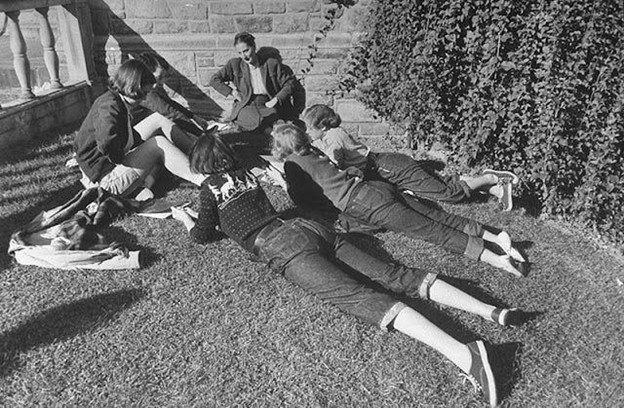
Then: Vassar students stretch out in their cuffed jeans and sweaters (including both aFair Isle sweater and a cardigan buttoned backwards, which became a popular campus trend), outside in 1950.
What I want to discuss here is what makes Seven Sisters style different. While some staples of this style can be found in the wardrobes of both men and women (the oxford key among them), there are some significant differences. Ivy Style emerged at a time when women were not allowed to enroll in Ivy League universities, but instead had their own colleges, notably, the Seven Sisters. Their education was just as rigorous–the same faculty taught the same courses at Harvard and Radcliffe, for instance–but they were not allowed full access to the same resources their male counterparts took for granted. One of my former neighbors in D.C., a Radcliffe graduate, once recounted how she managed to finagle access to the Harvard library—she became a research assistant to a Harvard student, and was thus able to use his library card to check out books for herself. She went on to become one of the leading historians in her field. (This was not unique to her–a similar situation in regards to the paucity of books in the Radcliffe Library was immortalized in that classic Ivy movie, Love Story).
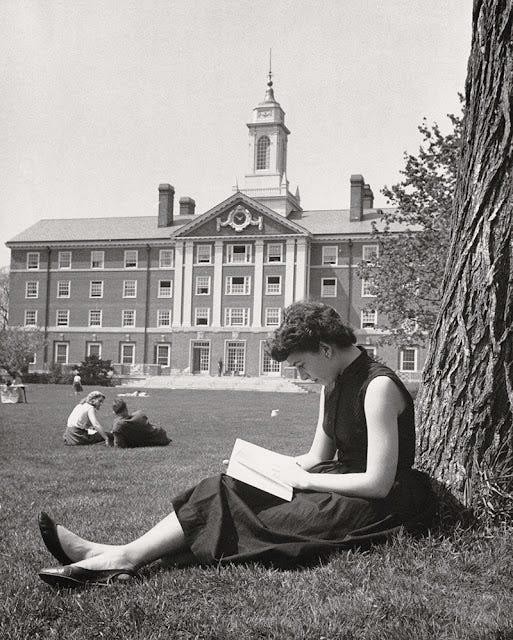
Then: Radcliffe, 1954
Now: A sleeveless shirtdress and black ballet flats are wardrobe staples in any classic wardrobe.
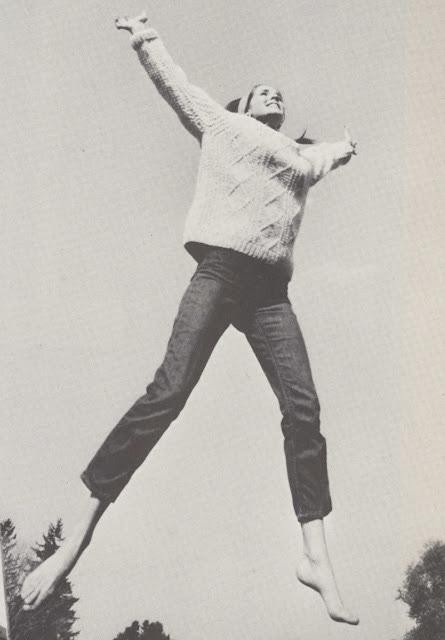
The separation between the sexes, as well as greater freedom for women in the years following World War II, contributed to a unique subculture and style. Pieces that don’t necessarily have a place in men’s Ivy–denim, for instance, and tennis shoes–were embraced by Seven Sisters style. Factory women had popularized denim and flat shoes during World War II, and without a male presence on campus, women chose to adopt comfortable clothing. They paired these new items with more traditional ones, such as sweater sets and pearls, leading to their own unique style. This style embraced the casual (denim, oversized sweaters and jackets) and the formal (twin sets, pearls), and formed that perfectly balanced look so many of us strive for in our own personal style.
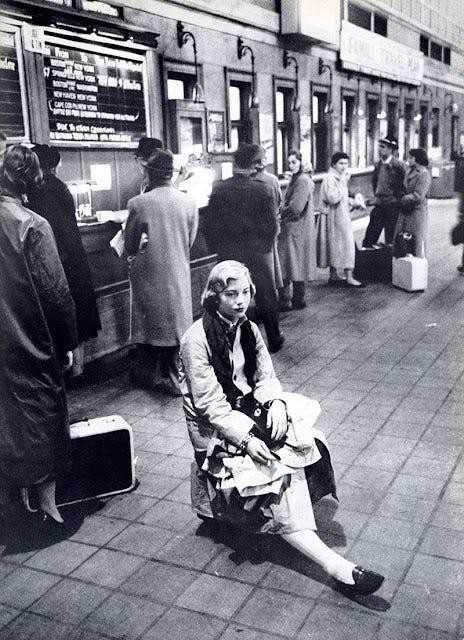
Then: A Smith College student waits for the train in the 1930s.
These silhouettes and fabrics are still desirable today–and in my opinion, just as revolutionary. Look at the vast majority of contemporary women’s clothing–it’s impractical. Trousers don’t have pockets. Shoes aren’t comfortable or made for walking. Blouses don’t button properly. It goes on and on. Women’s Ivy eschews restrictive fashion and embraces functional style. It allows the wearer to be at ease in their own skin and move through life without their clothes holding them back—without being exclusively masculine. It’s a lifestyle, not just a style of clothing. And isn’t that a wardrobe we should all aspire to?
It was so refreshing to see Ivy Style presented so realistically. Jeans, comfort, functionality, oxfords, pearls, all in one wardrobe, worn on one body. I weary of Ivy being so excessively portrayed as all flannels, blazers, tweeds, and repp ties or GTH threads.
my wife went to Wellesley 67′ and still dresses in the same style today less the Peter Pan collar with the gold circle pin. She still her her bike with the Nantucket basket with her Wellesley metal license plate with jeans, crew neck sweaters from the Andover Shop and now switched to All-Birds or running shoes. Still a GREAT LOOK
As always Sarah nice job. I have the Seven Sisters book on my Ivy bookshelf, that I learned of in one of your own earlier posts, although it is much outnumbered.
@Tim: I agree! It’s functional, practical, and inclusive–both in the sense that everyone can dress this way and you can go pretty much anywhere in this!
This a song worth singing, loud and strong. If Ivy took hold and spread far and wide, imagine how much we could do to eliminate polyester going to landfills, nearly 92 million tons annually.
I’ve always said we need more articles on women’s “Ivy” style. This was refreshing. But why the “plural singular” style in the last paragraph? Totally unnecessary. Always hurts my eyes when I come across this strange self censorship in the name of some extreme gender identity theories.
Nice piece on an overlooked subject. So many interesting deep dives might be made using this as a jumping-off place.
Were there discernible differences between the go-to-class clothes at the Sisters that were on their own (Smith, Mount Holyoke, Vassar, Wellesley), where weekday contact with “boys” was pretty unlikely, and those where daily contact with the opposite was more likely due to proximity (i.e., Radcliffe, Barnard)? How about between urban (Barnard, Radcliffe), suburban (Wellesley, Bryn Mawr) and small city/non-urban (Smith, Mount Holyoke, Vassar) Sisters?
And what was the story with respect to accessories? Pearls and circle pins, of course, but what about scarab bracelets (60s) and hinged gold bangles inherited from Grandmother? Signet rings? Tortoise shell headbands?
What costumes were worn to Ivy football games? What gowns for formal dances at Yale or Dartmouth? How about outfits for dressier events on the women’s own campuses? (Mount Holyoke, for example, had “Gracious Living” in the dorms one weekday evening per week, where students dressed up and dined by candlelight.)
And so on.
PS I don’t think that Smithie sitting on her suitcase on the floor of the train station is from the 30s. Looks more like 50s.
Not a whole lot of detail about clothes, but anyone interested in Seven Sisters culture should read The Group by Mary McCarthy (Vassar ’33) (although it begins just after graduation, so campus life has to be kind of sussed out between the lines). Also Uncommon Women and Others by Pulitzer- and Tony-winning Wendy Wasserstein (Mount Holyoke ’71), a play that does take place in the dorms. A fantastic production of it appeared on PBS’s Great Performances in the late 70s, starring Meryl Streep, Swoosie Kurtz, Jill Eikenberry.
It would not be surprising – perhaps even expected – to see a modified Ivy look in the early 1960’s among young women at northeastern schools and universities. But that style was also popular in my high school in rural southwest Virginia. There is a photo in my high school yearbook from 1963 featuring five or six girls. They were all wearing pleated skirts with knee socks and Bass Weejuns®. Some wore oxford cloth shirts, either with button-down or round Peter Pan collars. Their blouses were the same colors as the boy’s shirts – Carolina blue, maize (yellow), white, and blue and white stripes. Some also wore pink shirts, which would have been taboo for boys, even if they were available. Also popular were cotton Villager blouses with button fronts and Peter Pan collars in repeating floral motifs. Cardigan lambswool sweaters were de rigueur but some of the girls in our crowd wore V-neck sweaters. And of course, there was the ubiquitous circle pin in brass or silver. For outerwear, the preferred garment was the female version of the men’s long camel Balmacaan overcoat, or the popular London Fog raincoat in navy or tan – sometimes with a wool inner-lining for cold weather. I’m 81 years old but I remember those friends standing outside our homeroom in their Ivy-inspired outfits as if it were yesterday.



It was so refreshing to see Ivy Style presented so realistically. Jeans, comfort, functionality, oxfords, pearls, all in one wardrobe, worn on one body. I weary of Ivy being so excessively portrayed as all flannels, blazers, tweeds, and repp ties or GTH threads.
my wife went to Wellesley 67′ and still dresses in the same style today less the Peter Pan collar with the gold circle pin. She still her her bike with the Nantucket basket with her Wellesley metal license plate with jeans, crew neck sweaters from the Andover Shop and now switched to All-Birds or running shoes. Still a GREAT LOOK
As always Sarah nice job. I have the Seven Sisters book on my Ivy bookshelf, that I learned of in one of your own earlier posts, although it is much outnumbered.
Thank you, Randy! I have my copy in a box somewhere but I need to dig it out again. It’s a great one!
@Tim: I agree! It’s functional, practical, and inclusive–both in the sense that everyone can dress this way and you can go pretty much anywhere in this!
This a song worth singing, loud and strong. If Ivy took hold and spread far and wide, imagine how much we could do to eliminate polyester going to landfills, nearly 92 million tons annually.
@Sandy: It is a great look!
I’ve always said we need more articles on women’s “Ivy” style. This was refreshing. But why the “plural singular” style in the last paragraph? Totally unnecessary. Always hurts my eyes when I come across this strange self censorship in the name of some extreme gender identity theories.
I just like the helpful information you provide in your articles.
I was particularly inspired by the Then and Now photos chosen for this article, timeless classics that endure.
Nice piece on an overlooked subject. So many interesting deep dives might be made using this as a jumping-off place.
Were there discernible differences between the go-to-class clothes at the Sisters that were on their own (Smith, Mount Holyoke, Vassar, Wellesley), where weekday contact with “boys” was pretty unlikely, and those where daily contact with the opposite was more likely due to proximity (i.e., Radcliffe, Barnard)? How about between urban (Barnard, Radcliffe), suburban (Wellesley, Bryn Mawr) and small city/non-urban (Smith, Mount Holyoke, Vassar) Sisters?
And what was the story with respect to accessories? Pearls and circle pins, of course, but what about scarab bracelets (60s) and hinged gold bangles inherited from Grandmother? Signet rings? Tortoise shell headbands?
What costumes were worn to Ivy football games? What gowns for formal dances at Yale or Dartmouth? How about outfits for dressier events on the women’s own campuses? (Mount Holyoke, for example, had “Gracious Living” in the dorms one weekday evening per week, where students dressed up and dined by candlelight.)
And so on.
PS I don’t think that Smithie sitting on her suitcase on the floor of the train station is from the 30s. Looks more like 50s.
Not a whole lot of detail about clothes, but anyone interested in Seven Sisters culture should read The Group by Mary McCarthy (Vassar ’33) (although it begins just after graduation, so campus life has to be kind of sussed out between the lines). Also Uncommon Women and Others by Pulitzer- and Tony-winning Wendy Wasserstein (Mount Holyoke ’71), a play that does take place in the dorms. A fantastic production of it appeared on PBS’s Great Performances in the late 70s, starring Meryl Streep, Swoosie Kurtz, Jill Eikenberry.
It would not be surprising – perhaps even expected – to see a modified Ivy look in the early 1960’s among young women at northeastern schools and universities. But that style was also popular in my high school in rural southwest Virginia. There is a photo in my high school yearbook from 1963 featuring five or six girls. They were all wearing pleated skirts with knee socks and Bass Weejuns®. Some wore oxford cloth shirts, either with button-down or round Peter Pan collars. Their blouses were the same colors as the boy’s shirts – Carolina blue, maize (yellow), white, and blue and white stripes. Some also wore pink shirts, which would have been taboo for boys, even if they were available. Also popular were cotton Villager blouses with button fronts and Peter Pan collars in repeating floral motifs. Cardigan lambswool sweaters were de rigueur but some of the girls in our crowd wore V-neck sweaters. And of course, there was the ubiquitous circle pin in brass or silver. For outerwear, the preferred garment was the female version of the men’s long camel Balmacaan overcoat, or the popular London Fog raincoat in navy or tan – sometimes with a wool inner-lining for cold weather. I’m 81 years old but I remember those friends standing outside our homeroom in their Ivy-inspired outfits as if it were yesterday.
Definitely worth more coverage, that time and place of US women’s wear.