

By Matthew Longcore
Memorial Day this year will hopefully mark the end of a long cold rainy spring here in New England that followed a bleak and bitterly cold winter. I could start wearing white ducks with white bucks, but I’m not quite ready. It’s still too cold, the grass is wet, and the ground is muddy.

Wearing white only between Memorial Day and Labor Day, the traditional bookends of an American summer, is a long standing tradition for many of us. Although some of us believe that permission for white clothing extends as far back as Easter, most who follow this tradition agree that Memorial Day is the starting point. In any event, waiting to wear white is a uniquely American practice. You will not find an Englishman worrying over this; although he might not want to wear white on a damp, cold day in May for the same reasons I don’t – it doesn’t feel comfortable.

Though the origins of this tradition are obscure, it is often attributed to a practice once belonging to the upper class which has now become egalitarian thanks to 20th century washing machines and dry cleaners. Historically, the upper class could afford to wear white because they had all kinds of servants literally doing their dirty work. White is almost impossible to keep clean, but it’s also cool and comfortable.

Looking back at the 19th century (no one knows precisely when the tradition began), there was no air conditioning, so wearing white and other neutral or pastel colors, especially in a lightweight fabric such as linen, was desirable on hot summer days – as long as you didn’t bear the responsibility of cleaning your own clothing. Picture a Gilded Age robber baron heading to his 100,000 square foot “cottage” on Bellevue Avenue in Newport, exchanging his heavy tweeds for a white linen suit to be maintained by his valet – who would not have the luxury of wearing white at that time.

Seersucker and madras are also cool fabrics and staples of Ivy Style. Both originated in countries where temperatures routinely soar. According to The Historic New Orleans Collection, the city claims resident Joseph Haspel, Sr. as the inventor of seersucker. But they quickly debunk their own myth with the correct information as to its origins:
Seersucker fabric has been around for centuries. Its name comes from the Persian phrase shir-o-shakhar, meaning “milk and sugar” for the alternating textures. The textile is made of cotton, linen, or silk (or combinations thereof), woven on a loom with threads at different tensions. As the fabric is woven through the tight and loose threads, it creates alternating stripes of texture. These smooth and puckered stripes are what make the fabric especially breathable, because it doesn’t lay flat against one’s skin.

Mr. Joseph Haspel Sr., however, successfully manufactured and sold seersucker suits at Haspel Refreshable Clothes, his establishment on Toulouse Street, beginning in 1909. Seersucker is easy to wash and, of course, requires no ironing. There is an earlier Ivy Style article showing photos of Mr. Haspel plunging into the Atlantic wearing one of his drip dry suits in 1946. Yes, he really wore the same suit for dinner that night. You can still purchase a seersucker suit from Haspel made in their New Orleans facility. And in case you are wondering, National Seersucker Day is coming up on Thursday, June 12, 2025.

For a brief history of madras, check out my article last summer featuring madras sport coats at the Harriman Cup. Madras came to America from India via England. BBC.com has an interesting article written by Kalpana Sunder about the definition and meaning of madras. As I pointed out in my article, traditional checked madras is still woven in India in the city of Chennai. Sunder adds that for centuries the people in the “sleepy fishing village of Madrasapattinam (later called Madras, and now a major city called Chennai) wore a muslin fabric hand-woven in a rainbow of checks, as lungis (like sarongs) that were suited to the hot and humid weather of South India.”

The Official Preppy Handbook remains an indispensable guide to good taste. Despite being written as social satire, the book is spot-on when it comes to clothing, and there are several references to white summer attire. Here are a few:
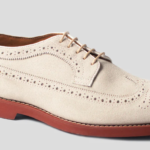
White bucks. Classic oxford style only, please. White suedes (“buckskin”) with brick-red crepe sole. Strictly a late-spring and summer shoe. Appropriate for garden parties. Use a chalk bag, if a touch up is necessary. (TOPH, 139)
White ducks. For lawn parties. Worn with summer jackets, tennis sweaters, and/or white bucks. Popular on deck. Keep them meticulously clean. (TOPH, 142)
Tennis whites. The color revolution in tennis wear has not hit the Prep world. The shorts are old, and all cotton. The shirt is a Lacoste or similar cotton jersey. The shoes are Tretorns or Top-Sider canvas sneakers, worn with socks. The sweatband is optional. Everything is white. (TOPH, 147)
Tennis pullover. V-neck, cable-knit sweater in cream-colored wool with navy-and-maroon stripes around cuffs, waist, and neckline. Smashing with white flannel trousers, it is also the one sweater that looks well with shorts. For men and women. (TOPH, 137)

Cool white linen and cotton, pale seersucker, and colorful madras are all great choices for a traditional Ivy Style summer wardrobe. Is wearing white only between the traditional bookends of summer, Memorial Day and Labor Day, still the rule for you or do you think it can be modified, or perhaps even ignored? Is limiting seersucker and madras to summer months still a requisite for maintaining Ivy Style or can you stray? And can you break one rule without breaking them all?







I start wearing linen and seersucker when the forecast high temperature clears 90. We typically see those temps mid-May through late September or early October in Austin. As I type this at 4:37 our time, it’s 97 and the feels like is 104. Yippee.
I live in Vero Beach ,Florida. so you can get away with wearing white all year round . Besides Haspel another clothing manufacture made the seersucker coat and suit and also Corbin. Just like linen the more wrinkled the better.
I got busy at the end of April and swapped out all of my cooler weather casual and dressier gear for warm weather attire, foolishly thinking that May would be warm enough here in mid-Michigan. To the contrary, the last three weeks+ have been delightfully chilly and wet here too, so that decision was a bit premature. Hopefully, early June will be warm enough for Madras and seersucker attire to be comfortable?
Kind Regards,
H-U
Regarding “can you break one rule without breaking them all?”
The pius St. Thomas Aquinas tells us that if one rejects even a single article of faith, he does not have faith.
Something to think about.
I live in Santa Fe. Wearing pants is considered dressing up. That being said, I will be wearing white RL chinos and Early 90s RL Madras jacket to Mass tomorrow. Rarely hits above 80- 85 in the summer here. Call me lucky.
It happens so that in NYC hot weather pretty much coincides with the “bookends”: Memorial Day and Labor Day, although September and even early October are still very warm and don’t feel like Autumn at all. My personal “rule” is that quintessentially summer fabrics, such as seersucker, madras, or 100% linen in light colors (navy is an exception) are to be worn MD to LB only. Light colored khakis, jackets made of linen and wool or linen and silk mix, and polo shirts can be worn until mid October (around Columbus Day). Speaking of pure white, I don’t even have any clothing in pure white except dress shirts of course.
Wishing everyone a pleasant summer!
A few years ago I relinquished (gave away) my white oxfords shirts, persuaded that ecru was/is the better option. Nowadays I much prefer it to white. Some persevere in referring to this particular shade as “cricket white,” as seen here:
https://foxflannel.com/products/classic-flannel-plain-cricket-white
Forgot to mention in my post yesterday that Palm Beach and Deansgate made great poplin and seersucker suits before they went out of business
While this column is not about shirts, I will add that when my company went tieless 🙁 I stopped buying white shirts, thinking they would just get dingy with little wear. Kept two for work trips to DC. Missed getting a Mercer creme version before they stopped making the color, but got 2 new BB ecru (like SE above) on ebay. No white pants in the closet and notice that the new release of white chinos from Donnelly’s are terribly see-through. Seersucker is the best but little opp to wear my suit now living in the West. Still think there is nothing like a crisp white dress shirt.
You have it right, Matthew. If the calendar, the occasion, and the weather agree, one is free, encouraged, to wear white. Concerning Easter, I like to wear a pale yellow, BB Audubon necktie, over a pink and white U-stripe oxford, whereas a white jacket, shoes, or trousers might be considered a bit too sporty for the occasion. If one is in a tropical climate, then sure, the weather and the occasion trump the calendar.
Here in the deep South,we start wearing white at Easter.
In my experience, the first day for seersucker (and related fabrics and colors) varies by region. While the northeast, as far south as Washington, DC, still adheres to Memorial Day to Labor Day, outside this region the bookends fluctuate by weather and custom. In Louisville, the running of the Kentucky Oaks (the day before the Derby) marks the beginning. In Richmond, the first Wednesday in May (the Westhampton Civic Association cocktail party) is the start. Further south (Savannah, Mobile, etc.), Easter is clearly the first. Sometimes, one sees relatives from the further south visiting their relatives in Virginia at Easter, and the guests are notable for wearing seersucker ahead of the local custom. As for the end date, again, I’ve seen it to be highly variable by region. Weather permitting (and it often does), one can see orange and white seersucker trousers at home games in Knoxville well into October. A thoughtful Memorial Day and happy summer to all of you.
I still keep to the Memorial Day through Labor Day rule, as noted here: https://www.ivy-style.com/it-happens-every-spring.html . Seersucker suits and sport coats (with a white shirt), poplin suits, cream linen trousers, white ducks, and occasionally white bucks are all in the rotation this time of year. A blue chambray sport coat and one in an off-white linen blend from J. Press are also favorites. Unfortunately today it is rainy with temps in the low 60s, so none of that feels especially appropriate today.
If one is south of the equator, I suppose the math might get complicated.
Looking at the weather forecast is far easier for me than math. I am very math-challenged. I’ve never gotten over the idea of only one right answer.
Here in my northern state (bordering Canada), I observe the Memorial Day to Labor Day timeline, with one exception. Yacht club events approaching the first weekend in May sometimes specify “summer club uniform,” which includes white trousers (or skirt) and white shoes, a navy blazer with club patch, white shirt, and navy tie. Of course you don’t wear that sort of thing around town.