Like migratory birds, they arrive every spring. The legs of the males are pale tan, the torso is a dark blue. They congregate all summer, and while some remain year-round, many will retreat when the leaves turn colors.
I’m talking about American men dressed in khakis and navy blazers. They’re staples at weddings and church services, and stalk offices that are still formal enough for a “casual Friday” dress code. As a historian, I see them when they flood the summer academic conferences in a sea of attire I call the “semiformal humanities.”
In the summer, this look might be worn with a white polo shirt and casual loafers. In the fall, button-down shirts and neckties return, joined by oxfords and sweaters as the weather turns cold. Eventually, the tan cotton khakis are replaced with charcoal wool slacks for the winter, only to return in the spring.
But why, out of all possible color combinations, does the American man gravitate to blue blazers and khaki pants? It turns out, this style has its roots in the American Revolution, a fashion that united the nation.
Of all the achievements history has attributed to George Washington, it’s remarkable that he hasn’t yet been credited for his fashion sense, since the two most long-lasting styles in modern menswear can be attributed to him.
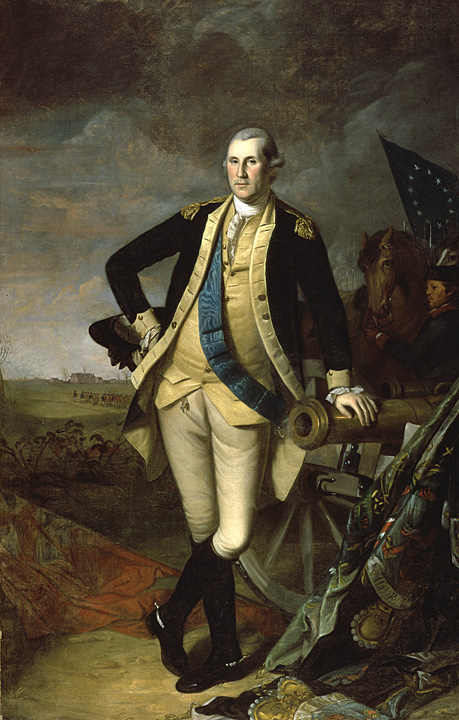
As a young provincial officer in the British Army during the French and Indian War, Washington wore a blue coat with red facings, which he donned for a later portrait by Charles Willson Peale. This blue coat was a reminder of his resentment over being denied a full commission from the crown. When he couldn’t wear the proper red coat of a British officer, he also didn’t receive their status, recognition, or paycheck.
“George Washington at Princeton” by Charles Willson Peale originally hung in the State House (now Independence Hall), but eventually came to hang in Peale’s Museum, and later the Academy.
Repeatedly passed over for promotions and snubbed by British-born officers for being unsophisticated, Washington fumed over being treated like a second-class citizen. In 1757, he complained in a letter to his commander Robert Dinwiddie, “We cant conceive, that being Americans shoud deprive us of the benefits of British Subjects.” Frustrated, he resigned his commission the following year.
In July 1774, Washington and fellow Virginia planter George Mason drafted the Fairfax County Resolves, a radical statement of constitutional rights and rejection of Parliament’s authority over the colonies. Later that September, they founded the Fairfax Independent Company, a volunteer militia to enforce the principles of the resolves.
Washington still considered himself a loyal subject of the British crown, though staunchly opposed to the treatment the colonies were receiving under the Tory regime and its prime minister Frederick, Lord North. When it came time to choose uniform colors for the new company, Washington picked buff and blue because they were the colors of the Whigs, the British political party that opposed the Tories.
Buff and Blue: The Colors of the Whigs
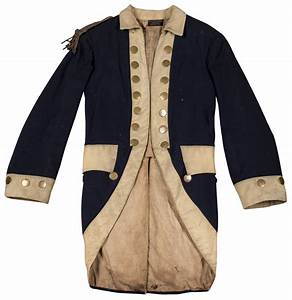
Washington and Mason decreed the company would “meet at such Times & Places in this County … dress’d in a regular Uniform of Blue, turn’d up with Buff; with plain yellow metal buttons, Buff Waist Coat & Breeches, & white Stockings.”
In April 1775, less than a year after Washington announced the Fairfax resolves, skirmishes between colonial militia and the British army at Lexington and Concord in Massachusetts ignited the American Revolutionary War. In May, when Washington set off for Philadelphia to attend the Second Continental Congress, he wore his buff and blue uniform.
When the delegates chose Washington as commander in chief for the new Continental Army, he kept his own uniform design, which he wore for the remainder of the war.
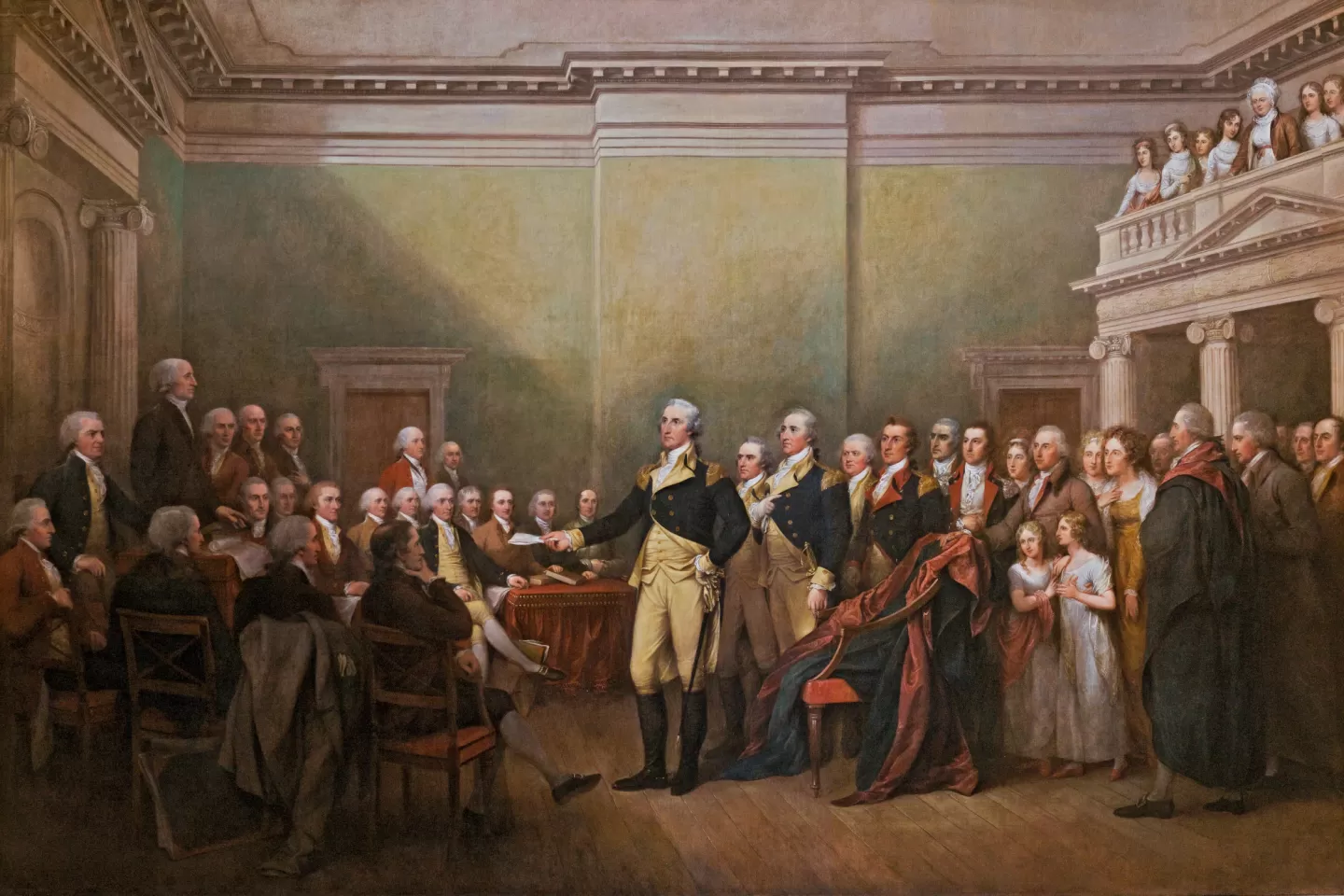
Washington’s military portraits showcase this uniform, including “General George Washington Resigning His Commission,” the painting by John Trumbull that has hung in the U.S. Capitol Rotunda since 1824. Washington stands center; the two men behind him, Cols. Benjamin Walker and David Humphries, are dressed in the same style of uniform, adopted by his aides de-camp to visually align themselves with the general.
“General George Washington Resigning His Commission” by John Trumbull is on display in the Rotunda of the U.S. Capitol.
In this painting, Trumbull also depicted men wearing buff and blue in civilian dress, referencing Washington’s uniform.
The French also associated buff and blue with Americans and democracy. On July 12, 1789, two days before the storming of the Bastille, French journalist Camille Desmoulins leaped onto a table in the garden of the Palais Royal, urged the crowd to take up arms and coaxed them to adopt cockades as a symbol of their own revolution. He asked the crowd if they would prefer “green, the color of hope,” or the “blue of Cincinnatus,” referring to Washington; the color by then was understood to be a symbol of American liberty and democracy. Washington had turned a color of politics and diplomacy into a campaign for freedom.
Perhaps one reason that khaki pants and navy blazers are still so popular among Americans is that it subtly conjures a simpler time before politics were splintered into parties, when we were united behind the cause of the buff and blue.
This summer, when the nation hosts barbecues in honor of the country’s 250th anniversary, Americans can raise their light beers, hot dogs and strawberry shortcakes to George Washington. He leaves behind a complicated legacy, but got many things right. He prioritized America’s welfare over his personal interests. He warned against the dangers of political factions. And he cautioned the country to maintain a limit on executive power. Between his character and his costume, Washington was more than a Founding Father — he was America’s first fashion icon.
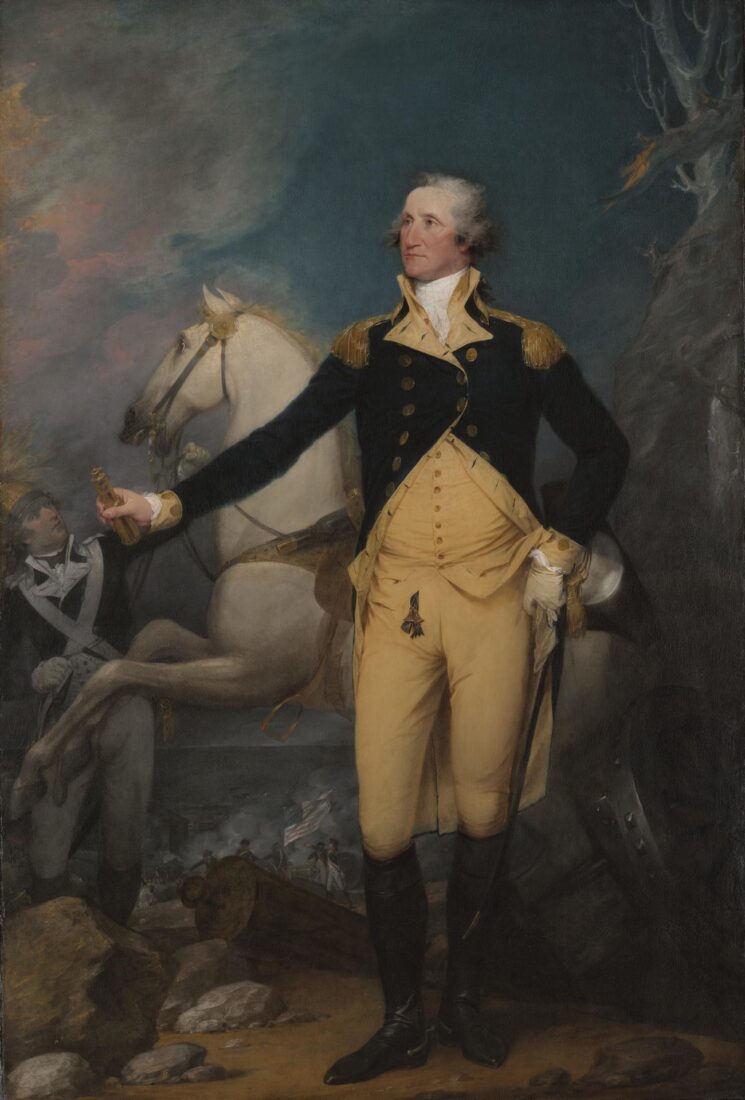
“General George Washington at Trenton” by John Trumbull, Society of the Cincinnati, 1806 at the Yale University Art Gallery, New Haven, Connecticut.
What better fashion example to follow than our founding father, George Washington? Also, he found the blue and buff in the correct locations, the blue jacket and buff trousers.
I agree completely. George Washington is a role model in all matters, from personal conduct to sartorial standards. Here is an excellent article about the blue and the buff:
The Washington family saga in America begins with the son of a relatively poor Anglican clergyman and Oxford don who, savvy and charming, married into a wealthy family (Twigdens). A rebellious act, to be sure, since dons were not permitted to court and marry. The Puritans, ascending in power, took aim: George Washington’s paternal great, great grandfather Lawrence was found guilty of “being a common frequenter of ale houses” who “encouraged others in that beastly vice.” His benefice was withdrawn and he was dismissed from that call (parish) in shame, judged harshly for drunkenness and sloth. He served as the rector of a tiny, impoverished parish in Essex. Too poor to financially support his wife and children, they stayed taken in by another family. He died alone and impoverished, the Washington family name besmirched.
Ah, but one of Lawrence’s sons, estranged from his father, was enterprising. John, left with nothing but debt(s), sought an apprenticeship in London — a tobacco merchant. He dropped out of school and managed to secure a (lowly) job as a “master’s mate.” He boarded a tobacco ship that departed for … Virginia.
The rest, as they say, his history. How amusing — what we learn as we excavate the backgrounds of patricians and “gentlemen.”
addendum: The aforementioned Lawrence’s grandson Lawrence (son of John) died young — age 38. His widow Mildred Warner Washington married a fellow named George Gale. Gale moved the family to England — and promptly died. Following Mildred’s death, Lawrence’s cousin (another John) petitioned for custody of the children. So, they returned to Virginia (Chotank Creek). A savvy business decision by John, since this resulted in his ownership (by transfer) of all the land and property the three children, including George Washington’s grandfather, had inherited.
I always found those uniforms to be beautiful in their simplicity (when compared to many other uniforms of the time) and I also always noticed the similarities between those uniforms and the quintessential American style of a navy blazer with brass buttons and khaki trousers. The buff color seen on the paintings is a perfect color for a pair of trousers to be worn with a dark blue coat. I believe Brooks Brothers sells pants in a similar color. Spier and Mackay sell pants in dozens of colors and this shade of buff is also usually offered.
I had never connected Washington’s uniform to today’s trad kit. That is beyond cool. And telling. I might never wear gray slacks with a blue blazer again.
Returning to the article: excellent and thanks. These days I opt for versions of “the blue and the buff” at least four days of any given week. The bolder the weave and stitching, the better (within reason).





What better fashion example to follow than our founding father, George Washington? Also, he found the blue and buff in the correct locations, the blue jacket and buff trousers.
I agree completely. George Washington is a role model in all matters, from personal conduct to sartorial standards. Here is an excellent article about the blue and the buff:
https://arlingtonhistorical.com/items/show/350
The Washington family saga in America begins with the son of a relatively poor Anglican clergyman and Oxford don who, savvy and charming, married into a wealthy family (Twigdens). A rebellious act, to be sure, since dons were not permitted to court and marry. The Puritans, ascending in power, took aim: George Washington’s paternal great, great grandfather Lawrence was found guilty of “being a common frequenter of ale houses” who “encouraged others in that beastly vice.” His benefice was withdrawn and he was dismissed from that call (parish) in shame, judged harshly for drunkenness and sloth. He served as the rector of a tiny, impoverished parish in Essex. Too poor to financially support his wife and children, they stayed taken in by another family. He died alone and impoverished, the Washington family name besmirched.
Ah, but one of Lawrence’s sons, estranged from his father, was enterprising. John, left with nothing but debt(s), sought an apprenticeship in London — a tobacco merchant. He dropped out of school and managed to secure a (lowly) job as a “master’s mate.” He boarded a tobacco ship that departed for … Virginia.
The rest, as they say, his history. How amusing — what we learn as we excavate the backgrounds of patricians and “gentlemen.”
addendum: The aforementioned Lawrence’s grandson Lawrence (son of John) died young — age 38. His widow Mildred Warner Washington married a fellow named George Gale. Gale moved the family to England — and promptly died. Following Mildred’s death, Lawrence’s cousin (another John) petitioned for custody of the children. So, they returned to Virginia (Chotank Creek). A savvy business decision by John, since this resulted in his ownership (by transfer) of all the land and property the three children, including George Washington’s grandfather, had inherited.
This is a professional and thoughtful exposition that advances the conversation in a constructive and insightful direction.
I always found those uniforms to be beautiful in their simplicity (when compared to many other uniforms of the time) and I also always noticed the similarities between those uniforms and the quintessential American style of a navy blazer with brass buttons and khaki trousers. The buff color seen on the paintings is a perfect color for a pair of trousers to be worn with a dark blue coat. I believe Brooks Brothers sells pants in a similar color. Spier and Mackay sell pants in dozens of colors and this shade of buff is also usually offered.
I had never connected Washington’s uniform to today’s trad kit. That is beyond cool. And telling. I might never wear gray slacks with a blue blazer again.
PS I need to buy a new blue blazer.
PSS Is the sash in the Princeton photo Ivy?
Returning to the article: excellent and thanks. These days I opt for versions of “the blue and the buff” at least four days of any given week. The bolder the weave and stitching, the better (within reason).
Not buff,
but stone,
https://oconnellsclothing.com/oconnells-plain-front-wool-lightweight-gabardine-trousers-stone-55499249-270.html
Crème,
https://oconnellsclothing.com/oconnells-plain-front-8-wale-corduroy-trouser-cream-m57129289-275-530-1091.html
Oyster,
https://oconnellsclothing.com/oconnells-khakis-plain-front-cotton-twill-trousers-oyster-9032oc-55-oyster-plain.html
Almond,
https://oconnellsclothing.com/oconnells-plain-front-wool-gabardine-trousers-almond-gab-trs-almond.html