
By Matthew Longcore
As a lifelong sailor, certain clothing items have been wardrobe staples for my entire life. Boat shoes (both leather and canvas versions), foul-weather gear, Norwegian sweaters, Breton red trousers, Guernsey jumpers. Sailors spend so much time on the water that these items invariably become part of our everyday wardrobe.


Sebago is one of those brands that sailors know well. Alongside with their equally well-known rival – Sperry – you can count on seeing your fellow sailors in Sebago shoes at any yacht club outing. These brands are what we now refer to as “heritage brands.” They are brands that stand the test of time. We wore them in yesteryear and we will wear them going forward. They never go out of style. Sebago Docksides – the brand’s answer to Sperry Topsiders – are a classic.

Appropriately, as of late, Sebago has been collaborating with other heritage brands.
J. Press pays homage to their collaboration with Sebago by referencing how both are mentioned in The Official Preppy Handbook.
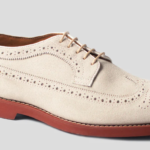
Founded in 1946, and featured — alongside J. Press — in The Official Preppy Handbook in 1980, Sebago is known for its boat shoes, bluchers, bucks, mocs, penny loafers, longwings, and more.

Sebago also teamed up with renowned American yachtsman Gary Jobson, the winner of the America’s Cup in 1977, on an updated version of its boat shoe.
The Portland Gary Jobson is more than a shoe—it’s a tribute to freedom, heritage, and life on the water. Originally crafted in the 1980s to honor the legendary American sailor, this reimagined classic carries forward the spirit of adventure with a sleek, modern edge.

These collaborations are a lot of fun and they appeal to the deeply nostalgic element of nautical style.
For me, the best collab to come around in a while is the one between Sebago and St Johns.

The synergy between these two brands starts with the fact that both were founded in 1946. Both brands are rooted in a love of the sea.
Sebago began in Maine, while St. Johns originated on the island of St Thomas in the U.S. Virgin Islands. Three New Englanders – Daniel J. Wellehan Sr., William Beaudoin, and Joseph Cordeau – founded Sebago, which takes its name from the second largest lake in Maine. St Johns was founded by John Webb of Minneapolis, a U.S. Naval Officer stationed in St Thomas during World War II.

The Sebago x St. Johns collaboration features a collection of personal care and lifestyle products, including fragrances, deodorant, soaps, and travel sprays in two signature scents: Bay Rum and Vetiver. Bay Rum is the more iconic of the two, based on a blend of rum with local bay leaves and other aromatic spices. Vetiver is the newer fragrance, a fresh scent based on sweet-scented grass native to India and also found in the Caribbean.

I personally like Vetiver the most. In the summer months, I enjoy Madras from St Johns, but when the weather cools down I switch over to Vetiver for the time sailors call “the off-season.” It retains that nautical charm but somehow feels right at home on a winter day drinking a glass of red wine by the fireplace.

My favorite item from the collection is the Sebago X St Johns Nautical Cap, a stylish design perfect for sailors and landlubbers alike.







I have used St. John’s since the sixties, and although I was a Sperry kudu guy, I always admired Sebago, too. However, the development of heritage brand collaborations is unsettling to me. If the collaboration truly makes sense and involves brands with similar ethos, it may be worth considering, but if either brand is comfort zone adjacent or more distant, either or both brands may be putting themselves at risk. If, as seems to be the case here, it is a matter of serving significantly overlapping market niches, there may be an incremental enlargement of the pool of interested buyers, but if both were already well known heritage brands, the odds are that the potential buyer was already aware of both, and the first logical question is whether adding a familiar name on a label I already support, makes me think I ought to try this. Given how negatively hide bound Ivyistas such as myself react to logos, the inclusion of a new label would really need to add something I wanted, or I might worry that my beloved brand was straying from its roots. I hope the author or other commenters can flesh out what adding Sebago on the label adds, other than evoking a few memories.
While I generally agree that showing off logos (especially large and obnoxious logos) contradicts the understated ethos of Ivy style, I also think that the these two brands have tasteful logos which I would be proud to display. The logos are burgees, which are symbolic of affinity with seafaring activities. All in all, this particular collaboration is synergistic and in good taste.
There is an old rule of booze marketing that says 80% of the alcohol is drunk by 10% of the drinkers. And that 10% is very loyal to their brands.
So I wonder if the same or similar rule applies here and the brands are trying to tap into each other’s frequent and loyal users. Maybe St. Johns wants the sailors who frequently get new Sebago deck shoes because saltwater keeps destroying them. And maybe Sebago wants the suave and debonair Ivy Style gentlemen who like to smell the Bay Rum all day every day. It shouldn’t be a hard sell for either brand.
As for myself, I am unapologetically masculine today and fervently wishing Sebago still made the tan suede penny loafers like the ones that succumbed to my abuse 30 years ago.
I left out “in size 14B” for the loafers.
https://vcleat.com/watchlist/
Not a lot out there in 14B.
I like it when Heritage Brands show comradery.
Thank you Craig. That was a large part of our motivation in collaborating.
Does Sebago still manaufacture shoes in Maine? I cannot find any reference on their website which leads me to think they do not.
According to AI:
Sebago boat shoes are made in various locations, including the Dominican Republic, Mexico, El Salvador, and Southeast Asia. The company, founded in Maine, has expanded its production to these countries and a few specialized producers in Southeast Asia.
I cannot vouch for AI’s accuracy.
“St Johns was founded by John Webb of Minneapolis, a U.S. Naval Officer stationed in St Thomas during World War II.”
Not a bad assignment.
Does anyone have a good comparison for the Vetiver? I used to love Guerlain vetiver, but of late it seems on the heavy side. I used Martin de Candre Vetyver shaving soap, and it seems just right.