If the Ivy League look is distinctly American, its British counterpart would be Savile Row. The former is characterized by traditional understated collegiate looks such as the soft shouldered sack jacket, the Oxford cloth button down shirt, chinos, and loafers. The latter represents bespoke tailored suiting, focused on structured garments such as the double-breasted jacket and the spread collar shirt.
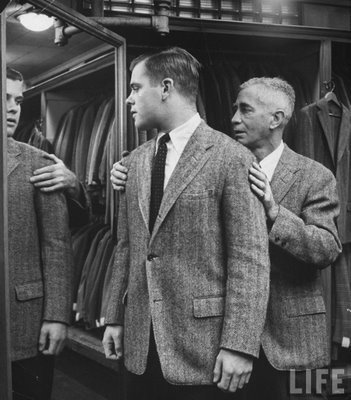
Ivy League Style – mid-20th century customer at J. Press
Ivy League style was born on American college campuses – particularly institutions such as Yale and Princeton – and borrows heavily from tweedy British country gentleman styles. Savile Row is more urbane and derives its name from the street in the affluent Mayfair district in central London, known principally for its traditional bespoke tailoring for men. During the early days of Ivy League look, Brooks Brothers and J. Press became the key American purveyors of the style. Historic tailors like Gieves & Hawkes and Huntsman embody the British style known as Savile Row.
Savile Row Style – Prince Philip with Queen Elizabeth wearing a double-breasted suit with shirt and tie (1951)
Menswear aficionados are familiar with The Rake, a British publication which describes itself as follows:
Founded in 2008, The Rake is the world’s preeminent publication dedicated to the education and empowerment of style. Recapturing the codes of classic men’s elegance, The Rake is inspired by icons such as Cary Grant, Gianni Agnelli, Sean Connery and their contemporary counterparts. It provides incisive, in-depth commentary on menswear and the many other elements of gentlemanly living, from manners and ethics to art and design, travel, the intellectual and the philosophical, homes, modes of transport, entertainment, food and drink.
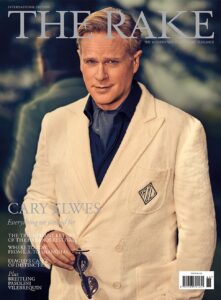
Cary Elwes on the cover of The Rake, Issue 88, June 2023
Ivy Style founder Christian Chensvold has authored articles for The Rake and has also shared some of that content on this page. Longtime readers will recall Christian’s article Philip The Fair (April 9, 2021) written In memoriam for style icon Prince Philip after his passing. The tribute features several photos of Prince Philip in his signature double-breasted blazer paired inevitably with a spread collar shirt, double Windsor knot necktie, and grey flannel or tan poplin trousers. Christian followed up the next day with a reprint of a lengthy feature titled Make Mine A Double which he wrote for The Rake back in 2014. Chensvold writes:
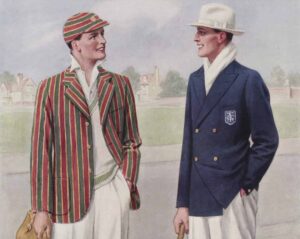
The 1930s, the so-called Golden Age of Menswear, is virtually synonymous with the double-breasted jacket. The ’30s trifecta of style inspiration — the Duke of Windsor, Old Hollywood, and Apparel Arts illustrations — show the DB in myriad fabrics and styling combinations.
Illustration of sports jackets in the 1930s
The Rake is very much the British equivalent of Ivy Style for Savile Row enthusiasts. Tom Chamberlin, Editor-in-Chief of The Rake magazine, is an elegant and eloquent gentleman nearly always dressed in an impeccably tailored double-breasted suit.
Tom Chamberlin, Editor-in-Chief of The Rake magazine
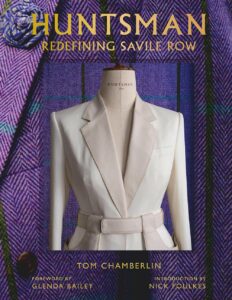
Chamberlin is the author of Huntsman: Redefining Savile Row. The book celebrates 175 years of Huntsman, founded in 1849 and one of the finest bespoke tailors on Savile Row. In addition to his work as a writer and editor, Chamberlin shares informative videos on a variety of topics from tailoring and craftsmanship to watches and cigars.
Chamberlin’s video refers to Poland in the 1930s, and specifically to the city of Białystok. Ivy Style readers will recall that I posted an article titled Ivy Style in Europe over the summer when my wife and I visited her family in Poland.
My wife’s grandparents
As I mentioned in that article, Białystok is my wife’s hometown. After posting the article online I learned from the owners of Madison Avenue 346, the Brooks Brothers store in Warsaw, that Białystok is also their hometown. They also informed me that Białystok was home to their first Brooks Brothers shop in Poland, before relocating to the capital.
Photo credit: Brooks Brothers. They dressed America (https://4gentleman.pl/brooks-brothers-to-oni-ubrali-ameryke/)
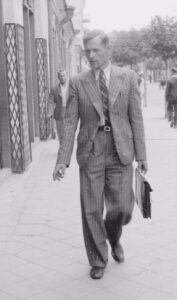
The photos in Chamberlin’s video are from photographer Bolesław Augustis. His story and photos have been featured in numerous publications, including the Polish edition of Vogue. The Polish website Culture.pl writes:
In 2004 in a shed in Bema Street in Białystok, two boys found a collection of photographs and negatives, which was then secured by the members of the group Zero-85, who happened to be rehearsing nearby. The collection was subsequently passed to Grzegorz Dąbrowski, a photographer and photography enthusiast from Białystok, the editor-in-chief of the local edition of the newspaper Gazeta Wyborcza in Białystok. After cleaning the materials, the photographs were scanned and a some of them published in the local edition of the magazine. With help of readers, it was established who Bolesław Augustis, the man whose name was written on the photographs, really was.
Polish photographer Bolesław Augustis
These photos show a vibrant city filled with well-dressed citizens. Poland was at its peak of culture and style in the interwar years prior to the onset of World War II, which began with the German invasion of Poland on September 1, 1939.
The front page of London’s Evening Standard newspaper on announcing the German invasion of Poland (September 1, 1939)
Bolesław Augustis was active in the underground independence movement, arrested by secret police of the Soviet Union, and sent to Siberia. He eventually joined the Anders Army and lived in England before settling in New Zealand. Augustis did not return to Poland and passed away 10 years before the archive of his photos hidden in the attic were discovered. Voguedescribes the popularity of his photos today:
Augustis’s photographs have achieved considerable success. His exhibitions travel internationally, and two books have been published. The latest, “Augustis 2.0,” designed by Ania Nałęcka-Milach, was nominated for the Book of the Year award at the world’s most important documentary photography festival in Arles. Augustis is considered a lost link in the evolution of Polish documentary photography.
The family photos that inspired my previous article Ivy Style in Europe, especially the pictures of her attractive and stylish grandparents, exemplify timeless elegance.
Photo credit: Bolesław Augustis
The transcript of the video from Tom Chamberlin has been posted below, along with some of the wonderful photos from Bolesław Augustis.
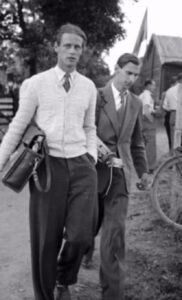
When we think of the chicest and most stylish nations, we think of Britain, Italy, and France. But let me tell you about Poland. In 2004, two boys found a set of negatives in a shed in Białystok. They were developed and the most amazing thing came to light. The photographer’s name was Bolesław Augustis, who used a 35 millimeter Leica camera to capture passing commuters and students, mainly on Kilńskiego Street, as a way of promoting his photography shop, Polonia Film. But it gives us amazing insight into just how stylish Poland was before communism.
Photo credit: Bolesław Augustis
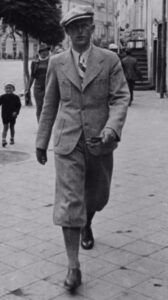
What he captured was a remarkably gregarious nation of aesthetes. Men and women who have no shyness around lapel widths, but a full grip of proportion, flattery, and fun that well-tailored clothing provide. These are not shots of models but Polish citizens going about their business, and Augustis becomes one of the original street style photographers as a result. An interwar Scott Schumann but even Scott would admit that that world’s boulevardiers of today seldom reach this level of cool and sophistication.
Photo credit: Bolesław Augustis
The sheer audaciousness and joy in these images are juxtaposed by the fact that these were taken between 1935 and 1938, so just a year after that everything in that nation would change forever with these people wrenched apart by the Germans and then given severe regimentation by the Russians.
Photo credit: Bolesław Augustis
And yet, the release of these images inspired an unexpected reunion of those where were in the images and recognized their friends after 65 years. I think it is high time that the world at large saw these and us men take a thousand notes and then a thousand more with regards to our own wardrobes.
Photo credit: Bolesław Augustis
When my wife and I embarked on our three-week visit to Poland this summer, little did we know that we would discover a treasure trove of family photos revealing a bygone era of elegance and style.This latest discovery only confirms my belief that Europeans dressed impeccably – not just for special events but even in their everyday activities – in the years leading up to the Second World War.
Poland is a wonderful country in many aspects whose people seem to truly cherish their culture and heritage.
Unfortunately, the way 99% of people dress these days is quite depressing and upsetting. It’s just ugly in every regard. And what’s baffling is that there’s actually plenty of decent clothes sold in stores, both cheap and expensive. There’s also a great diversity of styles as never seen before. One can really pick something to his or her taste to suit their body type and express individuality. One can look perfectly presentable, attractive, elegant, and tasteful in the most casual or inexpensive clothes if the right color, pattern, and fit are picked. Yet, what most people actually choose to wear makes them look like they’re out of their mind. I apologize for the rant, but I’m merely expressing my thoughts on what I saw, walking around midtown Manhattan on this past Saturday afternoon when most people around were dressed for leisure and going out, instead of work. To this I must add that the next day I went to see the show jumping grand finals at Greenwich Polo Club, and was pleasantly relieved to see so many nicely dressed people. Some were wearing casual clothes, while others dressed up, but everyone looked nice and presentable. Almost all the ladies were in pretty dresses and some wore hats. I was in a blue hopsack blazer cut in a southern Italian style with wide lapels and unpadded shoulders, chinos, a striped shirt with a soft spread collar that looks great without a tie, and light brown classic American penny loafers — one of the last such models from Cole Haan, which I bought exactly ten years ago at their shop on Columbus Circle, and which they sadly don’t make anymore (Cole Haan has unfortunately completely abandoned its roots and become unrecognizable). But outside such enclaves as Greenwich and events like equestrian competitions, it’s all but impossible to find elegantly dressed people. I still don’t have the answer to the question why people either don’t care at all about how they look or deliberately pick something that is objectively unattractive.
A favorite (and, I think, valid) theory regarding the 19th century collegiate rebuke of stiff, padded Savile Row tailoring (a decidedly military aesthetic) has to do with the quintessentially American spirit, nurtured and viable by the mid-19th century — small-r republican, and heavily informed by the New England Puritan rejection of excessive pomp (also a staple of empire military culture) and the ostentation of the regimental march. The traditional sack coat, lacking tapering and padding, supports both androgynous modesty and relaxed comfort as top priorities. The regal, formal dandyism of monarchies and their bishops and armies is renounced — in favor of cloth & cut suitable always for sporty leisure. Lapped seams, welted edges, thin canvas, and minimal sleevehead/cap function as a firm-if-subtle rebuttal of Savile Row excesses. To borrow from ecclesiastical vernacular, this is the abiding tension between the plain elegance of low church ritual and high church pageantry.
In my heart Ivy and low church are in perfect harmony. Style just isn’t an Ivy value as a separate pursuit. It is an inherently comfortable ethos. I always enjoy looking at how others dress, assuming they are trying to dress well, but Savile Row just isn’t an expression of comfort. It is always in search of a place to be exhibited, even if you go patched shoes a la Charles. Ivy sits quietly and enjoys itself. Low church happens quietly and thoughtfully.
Another counterpoint to American collegiate style was/is the Scholte-inspired drape cut, invariably affiliated with Anderson & Sheppard and Edward VIII. For all the talk about the soft tailoring, the intentionally V-shaped look is severe: broad/wide shoulders, full chest, absurdly tapered waist, raised waistline. A favorite of Hollywood types — Gary Cooper, Cary Grant, and Fred Astaire. In most ways the opposite of the 19th century American take on the sack coat, which is more akin to a work/chore coat. Paul Stuart’s “updated traditional” house cut is drape-ish, as are the multitudes of Paul Stuart impersonators.
I’m not sure I’d agree with the Row being a counterpart to Ivy Style
Ivy is far more democratic, that historically had regional traditional clothing stores across your fair country. Whilst not cheap it was within reach of the many.
SR has always been expensive due to the long winded nature of hand stitching, the rents in the area, the length of time it takes to train a cutter, etc. It is definitely not for the masses.
Also SR isn’t one style. A jacket from Huntsman will be very different to one from A&S. They have individual house styles.
Material weight also differs. UK mills in the fifties and sixties would create lighter cloth especially for the US market whereas in the UK heavier weights were preferred as they hid a multitude of misshapen bodies.
The fact that no modern-day manufacturer is making (able to replicate?) the mid-20th century American sack coat is a problem. No wonder all of the old trad outposts died; their makers could not maintain the standards of of the old CMT lot, most significantly Grieco Bros./Southwick (Superflex). A true 3-button with softly rolled lapel, sounded front (more 3/1 than 3/2 left unbuttoned), and “shirtsleeve shoulders” is a work of art. The current go-to’s for merely undarted jackets is making a version of the Southwick Andover model, which is too formal and stiff to render natural shouldered, campusy lassitude.
I find it difficult to believe that modern-day manufacturers are unable to replicate the mid-Century American sack-coat. For whatever reason, they just don’t want to. And for some reason, they like to put lapel notches up on the clavicle. It’s their way of imposing their will upon others, latent, post-adolescent, sticking it to the man. Angry at the world because they didn’t dream up the Ralph Lauren schtick.
One man, (Astro-physicist? Aero-Space Engineer?) Tailor Caid figured it out, but he charges a mint for it, plus travel and lodging expenses, and it takes a year or more to get it done.
I’m fortunate to have found local (relatively speaking) tailors who can/will replicate the old sack coat. They had fun with the soft rolled lapel, rounded front, padless shoulder, zero lining, thin canvas/chest piece. Just let the heavy cloth do the work of providing structure. I presented this picture and they understood immediately:
While not their house cut, the team at Alan Flusser has flawlessly recreated mid-century American sack coats for me. Highly recommend reaching out to Jonathan, he’d be happy to help.
A hopeful guess is that the new leadership at J. Press will reintroduce some of the legendary cloth (“fabric”) from days of yore — and demand a sack coat model that’s soft and rounded, the very specs that inspired a very young Ralph Lauren.
Last year they resurrected the Shaggy Dog Shetland tweed for odd jackets. The circa 1950s/60s brochures are the reliable source: both cut/style (shape) and cloth. (Much of post-‘71 is forgettable). Let’s hope they’ll ask reputable weaver to produce books unique/exclusive to Squeeze. I feel sure Lovat Mill will be pleased to design a book of a dozen or so. Molloy (Donegal) are Harris Tweed Hebrides, as well.
The American sack coat, which predates New Haven-based marketing and salesmanship, is far more New England than England. Fingers crossed that the new leadership don’t overindulge the Oxbridge Chap vibe. Even Lauren knew when to put the brakes on the Anglicanisms. Posh can descend into swank mighty fast.
I am a little late to the party, however I would still like to make an observation. If, as you state, “Ivy League style…borrows heavily from tweedy British country gentleman styles.”, then we much acknowledge Cordings.
Cordings has – at least how I observe them – gotten a little more urbane from their field and country outfitter roots. This isn’t necessarily a bad thing. But I believe the Cordings of the fifties and sixties has had an indirect influence on the evolution of our style.
I will be in London for the entire month of December and I will of course be visiting and shopping at Cordings. Perhaps I’ll even see Eric Clapton. Instead of asking for the obligatory “selfie” I’ll just say “Thank you, Sir. I really enjoy your shop.” And carry on.
Hollis
– Living it up authentically. With grace, style, and aplomb.
“believe the Cordings of the fifties and sixties has had an indirect influence on the evolution of our style.“
Actually, by that point, the American natural shoulder (“the civilian sack coat”) was a longstanding tradition — and had been steadily influencing some British tailoring. If anything, Cordings was influenced by American sensibilities.
The uniquely American innovation, an act of rebellion, was marketing the civilian sack coat for business and formal dress. From a Ssvile Row perspective, unthinkable. Sartorial heresy — sacrilegious.
— offensive to others who might’ve preferred the dartless, padless, slope-shouldered 2-piece sack remain relegated to casual arenas. It’s only a lapel shortening away from the chore coat, after all.
It’s the either the formalization of sports/country wear or the relaxing of formalwear. Or both. Offensive to two
American natural shoulder style is not a derivation of British and/or Savile Row style. It’s an offense.







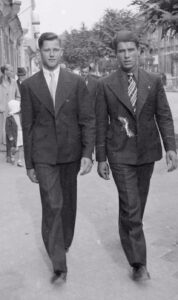






Interesting button point on those two wearing the too-short double breasted suits.
Not really double breasted, but they have nonfunctional buttons, looks like six of them. They seem to be fastened with a link?
Nice article. As one with both Ivy and savile row in my closets like here I appreciate and wear both.
And the Polish photos are amazing and stylish- I agree with Tom.
Of course during the 40s-50s here people dressed much the same, with women in dresses, hats, gloves and shoes to match, as my mother did.
Poland is a wonderful country in many aspects whose people seem to truly cherish their culture and heritage.
Unfortunately, the way 99% of people dress these days is quite depressing and upsetting. It’s just ugly in every regard. And what’s baffling is that there’s actually plenty of decent clothes sold in stores, both cheap and expensive. There’s also a great diversity of styles as never seen before. One can really pick something to his or her taste to suit their body type and express individuality. One can look perfectly presentable, attractive, elegant, and tasteful in the most casual or inexpensive clothes if the right color, pattern, and fit are picked. Yet, what most people actually choose to wear makes them look like they’re out of their mind. I apologize for the rant, but I’m merely expressing my thoughts on what I saw, walking around midtown Manhattan on this past Saturday afternoon when most people around were dressed for leisure and going out, instead of work. To this I must add that the next day I went to see the show jumping grand finals at Greenwich Polo Club, and was pleasantly relieved to see so many nicely dressed people. Some were wearing casual clothes, while others dressed up, but everyone looked nice and presentable. Almost all the ladies were in pretty dresses and some wore hats. I was in a blue hopsack blazer cut in a southern Italian style with wide lapels and unpadded shoulders, chinos, a striped shirt with a soft spread collar that looks great without a tie, and light brown classic American penny loafers — one of the last such models from Cole Haan, which I bought exactly ten years ago at their shop on Columbus Circle, and which they sadly don’t make anymore (Cole Haan has unfortunately completely abandoned its roots and become unrecognizable). But outside such enclaves as Greenwich and events like equestrian competitions, it’s all but impossible to find elegantly dressed people. I still don’t have the answer to the question why people either don’t care at all about how they look or deliberately pick something that is objectively unattractive.
Thank you for this insightful article, highlighting a forgotten era of pre-war Polish style.
Na zdrowie! Great article, the Poles look damned cool!
A favorite (and, I think, valid) theory regarding the 19th century collegiate rebuke of stiff, padded Savile Row tailoring (a decidedly military aesthetic) has to do with the quintessentially American spirit, nurtured and viable by the mid-19th century — small-r republican, and heavily informed by the New England Puritan rejection of excessive pomp (also a staple of empire military culture) and the ostentation of the regimental march. The traditional sack coat, lacking tapering and padding, supports both androgynous modesty and relaxed comfort as top priorities. The regal, formal dandyism of monarchies and their bishops and armies is renounced — in favor of cloth & cut suitable always for sporty leisure. Lapped seams, welted edges, thin canvas, and minimal sleevehead/cap function as a firm-if-subtle rebuttal of Savile Row excesses. To borrow from ecclesiastical vernacular, this is the abiding tension between the plain elegance of low church ritual and high church pageantry.
In my heart Ivy and low church are in perfect harmony. Style just isn’t an Ivy value as a separate pursuit. It is an inherently comfortable ethos. I always enjoy looking at how others dress, assuming they are trying to dress well, but Savile Row just isn’t an expression of comfort. It is always in search of a place to be exhibited, even if you go patched shoes a la Charles. Ivy sits quietly and enjoys itself. Low church happens quietly and thoughtfully.
Another counterpoint to American collegiate style was/is the Scholte-inspired drape cut, invariably affiliated with Anderson & Sheppard and Edward VIII. For all the talk about the soft tailoring, the intentionally V-shaped look is severe: broad/wide shoulders, full chest, absurdly tapered waist, raised waistline. A favorite of Hollywood types — Gary Cooper, Cary Grant, and Fred Astaire. In most ways the opposite of the 19th century American take on the sack coat, which is more akin to a work/chore coat. Paul Stuart’s “updated traditional” house cut is drape-ish, as are the multitudes of Paul Stuart impersonators.
I’m not sure I’d agree with the Row being a counterpart to Ivy Style
Ivy is far more democratic, that historically had regional traditional clothing stores across your fair country. Whilst not cheap it was within reach of the many.
SR has always been expensive due to the long winded nature of hand stitching, the rents in the area, the length of time it takes to train a cutter, etc. It is definitely not for the masses.
Also SR isn’t one style. A jacket from Huntsman will be very different to one from A&S. They have individual house styles.
Material weight also differs. UK mills in the fifties and sixties would create lighter cloth especially for the US market whereas in the UK heavier weights were preferred as they hid a multitude of misshapen bodies.
The fact that no modern-day manufacturer is making (able to replicate?) the mid-20th century American sack coat is a problem. No wonder all of the old trad outposts died; their makers could not maintain the standards of of the old CMT lot, most significantly Grieco Bros./Southwick (Superflex). A true 3-button with softly rolled lapel, sounded front (more 3/1 than 3/2 left unbuttoned), and “shirtsleeve shoulders” is a work of art. The current go-to’s for merely undarted jackets is making a version of the Southwick Andover model, which is too formal and stiff to render natural shouldered, campusy lassitude.
I find it difficult to believe that modern-day manufacturers are unable to replicate the mid-Century American sack-coat. For whatever reason, they just don’t want to. And for some reason, they like to put lapel notches up on the clavicle. It’s their way of imposing their will upon others, latent, post-adolescent, sticking it to the man. Angry at the world because they didn’t dream up the Ralph Lauren schtick.
One man, (Astro-physicist? Aero-Space Engineer?) Tailor Caid figured it out, but he charges a mint for it, plus travel and lodging expenses, and it takes a year or more to get it done.
I’m fortunate to have found local (relatively speaking) tailors who can/will replicate the old sack coat. They had fun with the soft rolled lapel, rounded front, padless shoulder, zero lining, thin canvas/chest piece. Just let the heavy cloth do the work of providing structure. I presented this picture and they understood immediately:
https://www.whiffalumni.com/whiffs/download.php?fileid=3621
You are fortunate, SE. My “local tailor” can’t even do 1.5 inch cuffs with no break. I can’t trust him (or anyone else) with any significant project.
If I were 18 years old, I think a good potential program would be a Bachelor of Arts degree with a concurrent “old school” tailoring apprenticeship.
I’d move.
While not their house cut, the team at Alan Flusser has flawlessly recreated mid-century American sack coats for me. Highly recommend reaching out to Jonathan, he’d be happy to help.
* rounded
A hopeful guess is that the new leadership at J. Press will reintroduce some of the legendary cloth (“fabric”) from days of yore — and demand a sack coat model that’s soft and rounded, the very specs that inspired a very young Ralph Lauren.
Last year they resurrected the Shaggy Dog Shetland tweed for odd jackets. The circa 1950s/60s brochures are the reliable source: both cut/style (shape) and cloth. (Much of post-‘71 is forgettable). Let’s hope they’ll ask reputable weaver to produce books unique/exclusive to Squeeze. I feel sure Lovat Mill will be pleased to design a book of a dozen or so. Molloy (Donegal) are Harris Tweed Hebrides, as well.
* Actual Shaggy
Dog not included
The American sack coat, which predates New Haven-based marketing and salesmanship, is far more New England than England. Fingers crossed that the new leadership don’t overindulge the Oxbridge Chap vibe. Even Lauren knew when to put the brakes on the Anglicanisms. Posh can descend into swank mighty fast.
Interesting article and great pictures, amazing the detail you can see on film. Białystok, Białystok………where have I heard that before Mel Brooks
I doubt very much that The Rake represents Ivy Style for anyone in GB, it’s ok if watches are your thing. Online check out https://www.permanentstyle.com/ it has some articles about Ivy,
or for shops; in London https://johnsimons.co.uk/ or in Oxford https://burrowsandhare.co.uk/,
both shops do mail order.
Matthew,
Another piece of outstanding writing.
I am a little late to the party, however I would still like to make an observation. If, as you state, “Ivy League style…borrows heavily from tweedy British country gentleman styles.”, then we much acknowledge Cordings.
Cordings has – at least how I observe them – gotten a little more urbane from their field and country outfitter roots. This isn’t necessarily a bad thing. But I believe the Cordings of the fifties and sixties has had an indirect influence on the evolution of our style.
I will be in London for the entire month of December and I will of course be visiting and shopping at Cordings. Perhaps I’ll even see Eric Clapton. Instead of asking for the obligatory “selfie” I’ll just say “Thank you, Sir. I really enjoy your shop.” And carry on.
Hollis
– Living it up authentically. With grace, style, and aplomb.
“believe the Cordings of the fifties and sixties has had an indirect influence on the evolution of our style.“
Actually, by that point, the American natural shoulder (“the civilian sack coat”) was a longstanding tradition — and had been steadily influencing some British tailoring. If anything, Cordings was influenced by American sensibilities.
The uniquely American innovation, an act of rebellion, was marketing the civilian sack coat for business and formal dress. From a Ssvile Row perspective, unthinkable. Sartorial heresy — sacrilegious.
— offensive to others who might’ve preferred the dartless, padless, slope-shouldered 2-piece sack remain relegated to casual arenas. It’s only a lapel shortening away from the chore coat, after all.
It’s the either the formalization of sports/country wear or the relaxing of formalwear. Or both. Offensive to two
American natural shoulder style is not a derivation of British and/or Savile Row style. It’s an offense.
* two camps