
By Ebrima Santos Sanneh
Ebrima is a reporter at American Banker who covers government regulation of the financial industry primarily at the Treasury, FDIC, and the OCC. He also moonlights at classic clothier J. Press, where he helps clients, from senators to students, find their footing in classic American style. This article was originally published on his Substack.
Alfargo’s and the second wave of #menswear
Since 2021, Alfargo’s Marketplace has anchored New York’s menswear revival — serving as a stylish meetup of vintage, Ivy, and #menswear 2.0 energy. Now it’s evolving, and so is the scene.

In the years since the pandemic, Alfargo’s Marketplace has become a cornerstone of New York’s revitalized menswear scene. What began as a pop-up vintage sale on a Bowery sidewalk now draws large crowds to Neuehouse. As the market has grown and evolved, its vibe has shifted — becoming more polished and a little corporate, which complicates its original, grassroots appeal for long-timers. Yet it remains a vital space where heritage brands, internet tastemakers and menswear enthusiasts converge under one roof.
Launched in 2021, the monthly market channeled the energy of online men’s fashion discourse into real-life connection. At a time when most Americans were dressing down, Alfargo’s met the demand for durable, timeless garments for those who chose to go the other way. At the end of the day, it was an excuse to throw on a fit, see some friends and dig for some affordable vintage, as longtime attendee Dan Hakimi put it at last month’s market.
“It was a time that we needed to build community, when everybody had been stuck at home for so long and had no excuse to get dressed,” Hakimi said. “So people who wanted to get dressed, who were into clothes…wanted to find cool clothes, see people and talk about menswear.”
Vintage is still at the heart of the market, but today it’s bigger, more recognizable, and more diverse in it’s offerings. The market now sells high-end contemporary pieces, vintage menswear, jewelry and candles in addition to offering on-site tailoring and even a pop-up salon. While some lament the shift from scrappy popup to curated emporium, many agree Alfargo’s remains one of the few places where menswear still feels vibrant, alive and — and still to an extent — within reach.
Brian Davis, owner of the Tuckahoe-based vintage shop Wooden Sleepers, says the market is more than just a place to sell for him. It’s a refreshing break from the often competitive and territorial trade side of the industry he’s used to as one of the nation’s best-known vintage sellers.
“It has a totally different energy than a trade show, which is very corporate — people’s jobs and livelihoods are on the line — or even, in my world, a vintage show, which can be really competitive and stressful,” Davis said standing on the sidewalk outside the venue. “My business is pretty solitary — I run a by-appointment showroom that’s only open to the public one day a week—so this is a rare chance for me to meet people who already know my work, introduce myself to new folks, and just hang out with others in the scene that I’ve become friends with. It’s about feeling part of something.”

Other market regulars see the rise of Alfargo’s as part of a broader trend since the pandemic. Denny Balmaceda — a 37-year-old New Jersey–raised menswear creative, longtime blogger and market vendor — drew a direct line from today’s scene to the early-2010s Tumblr era known as “hashtag menswear.”
“I always say this feels like the second coming of ‘hashtag menswear’ because I lived through that time where it was like, we were all just nerds about it — and we still are…[but] menswear has become this thing where it’s kind of like how Comic-Con, it has this culture within itself.” Balmaceda said, between selling items. “But the community is so much better now. And bigger too in a way where it’s less gatekeeping, more about embracing.”
The current growth in interest in quality tailoring and classic menswear is arguably a revival of an online subculture beginning in the late aughts, which peaked in the early 2010s on Tumblr and other sites like Styleforum and Instagram. The movement consisted of guys obsessing over the minutia of classic men’s tailoring, Ivy League style, sprezzatura and high-quality craftsmanship.
The term was coined partly in jest, sometimes to criticize the fastidiousness of menswear heads obsessed with particular details. Ultimately, hashtag menswear became a shorthand for a specific moment when guys got very into clothes, treated them seriously and discussed them obsessively online.
GQ editor Cam Wolf predicted a #menswear 2.0 would blossom in the wake of the pandemic. In a prescient 2020 piece, Wolf predicted the pandemic, like the 2008 recession that triggered the first wave, would cause a cultural and economic shift that would push menswear from loungewear, hypebeastism and big luxury logos toward tailored, ethically made and high quality clothes.
While the first wave of 21st-century menswear drew heavily from Italian sartorial traditions — soft, unlined sport coats, double monk-straps, and minimal pants break trousers dominated the 2010s discourse. #Menswear 2.0 has developed its own stylistic bent.

Menswear 2.0 continues the obsession with Ivy style and a focus on vintage, American-made pieces, but it’s less interested in making tailoring look youthful. The aesthetic leans more Anglo-American in its sensibility, embracing what’s now dubbed #grandpacore: think wide-legged pleated chinos, navy blazers, Oxford cloth button-downs and Alden tassel loafers. While it’s not everyone’s cup of tea — some might call the look even “stodgy” — it’s stodgy on purpose. A reaction to the excesses of its predecessor. While the #menswear 1.0 scene took pains to avoid looking too conservative by, say avoiding baggy cuts and pleats. Today, eschewing the pressure to dress in a forward-facing style has driven men of diverse backgrounds to embrace an unflinchingly traditional American style. At a time when “the man” — big tech moguls — wear t-shirts and jeans, there’s something a little edgy about putting on a bow-tie, or a double breasted navy blazer, unironically.
Many of the best dressers in the menswear scene aren’t necessarily aiming to look like a guy at Pitti — they’re channeling something closer to Black Ivy by Jason Jules or a professor walking his dog on the Upper East Side.
In addition to meeting the needs of guys suddenly interested in classic aesthetics — aided by the likes of menswear writer Derek Guy — the market was a much-needed community gathering when it launched.
So when the first Alfargo’s took off, Davis immediately saw the potential. “I thought, wow — what a cool concept and something that’s so needed,” he said. For him, the draw isn’t just commerce — it’s the people.
“‘Community’ is a word that gets thrown around a lot — especially by big corporations and brands — where it often doesn’t mean anything,” Davis, who moonlights as a hardcore punk singer, said. “Everyone’s trying to ‘build community’ or be a community, whatever that means. But what these guys have done is actually build one — a real place for menswear enthusiasts to gather, connect and check things out in person.”
Balmaceda frames Alfargo’s as special for its unpretentiousness. He says the market serves as an inclusive, affirming space for self-expression and contrasts Alfargo’s with more competitive or exclusive fashion environments, emphasizing that while people show off their personal style, it’s not about one-upmanship — it’s about mutual appreciation.
“Rather than people focusing on you know, who’s probably dressing better and blah, blah, blah, the current menswear scene is more complimentary, like: ‘you look fire,’ rather than like, ‘uh, did you see what he was wearing?’” Balmaceda said. “It’s encouraging, that’s why it’s even bigger and with each market more people get introduced to it…it doesn’t feel like cool people not trying to let other people be a part of it, everyone’s welcome here.”

Still, this spirit of openness sits somewhat uneasily alongside the growing presence of social media influencers at Alfargo’s. While the vibe on the ground may be generous and affirming, the online dynamics tell a slightly different story — one shaped by the inherent one-upmanship of likes and followers. Calculated collaborative outfit posts featuring multiple viral influencers designed to grab attention — have become as much a part of the Alfargo’s ecosystem as the vintage racks themselves, subtly recentering the space around visibility and influence.
After the market moved to Neuehouse — an exclusive Flatiron social club — that sense of unfiltered accessibility that made Alfargo’s feel like a grassroots community gathering — has evolved, according to Hakimi.
“One of the real bits of charm about the original location that we’re missing now is obviously the fact that we went out on the sidewalk and people would pass by and be like, ‘Oh, what’s going on over here? This is a thing.’” Hakimi said at Alfargo’s most recent market, “I love the new location obviously, it’s well air conditioned and everything, but yeah, that is unfortunate that we can’t, like just hang out on the sidewalk, put a rack out there, just hang out.”
Alfargo’s East Village location operated out of a vacant former bar and spilled into a heavily trafficked street, meaning one could just stumble upon the venue. With a bar, plush seating, clean backdrops and better lighting, NeueHouse undoubtedly lends itself more to lingering, content-making and networking — that bolster the presence of influencers at Alfargo’s. Sometimes, there’s no signage out front to alert passersby — so if you know, you know.

One longtime vendor, however, who wished to be quoted anonymously, says it more frankly: the vibes are different.
“I think East Village was a better location because the community was a lot better there…we had overflow from Bowery, we had a lot more going on,” the vendor said. “Here, it’s just the same hashtag menswear people looking for the same hashtag, menswear stuff, and they’re not looking for anything, you know, really inspiring, actual vintage anymore…I don’t know if we can ever return to the original vibe.”
The vendor said they did not attribute the shift solely to the increasing scale of the market either, but said the shift was inevitable.
“I think a part of it was the fact that it was two years ago,” they said. “Time has passed, trends have changed, trends grow.”
Hakimi notes the changes have had tradeoffs, with the higher-end Neuehouse crowd requiring more curated clothing selections and, in some cases, higher prices.
“The old location was like a dive bar — versus this, which is nicer, but — at the old location you really felt like you were getting a deal, you were scrounging through the racks and that was fun,” Hakimi said. “[At the new location] it feels more like you’re about to pay a lot of money. Obviously, we still have [people like vendor Shane Joseph, known for amazing pieces at very fair prices], we still have some deals — I got this for 100 bucks — (points to his model 3 Ring jacket, from The Armoury) — but like, I walk in here and it’s fancier.”
While selling and sourcing quality vintage menswear has always been high-pressure and territorial, that intensity has only grown with more consumers tuned in and sites like eBay allowing consumers to snatch up pieces with the click of a button. That has made making a living as a full time seller a bit more tricky.
“I’d be naïve to say it’s as easy as it used to be — vintage is bigger than it’s ever been before. I’ve been doing Wooden Sleepers for 15 years, so in that time, a whole new generation of people has surfaced. And not just as customers — as dealers. People are getting into the business side at a much younger age.”
While Alfargo’s market may not be the same grassroots hub of hidden steals it once was, Hakimi acknowledges that it has evolved into a more polished experience — one that can feel less approachable than before. Yet despite this shift, he and every person interviewed believed it remains a positive community space.
“As the community has grown, there have been tensions — which is natural — and it’s not like they’ve taken private equity or anything stupid like that,” Hakimi said. “Obviously, this is not J. Crew or anything, but a lot of companies did grow too fast and that hurt them in the long run because they had to repay their loans. And this, they have not gone in that direction at all. They are still working with niche menswear brands.”
Market founder Stephon Carson said the he and his team — Zane, Nick and Elias — aim to continue to diversify the composition of the market while sticking to what they’ve always done. At its core, he says the goal is to provide like-minded menswear enthusiasts a single destination to shop: but now with more than just vintage Ivy pieces.
“We want to continue working with these cool, up and coming brands, and also established brands, vendors, sellers, independent sellers as well, too, you name it,” Carson said. “But still cultivating that culture of community: bringing together like minded individuals who love the shop, especially guys who have a place to shop new, used and vintage all in one location.”





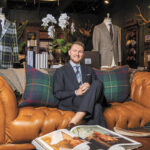

It’s 91 degrees here in south-central Pennsylvania, and watching the three fashionably dressed men in the “Why Is This Trending?” video makes me yearn for a cold winter day to wear these well-coordinated outfits.
A stubbornly persistent challenge for Ivy/preppy/trad/etc. is an always looming deficit of cool. A lot of post 70s preppy has been conspicuously uncool. Dweebish. Between all multitudes of Paul Stuart imitators (ugh) and the “preppy lifestyle” goofiness, the once-upon-a-time cool of Ivy is constantly vulnerable. There’s been such sterilization of the style throughout the past few decades, in no small part because of the affiliations with frat bros, Gold Coast vulgarities, and graceless, unsophisticated Wall Streeters.
The revival of vintage confirms an impulse to revive the cool. The coolest men and women in my hometown wore classic, well made natural shoulder clothing. Think yesteryear Norman Hilton ads.
What is so difficult about making khakis, chinos, whatever. Just make ‘em normal for heaven’s sake! I’m not spending a dime on a stupid ugly clown costume. I buy one pair of 501s, on sale, at JC Penney’s, and wear them pretty much every day. If someone made normal guys khakis I’d probably have several pair.
Um, ok…but there are several companies currently making “normal guys khakis”, however one chooses to define normal. Maybe take a gander at PennBilt (“The Authentic”), JPress, or – shudder – Duck Head (“Classic Fit Gold School”).
Unrelated, but Rest in Peace Bob Prenner and condolences to the Ben Silver team.
Hardbopper- I too am a fan of 501s, and have a couple of pairs in white and standard blue. I also have 7 pairs of Bill’s Khakis M2 fit, all bought at Eljo’s in Charlottesville some time ago before the price roughly doubled. They are great, but unfortunately I have no idea who makes all cotton khakis that fit properly (not low-rise, not too tight or too baggy), and without extraneous pockets, logos, etc. for a reasonable price. Maybe J. Press or O’Connell’s, but I haven’t tried them.
It’s not that I’m a fan of 501s. Its that 501s are consistent, if you avoid all of the varieties. If I need a pair, I check to see if they’re on sale, drive over to Penny’s, grab a pair in my size, and be on my way home again in 10 minutes. Not my preferred Ivy Style, but they’re available.
For trousers, I prefer O’Connell’s, but their nice normal fit is sold out, and mail order can be tricky. Why not make more?
“Mail order”, aka online shopping, is dead easy. Order, try on, return if not a fit. Heck, you can even go crazy and order in two sizes if there’s a concern.
O’Connell’s carry some gentlemen’s cut, drill cloth, on-seam pockets, good rise, all that, but of course they’re sold out. They can’t move the skinny fit, so they’re marked down. I dunno…Not my problem. Gym shorts and Levi’s, man. I’ve got two suits and a couple pair of Gabbies. I can make it with that from here on out. Looking at old photos is fun, but kinda losing interest…
This was their intent.
Uh, ok.
J Press, PennBilt, and -shudder- Duck Head, all make “normal guy” khakis.
Everyone knows Levi’s denim was much better 50+ years ago than now. It now fades to an ugly burlap sackcloth color, so less of a lifespan now. It never was considered to be Ivy. And yet, a nicely faded pair of 501s, brushed tassel or penny loafers, navy blue socks, white or u-stripe OCBD, navy or striped tie, and a flannel blazer, was a great look for students and professors alike. Uncle Ralph took the look and made it more expensive.
@Hardbopper – check out Jack Donnelly khakis. Fantastic quality and great fit.
You can buy an exact reproduction of raw, unsanforized selvedge 501s made in 1890, 1947, 1954, 1955, 1966, and other years. LVC 501s are repros made in Japan, as are many models of Sugar Cane, Freewheelers, Warehouse, One Piece of Rock, et al. In the early 70s, as Levi’s began to move production from its American mills, the most famous of which is the White Oak mill in Greensboro, NC, to mills in China, Mexico, and the Philippines, the Japanese were making selvedge jeans on Toyodas and Sulzers, looms of significantly higher quality than White Oak’s Drapers, in Okayama. W. David Marx tells this story in his book ‘Ametora: How Japan Saved American Style.’ The 501s that Levi’s sells at JCPenney and other retailers are 501s in name only. Speaking of Uncle Ralph, his Westernwear brand, RRL, sells pre-distressed jeans at outrageous prices.
Did not intend to make this a 501 centered discussion. I clicked an embedded link and found lots of khaki chinos info. One of the sites, I happened upon a few years ago, shows authentic reproduction button-fly drill cloth.
O’Connell’s Gentlemen’s-fit flat-front comes closest to normal. Button fly would be my only suggested improvement, and not necessarily applicable to cotton twill, but to drill cloth.
That aside, the only persistent problems seem to be supply chain disruption and an over stock of skinny fit due to aggressive marketing of that which most men do not want.
Made to order might be a solution, but the supply chain issue seems to be that manufactures will only make one run of thousands of pairs and stick retailers with the overhead.
Check out Full Count’s 1201 Army trousers. They have a button fly, a high rise, and a full leg.
https://fullcount.co/products/1201-u-s-army-41-khaki-trousers-1
Two more excellent (and cheaper) options are Buzz Rickson’s 1942 and 1945 chinos.
https://www.historypreservation.com/products-page/khaki-chinos/buzz-ricksons-1942-u-s-army-khaki-trousers-qm-spec-no-19c/
https://secondsunrise.se/collections/buzz-ricksons/products/buzz-ricksons-chino-1945-model-beige-m43035-1?variant=51101542154567
Some of the commenters here bemoan the fact that young people are not interested in this style.
Then they recommend clothing items that cost $150+ for ONE piece. See the math?
JPress, Bills, etc. are great companies – but add an affordable option or two. Let me try…
I have khakis/chinos/whatever is the cool word for them from Lands End. They are cotton and fit fine. I use those for work and social events. I believe LLBean is pretty good too, maybe a bit better but they did not fit me as well. For everyday I have a few beater pairs from Target that are super-comfy. I guess I focus more on shirts, pants are utilitarian for me. Shirts are mostly BB (mostly bought before the current nosebleed prices).
Want to take this chance to tell the current management that they are doing a great job!
I enjoy coming here, learning some history, and reading all the arguments and discussions.
Cheers!
Thank you, Andrew! Agreed about the contradiction. We cannot criticize young people for being disinterested in this style of dress while simultaneously asking them to spend their entire paychecks on it. Vintage clothing gives an another option. I work at Yale and teach at UConn. Recently I met with a former student who earned a master’s degree at Cambridge (UK) and is now a fellow staff member at Yale. We had lunch in New Haven and visited J. Press. He greatly admires the style, and would gladly purchase his entire wardrobe from the store. But being practical and budget conscious, he buys most of his clothes on Poshmark. Vintage pieces from J. Press, Brooks Brothers, and Ralph Lauren are his favorites.
totally get it, but echo Matthew’s suggestion for vintage, etc. Places like Alfargo’s are a great resource for those looking to buy quality on a budget, as is ebay, for that matter.
My kids school uniforms are run through Lands End, and I do think they make hard wearing chinos. That said, wouldn’t mistake LE or LL B for quality makes at this point – one may do better purchasing fewer and better and enjoying the longevity.
Havent commented previously..has the sad decline in quality of BB t shirts been covered in your pages ?
My apologies for the late comment, but Wife and I are visiting an old Law School buddy and staying at his cabin on Sebago Lake, Maine, for a week… after a wonderful week with the kids and their friends on Nantucket. A J. Press pop up happened to be on Nantucket while we were there. Some fun stuff, but hard to justify the prices, when they were having a wonderful Fourth of July sale online at the same time, which I indulged in. Bought a couple of their Zeypher weight OCBDs, a pair of white cotton ducks and some of their Sebago collab boat shoes to ship home. Visited the Brooks Bros outlet in Freeport and scored a wool tennis/cricket sweater for $30, similar to the one Matthew pictured above, save mine is in the cream color, with navy and maroon collar/sleeve striping. Pretty happy with that pick up…