Daniel Covell is a Professor of Sport Management at Western New England University and a contributing writer for Ivy Style. Dan will deliver a lecture titled “Yale Means Football” at the Yale Club of New York City on Wednesday, November 18 at 6:00 PM. The lecture will look at Yale’s storied history through the cover art of Ivy League football programs – from early woodcut illustrations to the photography that took over by the 1950s.
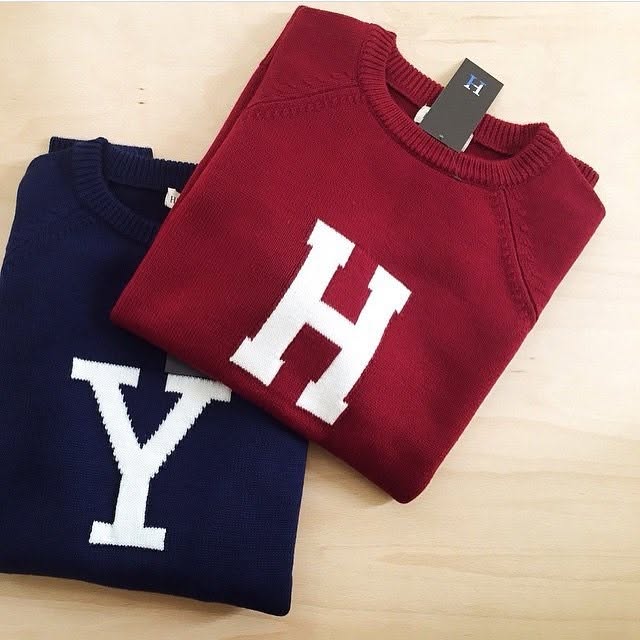
Yale and Havard sweaters from Hillflint.
“The Game,” or, depending on how some might say it, “THE Game”, is, as many of the readers of this site need not be reminded, the annual resumption of football relations between the teams from Harvard and Yale. While other schools and their faithful often claim the same superlative moniker for their own rivalry contests, it’s purported that former longtime Yale sports information director Charley Loftus coined the term first for the Harvard-Yale game, along with creating the term “tailgating.” Others, possibly folks at Princeton, Pennsylvania, Dartmouth, Brown, Cornell, and Columbia, suggest he merely popularized them.
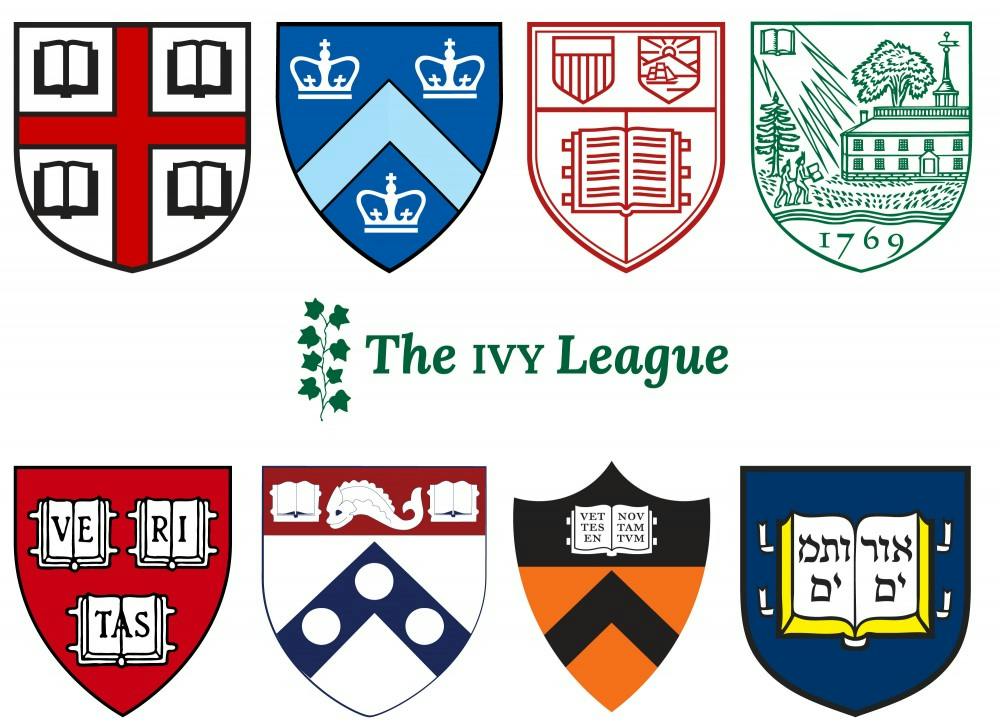
The eight universities of the Ivy League: Brown, Columbia, Cornell, Dartmouth, Harvard, Pennsylvania, Princeton, and Yale.
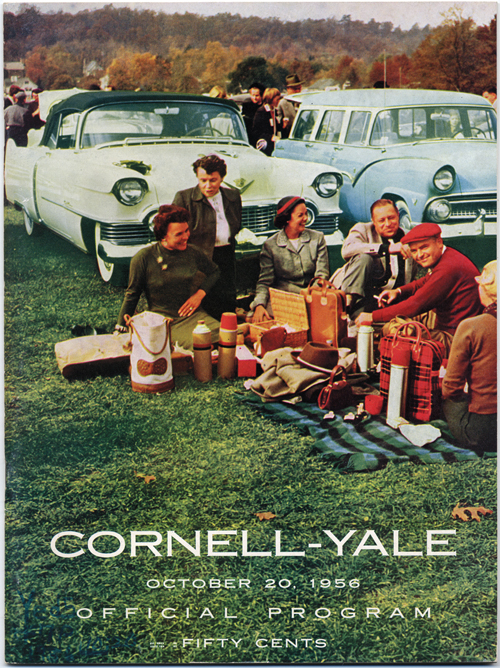
Stylish tailgaters on the cover of the official program for the Cornell-Yale game, October 20, 1956.
I’ll be taking this show on the road on Wednesday, November 18 at the Yale Club of New York City, with a slide show and talk on the cover art and inside content of the programs throughout the balance of Yale football’s long and storied history.
“Yale Means Football” lecture by Professor Daniel Covell of Western New England University. Wednesday, November 18 at 6:00 PM.
There’s a bigger event happening up in Boston on Saturday, November 21, when the Bulldogs take on the Crimson at Fenway Park – that lyric little bandbox of a ballpark, as John Updike called it in the pages of the New Yorker back in 1960.
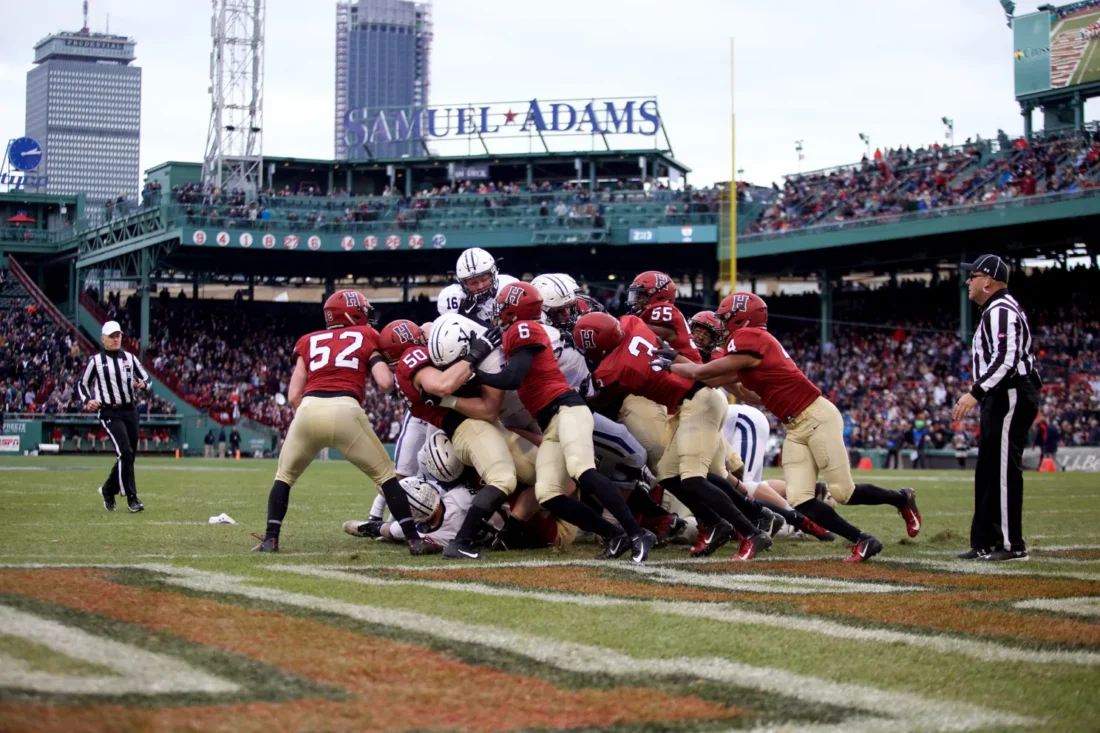
The last time Harvard and Yale played at Fenway Park was on November 19, 2018 (the 135th playing of “The Game”), where Harvard defeated Yale 45–27. Photo by Olivia Falcigno for The Harvard Gazette.
And while as a lifelong Red Sox fan who counts among his most cherished sports memories moments observed while in the stands there, those were baseball moments. Fenway, charming as it is with its design quirks and oddities – is not, nor was it built to be – a venue suitable for football, and anyone who’s seen a game there will say as much. Something as venerable as The Game should never take place there. The Game belongs only at Harvard Stadium or the Yale Bowl.
On that note, since I’ve already made that declaration of principle, let’s further this Ivy Style prospectus of the H/Y grid rivalry itself, and see if we can come up with a predictive albeit mostly subjective measure on how The Game #142 will play out.
Factor 1: The rivalry on the field
The Bulldogs hold a slight edge all-time 72-61-8, dating back to the first contest back in 1875, a 4-0 Yale win. Under the direction of Walter Camp, Yale emerged as the dominant football program of the sport’s formative era. Yale squads lost only 14 games in the 34-year span from 1876 to 1909, including a record of 124-3-3 from 1886 to 1895, with the 1888 team outscoring opponents 698-0.
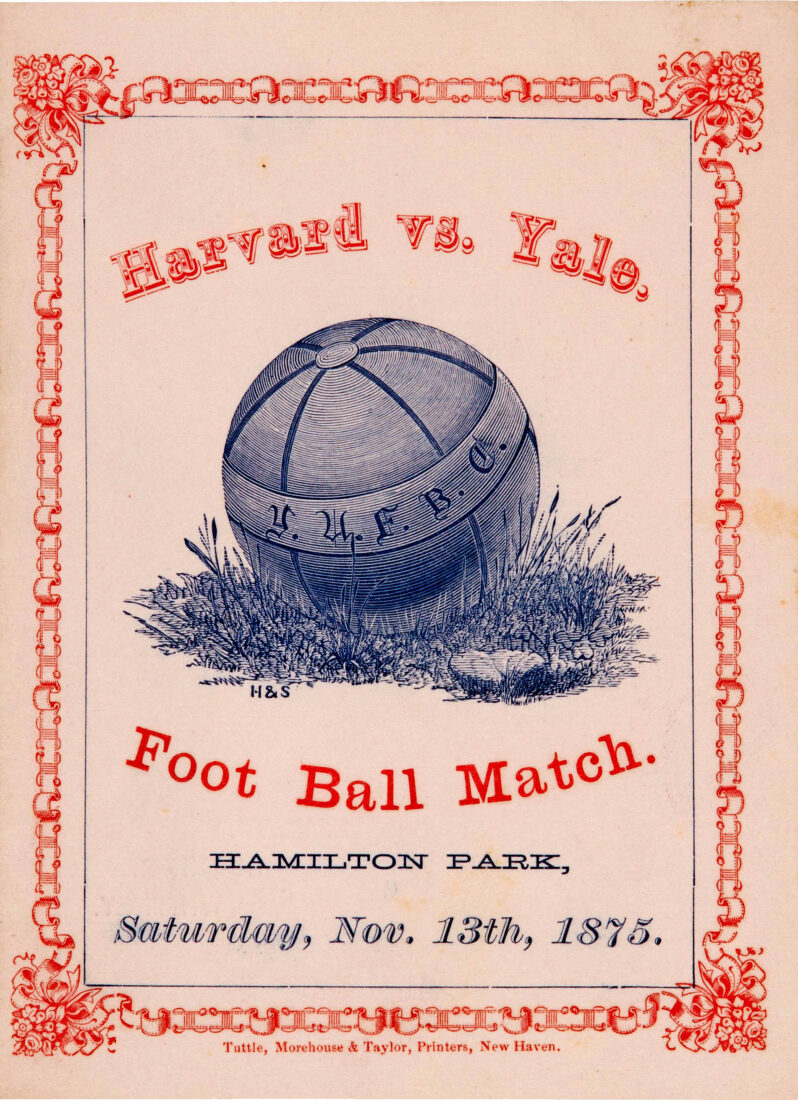
Program for the “Foot Ball Match” – Harvard versus Yale – the first intercollegiate rugby football game between Ivy League teams. The two teams played with 15 players on a side.
Since those early days there have been streaks in the series where one team or the other have dominated – Yale has won the last four, and Harvard won nine straight from 2007-2015. This year, the Crimson sit atop the Ancient Eight standings, and the Bulldogs are in the middle. A Harvard win could secure a bid the NCAA Football Championship Subdivision playoffs and make no mistake the Bulldogs would like nothing more than to spoil that party.
Edge: Yale
Factor 2: Venues
As noted above, both Harvard Stadium and the Yale Bowl are superior spots to Fenway Park for watching football, but of the two, which is the better place to experience The Game?
Football historians know that Harvard Stadium, built in 1903, was the nation’s first concrete and steel reinforced sports venue of any kind. Soon thereafter, in those early days when antiquated game rules and tactics contributed to multiple player injuries and fatalities, proposals such as the adoption of the forward pass were initiated to try and make the game safer.
Another change floated was to make the game field larger, thereby spreading out the play and the players from a tightly compacted mass of tangled bodies. No go, said Harvard to the rest of the sport’s power brokers. Our brand-new stadium can’t accommodate such an expansion, so the measure failed. So, the Crimson kept the horseshoe with the arched openings perched on the Boston side of the Charles, and fans today can spy it still as they walk down John F. Kennedy Street, cross the Anderson Memorial Bridge, passing by the Weld and Newell boathouses, just as they have since 1903. It’s an especially spirited approach if a Crimson game happens to coincide with the Head of the Charles Regatta, where one will have to navigate the crowds perched on the edge of the bridge as they watch boats cruise toward the BB&N boathouse just around the bend upriver.
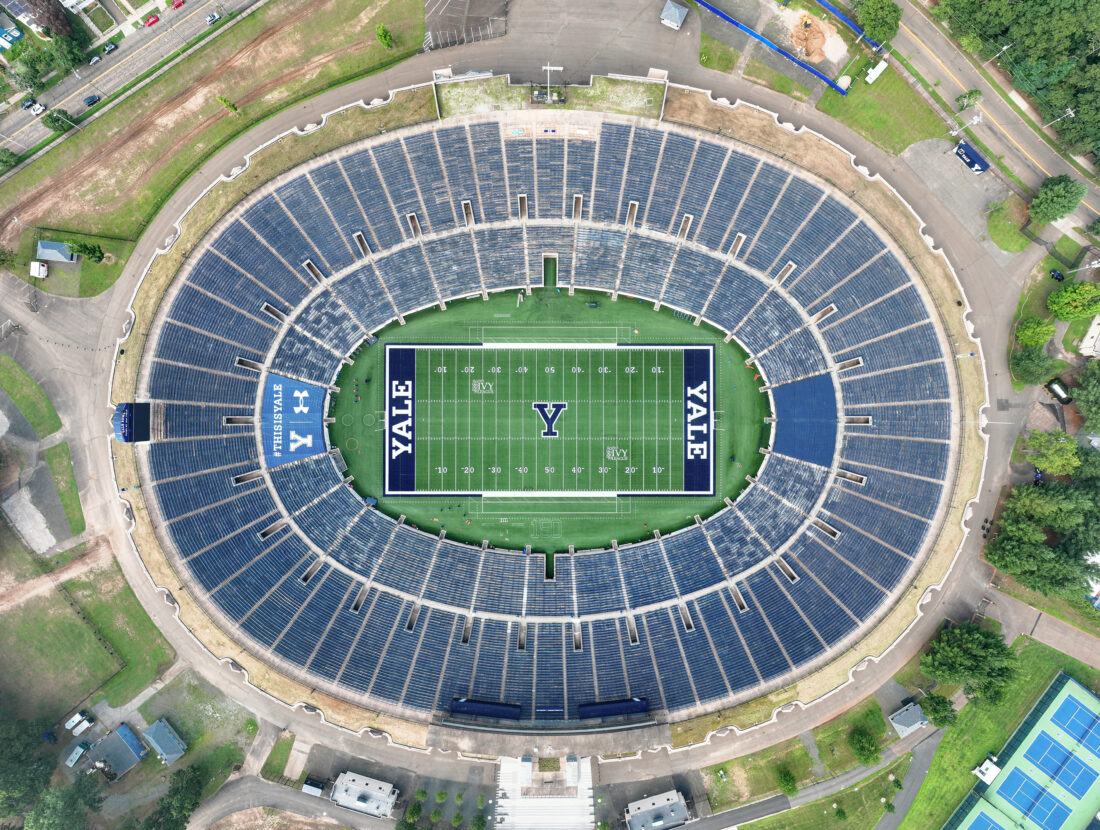
Aerial view of the Yale Bowl in 2023.
The Yale Bowl, which in its heyday in the ’20s and ’30s shoehorned in 80,000 fans, looks now much the same as it did when it opened in 1914. While walking through the one of its 30 darkened access tunnels burrowed into the berm and emerging into a sea of navy-blue benches is a visual treat, the Bowl isn’t an especially good place to watch a game. The bowl structure pushes seats back away from the playing field, as compared to Harvard Stadium where the concrete seating slabs, while uncomfortable, are pitched more steeply and are therefore closer to the action.
And while there are ample fields around the Bowl that make it better for pre- and post-game tailgating, the approach lacks the dramatic and picturesque aspects of attending a game at Harvard Stadium, with apologies to those who take the time to walk through the Camp Gate as they travel up Derby Avenue.
Edge: Harvard
Factor 3: Most memorable edition of “The Game”
Although devotees of both teams likely have their own personal favorites, it’s a lock that most people would point to the 1968 matchup in Harvard Stadium, where the two-time defending league champion Bulldogs, led by head coach Carm Cozza, QB Brian Dowling and RB Calvin Hill, took on the Crimson, led by head coach John Yoviscin and o-lineman and future Oscar winner Tommy Lee Jones. Both teams came into the game with 8-0 records, but Yale, riding a 16-game winning streak, had rolled over the opposition, while Harvard had to battle in close contests, including a 9-7 win at Princeton two weeks prior.
A full house of over 40,000 were in the stands as Yale went ahead 22-0, but the Crimson rallied behind backup QB Frank Ciampi and scored 16 points in the last 42 seconds – with more than a little help from some calls by the game officials, Yale fans will probably say (not wrongly) – with the final tying play the result of a two-point conversion catch by tight end and future Chicago White Sox catcher Pete Varney.
The Harvard Crimson’s headline said it all – and it might be the greatest such sport headline of all time: “Harvard Beats Yale, 29-29.”
Harvard Stadium, November 23, 1968. For the first time since 1909, the football teams of Harvard and Yale are undefeated as they meet for their final game. Final score: 29-29.
And one of the best things about it was a few months later, both Dowling, who would become legendary for his presence as “B.D.” in the “Doonesbury” comic strip, and Ciampi appeared together on an episode of “The Dating Game” television program. It was yet another H-Y tie, for as the Crimson reported “both lost out to some hotshot from the West Coast with a moustache.”
If you are hankering for more on this one, read George Howell Colt’s book The Game or watch Kevin Rafferty’s documentary. Both are great.
Edge: Push (of course)
Factor 4: Fight songs and mascots
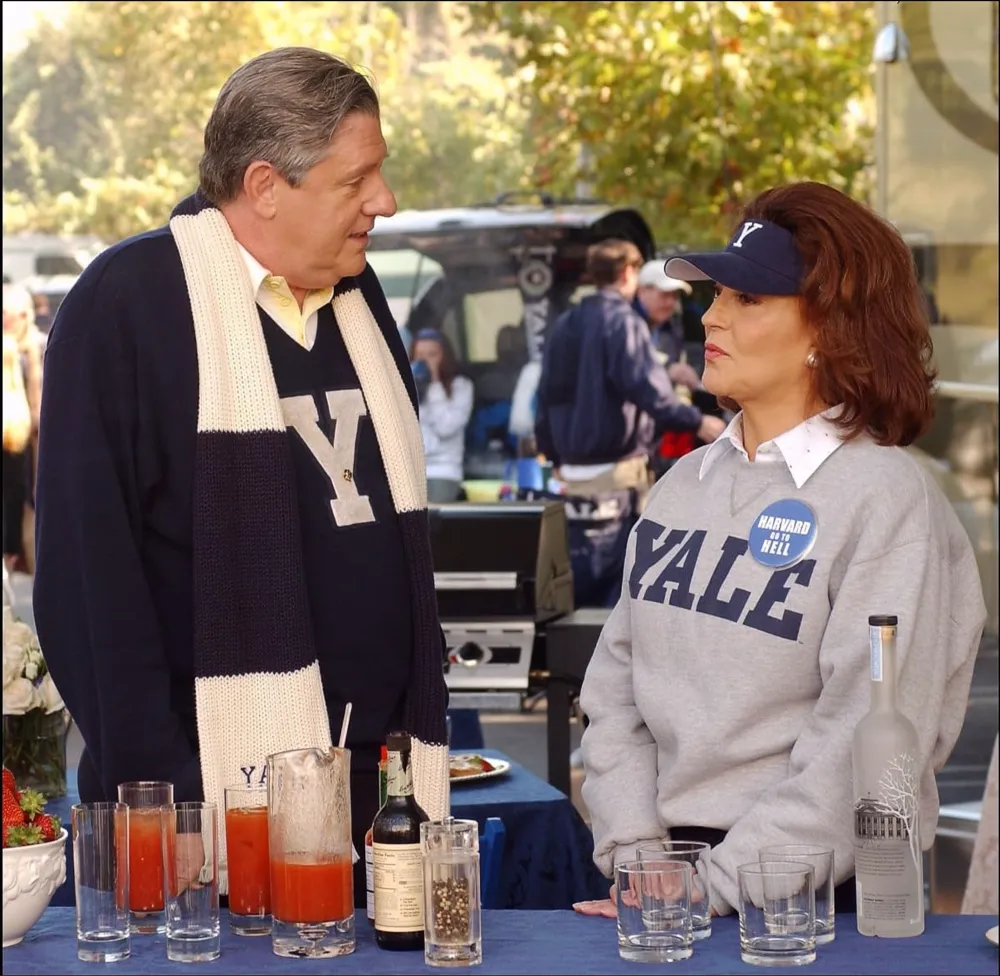
Richard Gilmore (Edward Herrmann) and Emily Gilmore (Kelly Bishop) tailgating at The Game in the TV show Gilmore Girls. In the episode, Richard Gilmore, a Yale alumnus and former member of the Whiffenpoofs, joins current members to sing or the official fight song “Bulldog” (1913) by Cole Porter.
“Bulldog” written by Cole Porter (Yale Class of 1913) during his time in New Haven versus “10,000 Men of Harvard” penned by Murray Taylor and Alfred Putnam (both Harvard Class of 1918) is also a push. Both schools have others great songs as well, most notably “Boola Boola” for the Bulldogs and “Harvardiana” for the Crimson, and most of those are equally good.
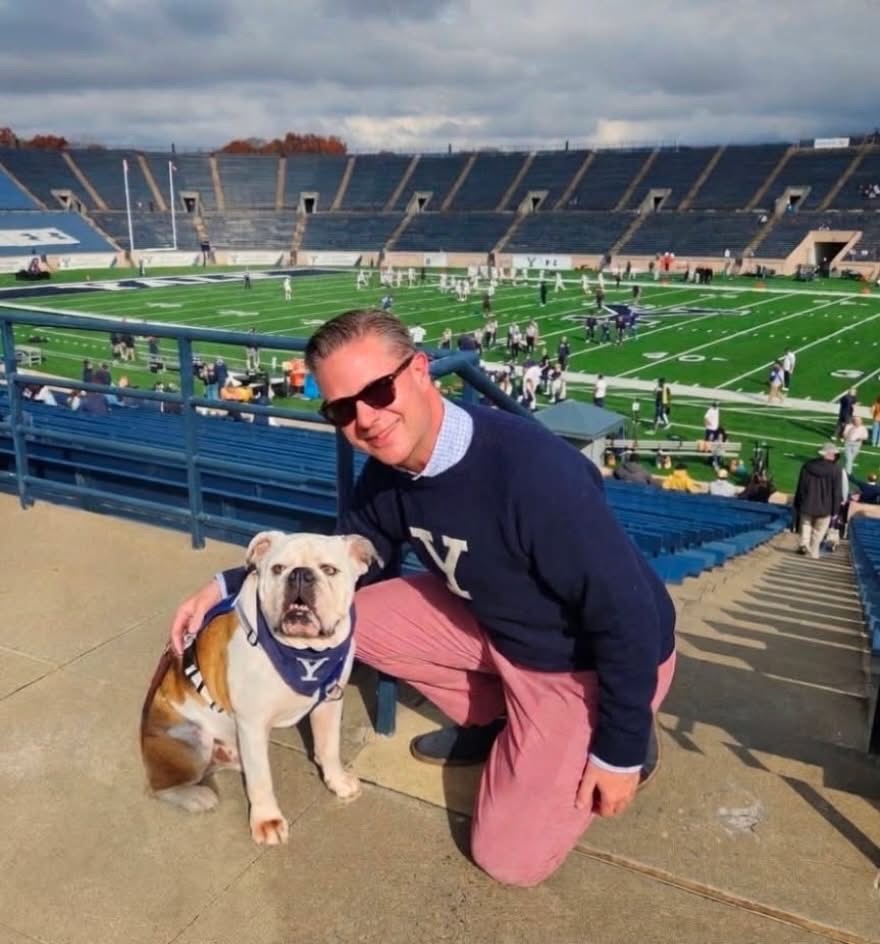
As for mascots, Handsome Dan would win even if Harvard had one. He comes to many games in person, and is a seasoned pro, standing by as fans lavish attention on him, posing with players and their families for each team’s Senior Day photo and curating a fun and happy Instagram presence. The current Dan – Number XIX – is named Kingman, a nice nod to the former Yale president Dr. Kingman Brewster (Yale Class of 1941) who served from 1963 to 1977.
Yale mascot Handsome Dan XIX with Ivy Style editor and publisher Matthew Longcore at the Yale Bowl on November 7, 2026.
Edge: Yale, by dint of the top dog
Factor 5: Uniforms
Of course we have to talk about clothes.
A good friend of mine, a pal from our prep school days, once made the pithy observation that one should immediately be able to tell a team when it sees its uniforms. Lucky him, he’s a UCLA alumnus, and I would argue that the Bruins’ light-blue and gold combination is the best one in all of college football, so he gets to see them all the time when he goes to games at the Rose Bowl.
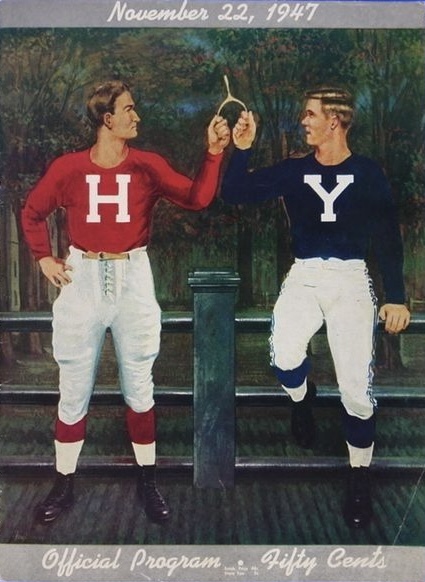
One can do this with Yale. Their current uniforms, with very little adjustments, emerged in the mid-1960s, featuring the now familiar navy block “Y” on a white helmet with two narrow navy stripes along the centerline of the helmet, and when at home, the now-familiar simple navy jerseys with white numerals (block then, rounded and serifed now), and white pants with two navy stipes down each side. The blue used was codified as PMS 289 on the Pantone Matching System in the mid-1970s.
The Game, November 22, 1947
As is the trend these days, most schools have alternate or multiple uniform combinations – if you’re not a fan of this, blame the University of Oregon, which through its close partnership with alumnus Phil Knight’s Nike, have 300 or so potential combinations of helmets, jerseys, pants, and cleats. Once in a while Yale falls prey to this, sporting navy pants. Harvard has gone in for the Oregon-ization trend as well, favoring all crimson, or all white, or crimson and white, or black and white, or black and crimson.
A decade or so ago, when Yale wore what Yale wore and Harvard wore its’ crimson helmets and jerseys and buff pants, all with just a smidge of black trim, that this factor would have also been a push. No more.
Edge: Yale – by several yards
Factor 6: Campus adjacent clothiers
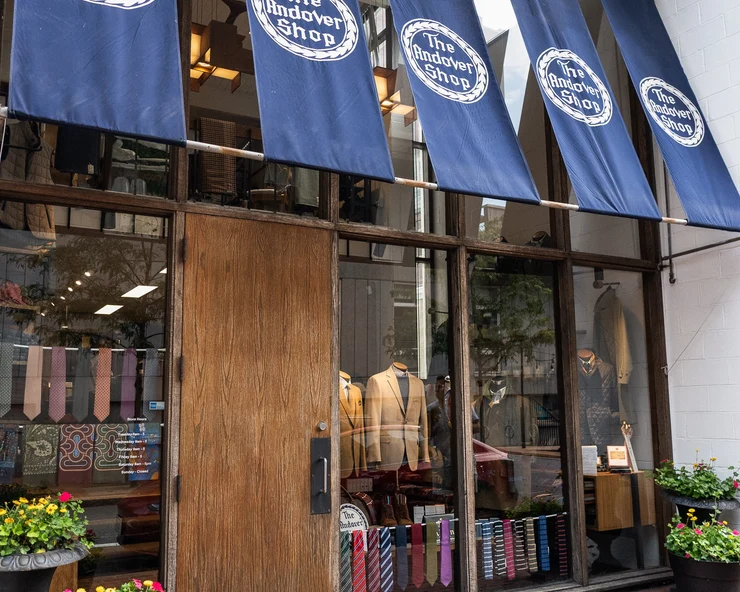
Awhile back, this also would have been a lock – for the Crimson – thanks to the Harvard Square presence of J. Press’s marvelously cluttered ground floor enclave in the former D.U. Club (a.k.a., the “Duck”) near the corner of Mt. Auburn and Dunster streets, along with The Andover Shop, just around the corner at 22 Holyoke Street, with its five Andover-blue strip awnings over the entrance and equally chockablock displays inside. Sadly, only the latter survives.
The Andover Shop at 22 Holyoke Street in Cambridge, Massachusetts.
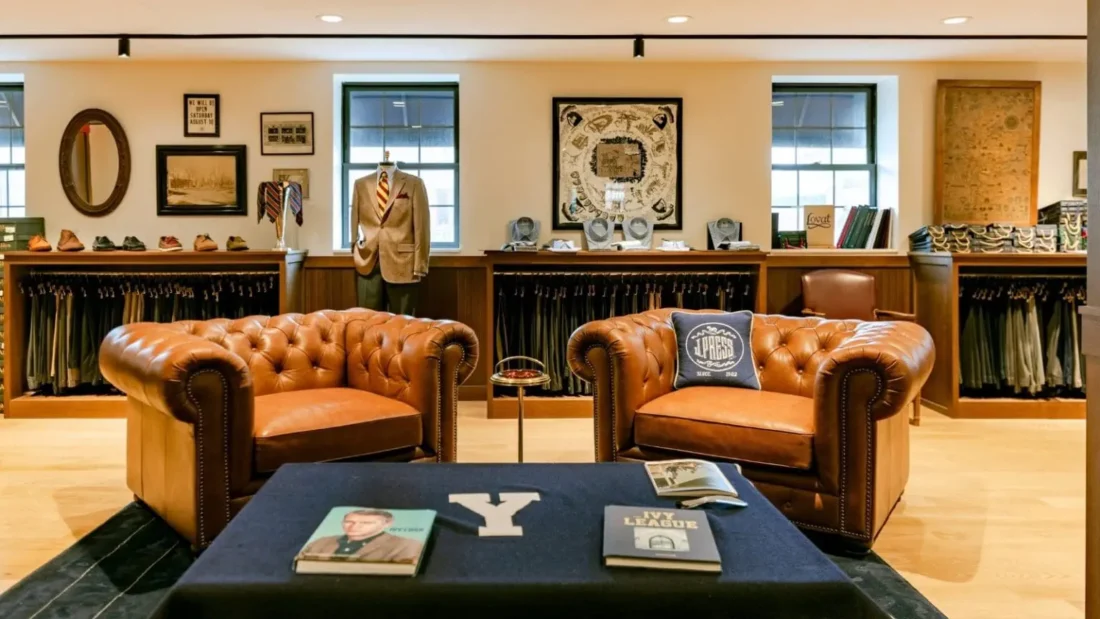
In New Haven, the recently rejuvenated J. Press store near the corner of Elm and York streets has brought Yale equal to Harvard. In addition, both campuses have a solid selection of licensed products fit to wear in the stands or on the sidelines this Saturday.
J. Press at 262 Elm Street in New Haven, Connecticut.
I guess the best way to settle this one is to see how many fans at Fenway pair their school gear with a pair of Cambridge fit wool and cashmere whipcord trousers from The Andover Shop, and a Chrysalis for J. Press black and white tweed herringbone field coat. Throw on a pair of L.L. Bean boots, especially if it’s rainy. Whether you’re in Harvard crimson or Yale blue, it’ll all work perfectly, and we’ll have a tie as glorious and memorable as that one back in ’68.

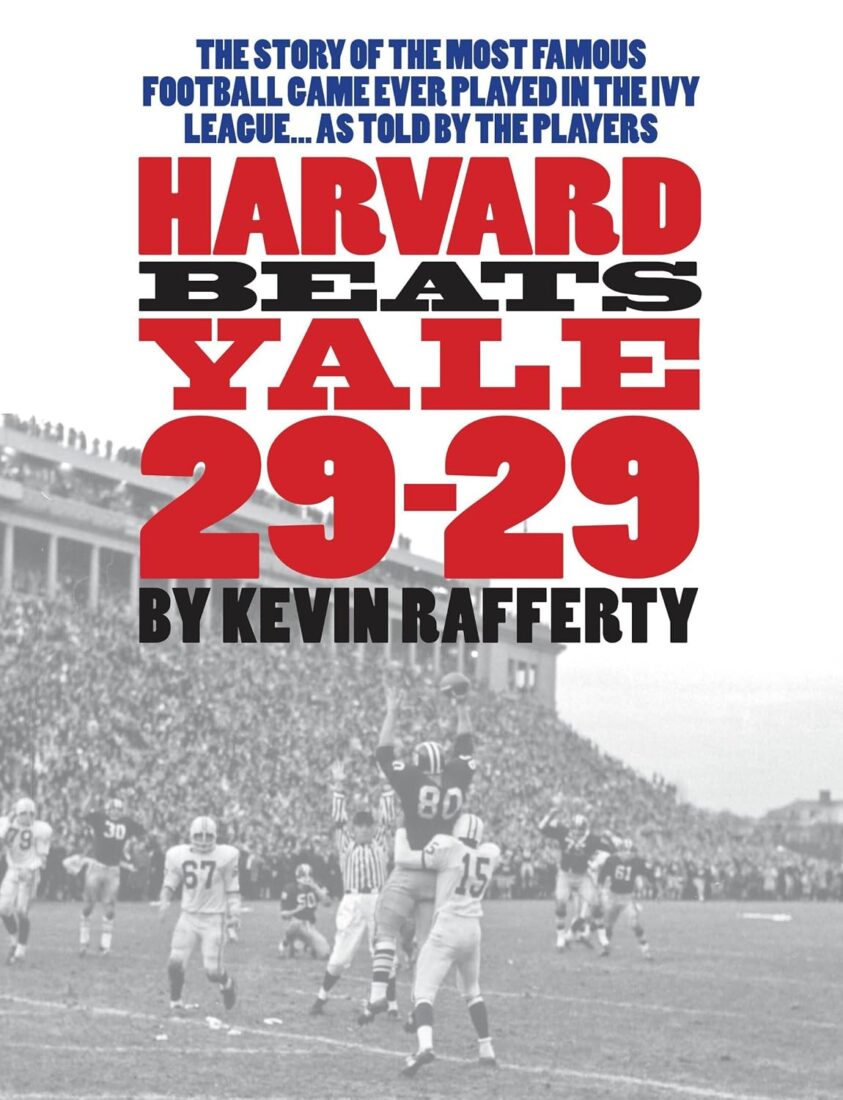




In 2009, I watched a great documentary on the 1968 game that was titled “Harvard beats Yale, 28-28”. I think it aired on HBO.