Interview with J. Press President & Creative Director Jack Carlson
November 21, 2025
Ivy Style editor and publisher Matthew Longcore had the opportunity to interview J. Press president and creative director Jack Carlson. Here is the transcript from the interview.
Dr. Jack Carlson, Creative Director & President, J. Press | Est. 1902
Matthew Longcore:
You hold a doctorate in archaeology from Oxford. This is a somewhat unusual background for an executive in the clothing industry. And yet there may be a common denominator between these two seemingly disparate interests. Your doctoral dissertation mentions anthropologist David Miller and his work on materiality. Miller has written on the subject of clothing as material culture. Do you see your own interest in clothing as part of a broader anthropological perspective?
Jack Carlson:
Like most archaeologists, I watched too much Indiana Jones as a kid. But archaeology is essentially the study of material culture — the study of things — and I’ve always been interested in things: material objects and their meanings in terms of status, power, culture, and belonging. This includes clothing, of course. I’m interested in the ways humans choose to dress and adorn themselves — and why. Some of it has to do with what you might call practical considerations: the physical properties of certain cloths or materials; or the ways in which a garment is cut or constructed. But even more has to do with the cultural and social connotations of particular materials and garments. And this is true of what we call “Ivy style” or the “Ivy League look.”
I think my background in archaeology has made me particularly attuned to — some might say obsessed with — small details. It’s also made me very big on reading and research. After all, 70% of archaeology is done in the library (and “X” never, ever marks the spot!).
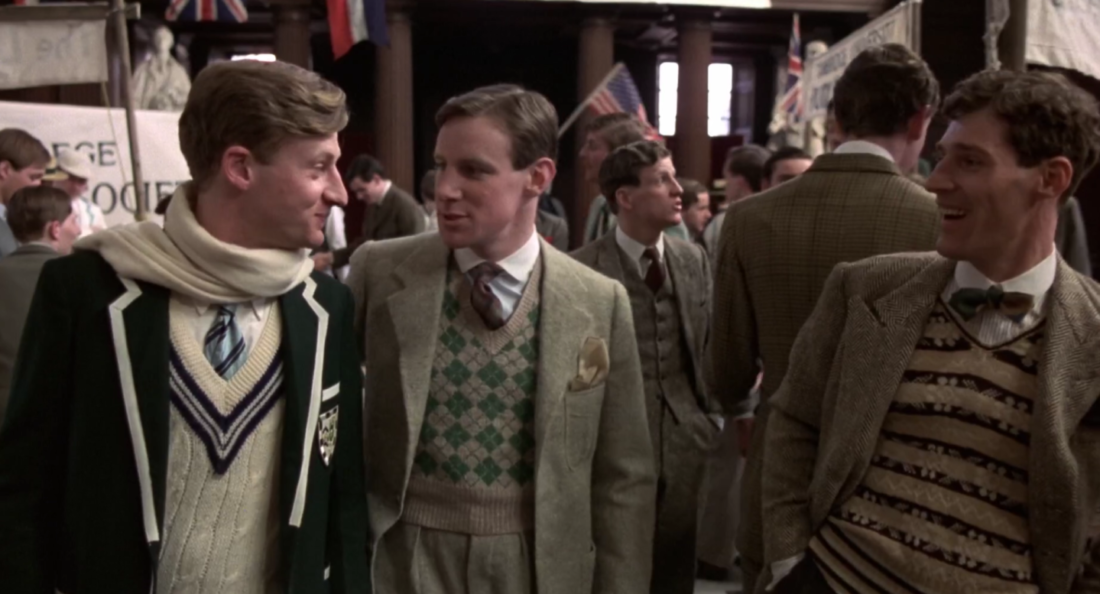
I’ll also add that I loved my time at Oxford. It helped to inform my sense of style and helped to deepen my understanding of menswear. So much of “Ivy style” traces its origins back to Oxford and Cambridge, and British boarding schools, and the clothes historically worn in those places for sport and leisure.
Oxbridge style in Chariots of Fire (1981)
Matthew Longcore:
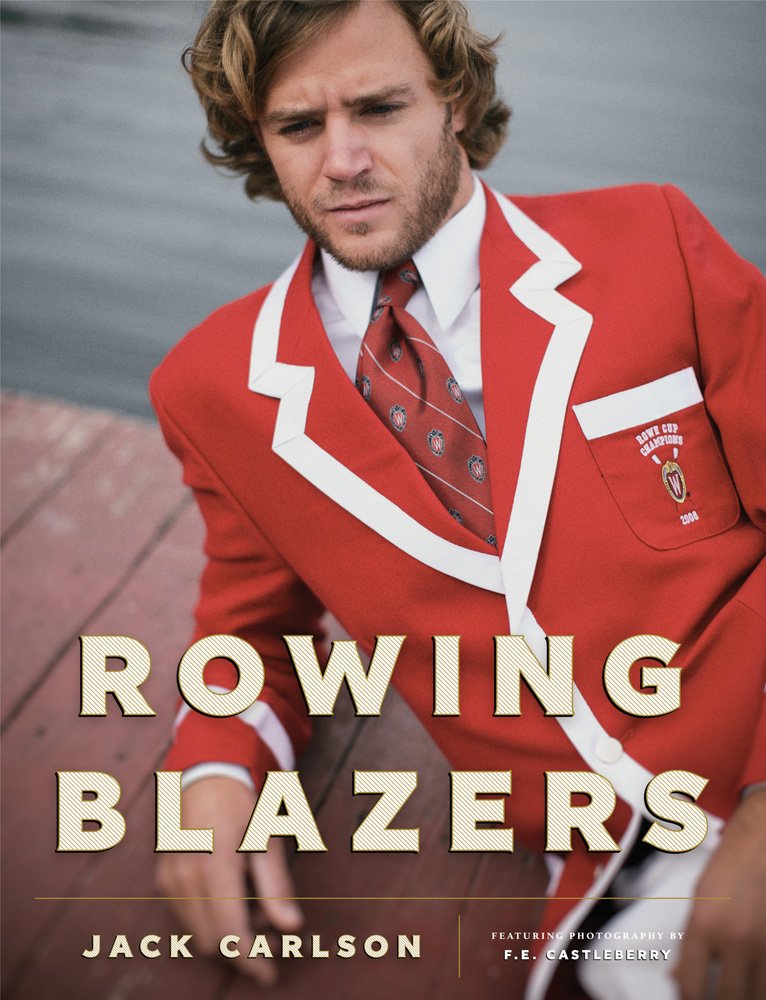
I read that Ralph Lauren discovered you through a pre-publication copy of your book Rowing Blazers and that he hosted a series of launch parties to promote the project. This served as your entrée into the apparel industry and inspired you to launch your own brand, also named Rowing Blazers.
Since then you have often been compared to Ralph Lauren. Do you admire Mr. Lauren and do you see yourself as following in his footsteps?
Polo Ralph Lauren, Fall/Winter 1988
Jack Carlson:
I was out on a bike ride around Oxford one day, and felt my phone vibrating. I pulled over and looked at the phone: it said the incoming call was from “Ralph Lauren.” I thought it must have been about an online order or something, but I didn’t remember placing one. I answered, and I found myself speaking with Jerry Lauren — Ralph’s brother and the head of menswear at RL. My publisher had sent a pre-publication copy of my book to the RL office, and it ended up on his desk. He told me he loved the book and that he had shown it to his brother Ralph, and he loved it too. He invited me to New York to meet with them, and that’s how that partnership was born. They were so supportive and thoughtful. That’s what led to the launch of the Rowing Blazers book and ultimately the Rowing Blazers brand.
It’s funny being at J. Press now. I think as a business, RL is very different from what we’re doing at J. Press — though in many ways, J. Press is an important antecedent for Ralph Lauren. J. Press is the great granddaddy. The original Ivy brands like J. Press created the vernacular that younger, (much larger, more mainstream) brands like Ralph Lauren popularized later in the 20th century.
I have tremendous admiration for – and draw great inspiration from – Mr. Lauren and his company. I think Ralph Lauren both as a brand and as a person has been instrumental in keeping this style of clothing, “Ivy style,” in the mainstream. At the same time, Ralph Lauren is so big that it’s really its own genre at this point — and it goes well beyond Ivy: it’s the American west, it’s Jamaica, it’s the workwear world of RRL etc.
I’m so grateful to Ralph Lauren for all he has done for me, for the industry, and for American style.
First edition of Rowing Blazers (2014) by Jack Carlson (Author), F.E. Castleberry (Photographer)
Matthew Longcore:
The Financial Times (September 8, 2025) called you “the king of preppy.” What do you think of that title? When it comes to clothing and style, what do the terms “preppy” and “ivy” mean to you? Where does J. Press fit in?
Jack Carlson:
Ha — I often try to avoid the word “preppy” actually, because it means so many different things to different people. What I think about with that word, mostly, is The Official Preppy Handbook. My mom gave me her copy when I was in high school. Growing up, I dressed pretty “preppy,” if I can use the term, although for most of that time it wasn’t necessarily the cool thing. When I went to school in England as a kid, I had to wear a uniform everyday — complete with a little wool cricket cap and everything. And I used to keep it on all evening after school just because I liked wearing a blazer and tie. Back in the U.S., I wore hand-me-down Lacoste polo shirts, cricket sweaters, and old yacht club sweaters from my parents, and rugby shirts I had picked up during family trips around England, Ireland, France, and Italy — while virtually all of my classmates were wearing head-to-toe Y2K era Abercrombie.
Then a funny thing happened my senior year of high school: a brand called Ralph Lauren Rugby launched. And, at least in my corner of New England, that became the new cool thing. And suddenly everyone was dressing like me! But that was how I had been dressing the whole time.
“Ivy,” if you make the distinction, is much older, subtler. More academic, more tweedy. To introduce another modern-day term I despise, it’s more “old money.” And J. Press is quintessential Ivy.
But like Supreme Court Justice Potter Stewart said of pornography, “I shall not today attempt further to define the kinds of material I understand to be embraced within that shorthand description, and perhaps I could never succeed in intelligibly doing so. But I know it when I see it!”
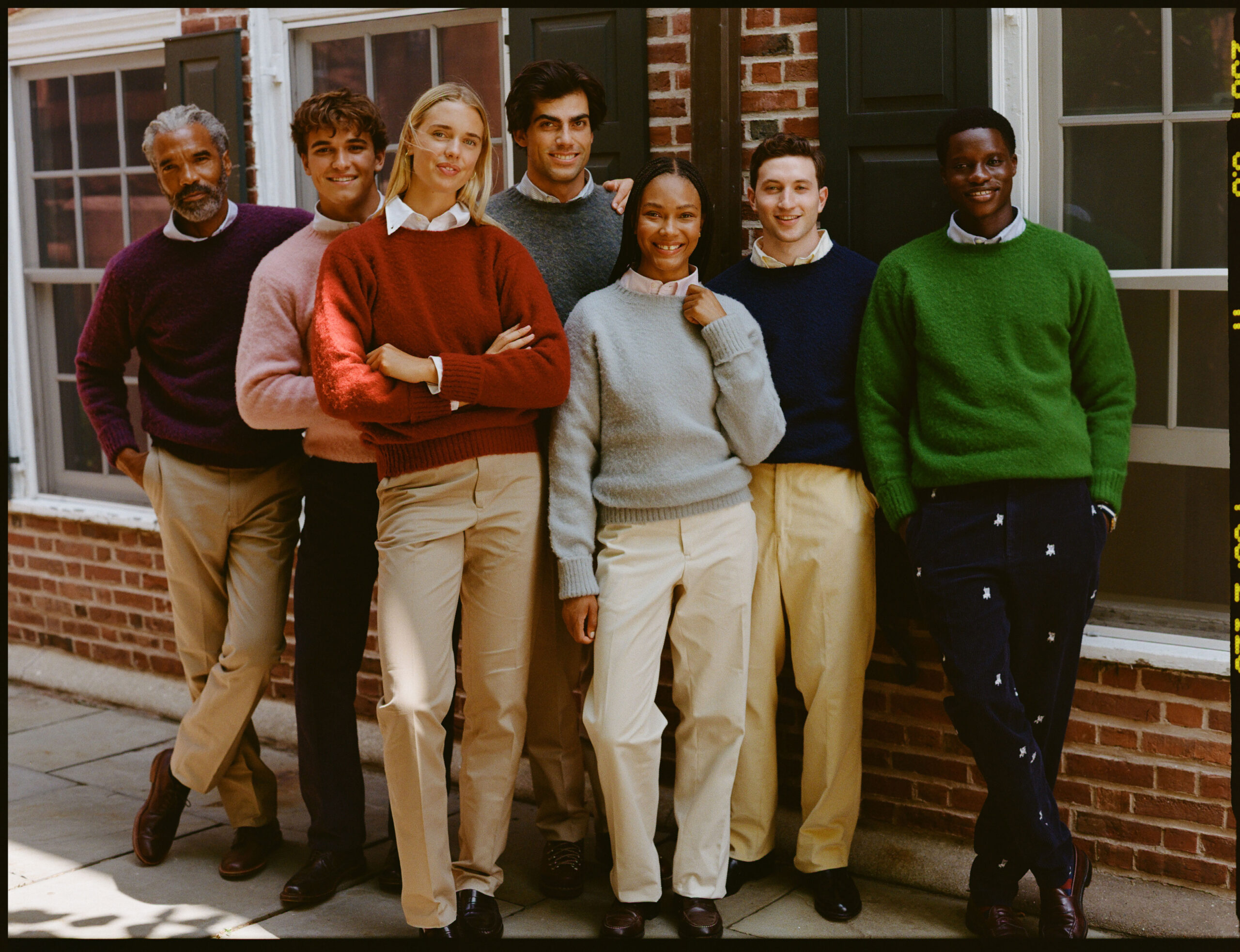
J. Press FW25 Lookbook
Matthew Longcore:
The Official Preppy Handbook references J. Press and describes its customers as “ultraconservatives of the Old Guard.” That book was published 45 years ago, so much has changed, but there is still a sense that J. Press is one of the last vestiges of traditional menswear in America. How can J. Press attract a new generation of customers while at the same time retaining its traditional constituency?
Jack Carlson:
I love it. Nowadays, we hear the word “conservative” and probably think politics, though of course that’s not what Lisa Birnbach meant when she wrote. I think in some ways her sentiment is truer than ever. As many of the other old American men’s brands have turned in different directions, changed hands, or gone bankrupt in the last several decades, J. Press is, more than ever, the last bastion of real Ivy style and classic American menswear.
I plan to embrace that, and to make J. Press, more than ever, the standard bearer for Ivy style. I grew up with J. Press, shopping at the Harvard Square location — so a lot of the J. Press staples are almost sacred to me.
I’m also an academic: I’ve spent large chunks of my adult life reading and researching, especially when I was a doctoral student at Oxford — so I am a great believer in rigor, research, and authenticity.
I think all of that is actually the key to attracting a new generation. Thoughtful people with good taste like and appreciate authenticity, regardless of their age. So really, I think the key is in not dumbing it down. Not trying to give it a more “mass” appeal. I think these are moves that some of J. Press’ historic competitors have made over the years, and I don’t think it’s worked out particularly well for many of them.
Made-in-America, Made-in-Scotland, Made-in-England: these are aspects of the brand that are extremely important to me. So is classic Ivy styling, and so are all of the classic Ivy details.
When my appointment was announced, I found it funny to read what some of the armchair pundits were speculating about what I’m going to do at J. Press — suggesting that I’m going to make it “zany,” or I’m going to water it down. A few people seemed to think I would just recreate the Rowing Blazers brand all over again, having sold it two years ago. I saw someone speculate that I was going to move our Shaggy Dog sweater production out of Scotland and change it to a polyester blend! Whoever these people are, they clearly don’t know me at all.
I’m not a one-trick pony. And a few items at the top of my list when I joined J. Press included: bringing back our focus on products made in America, Britain, Canada, Ireland, Norway, etc.; launching a creators series to highlight the people, places, and processes behind our most important categories; bringing back the Ivy-purist blazer, with the patch chest pocket, which J. Press, to my surprise, had not run for some time before I arrived; restoring the original color length and collar roll on our O.C.B.D. shirts, which is underway now; a renewed focus on the flap-and-patch Oxford shirt, for which J. Press has historically been known; restoring the historic white-and-red, slightly wonky, J. Press woven label; and all sorts of other small changes to bring the brand back into line with its heritage and pedigree, like grosgrain lapels rather than satin on our formalwear.
This is just the beginning, and not all of these changes can happen overnight. And, of course, there’s a lot of product that was developed and ordered before I arrived that we are selling now; and a lot of things I’m working on developing that are not ready yet.
But, from my perspective anyway, these are all changes that take J. Press back to its rightful place in the Ivy pantheon — rather than taking it to some new, uncharted place.
If you looked at the product assortment, the styling of the campaigns, etc., before I arrived, you would have seen a brand that was not fully embracing its core ethos in my view. You would have seen some product that was more Italian-leaning, or more generic-contemporary. Some of it sold well, but to me that is not the point if it does not connect directly back to the things that make us J. Press. So I’ve worked to phase out things that take J. Press away from what the brand is all about. And before I joined, you would have seen some styling choices which, at least from my perspective, did not have much to do with classic Ivy style. I’ve tried to change that too.
Maybe that makes me a reactionary — an “ultraconservative of the Old Guard” in Lisa Birnbach’s words. So be it. I’ll take it!
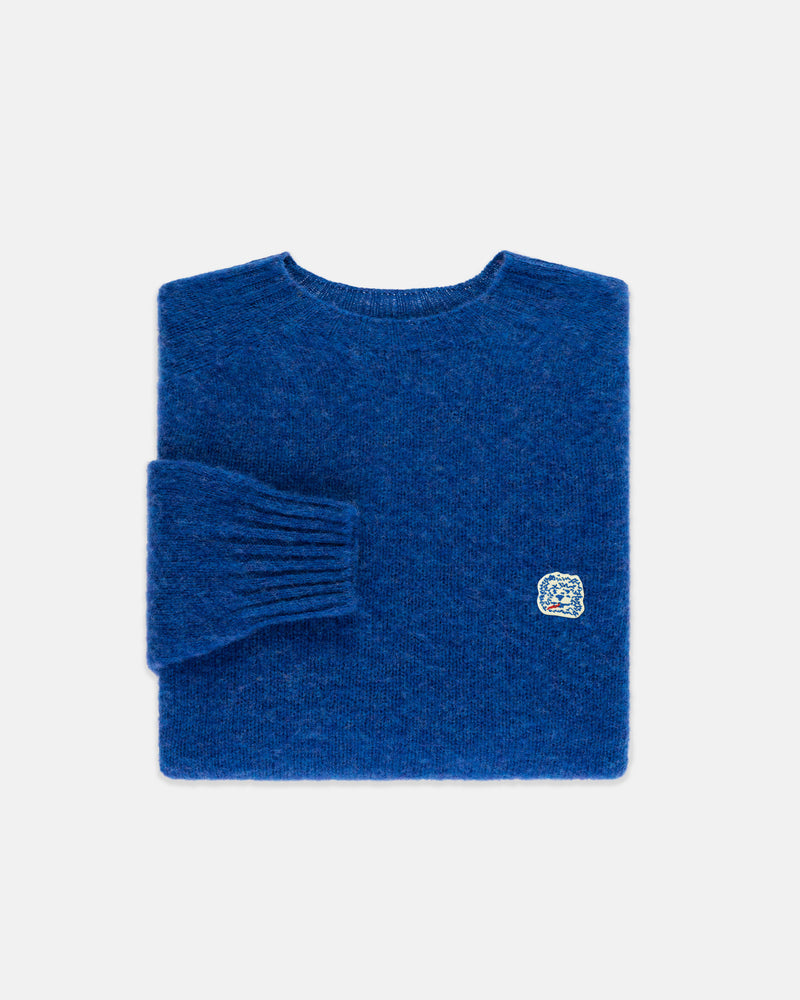
That’s not to say we can’t have fun. And part of me, perhaps, even likes getting a rise out of those who are determined to flip out. I introduced a version of the Shaggy Dog sweater with a little shaggy dog face (the one from the original label, which we’ve also brought back) as a Lacoste crocodile-style patch on the left chest. Not instead of the classic, patch-less, Shaggy Dogs. But in addition. And a couple people had full-blown meltdowns. Their minds could not comprehend. Or, at least, they pretended that their minds couldn’t comprehend. But that smiling little Shaggy face has proven extremely popular — and to me, they don’t take anything away from regular, plain Shaggy Dog sweaters! I own and wear both.
We can also have fun with a few unexpected collaborations or editorial pieces. That’s part of the job, and part of what I enjoy about it. But in my view, 90% of the business should be the core classics. And that’s where 90% of my energy is going — into making sure that we are doing those core classics better, and more consistently, than ever, and with all the correct details. I think that’s the real key to attracting new customers and doing the very best for existing customers.
Made-in-Scotland Medium Blue Shaggy Dog Icon Sweater
Matthew Longcore:
The Ivy League look has been described as distinctly American, and yet we hear so many references to its English roots. How indebted is Ivy League style to England, and to what degree is the style truly all-American? How much of the current offerings from J. Press are made in the U.S.A.?
Jack Carlson:
I’m proud to say that the majority of J. Press’ offerings are made in the U.S.A. And of the rest, the vast majority are made in the U.K. and Canada. We don’t aim or purport to be a brand that makes every single item in every collection in the one given place. But I’ll go out on a limb and say that I don’t think there’s any other American menswear brand of J. Press’ size and scale making such a large percentage of its offerings in the United States. And that’s a great point of pride for me.
Our Austrian jacket is made in Austria; our Norwegian sweaters are made in Norway; our madras is from India; and our Aran sweaters are from Ireland, and so on.
Forty years ago or more, there were other brands alongside J. Press operating the same way. But today, in many ways, we are the last brand standing. I feel and bear the burden every day of keeping these factories going, and keeping the men and women who work in them employed. And, ideally, helping these factories to scale up and improve their operations. It’s a big responsibility, and it’s also an exciting opportunity. Everyone who shops at J. Press is part of this project too.
I love meeting the people behind our products. On my second day at J. Press, I met a gentleman who has been making ties for J. Press for over fifty years. He’s a Holocaust survivor who came to the U.S. as a teenager. He was in Auschwitz during the war. He’s in his mid-nineties, and he still comes to the factory almost every day. People and stories like this are part of why J. Press is such a special brand and place to work.
To answer your question about England — What we think of as Ivy style owes a huge debt to England. So much of it comes from the leisure and sporting attire traditionally worn at Oxford, Cambridge, and the great British boarding schools. That’s a big part of my world and my life personally, having grown up in England as a little kid and having gone to graduate school in the U.K. I think it informs my perspective on all of this, and on what I’m doing at J. Press.
And I think we can do more in that vein. When I arrived, we had button-down collar shirts and point-collar shirts in our ready-to-wear collection. But we didn’t have too many of what I would call proper dress shirts. English-style shirts, with a spread collar. And I know we can make them. We can make them in America, and we can make them really beautifully. With that swelled seam on the collar, etc. Some might think of it as being a little more British, but I think it has a place in our world.
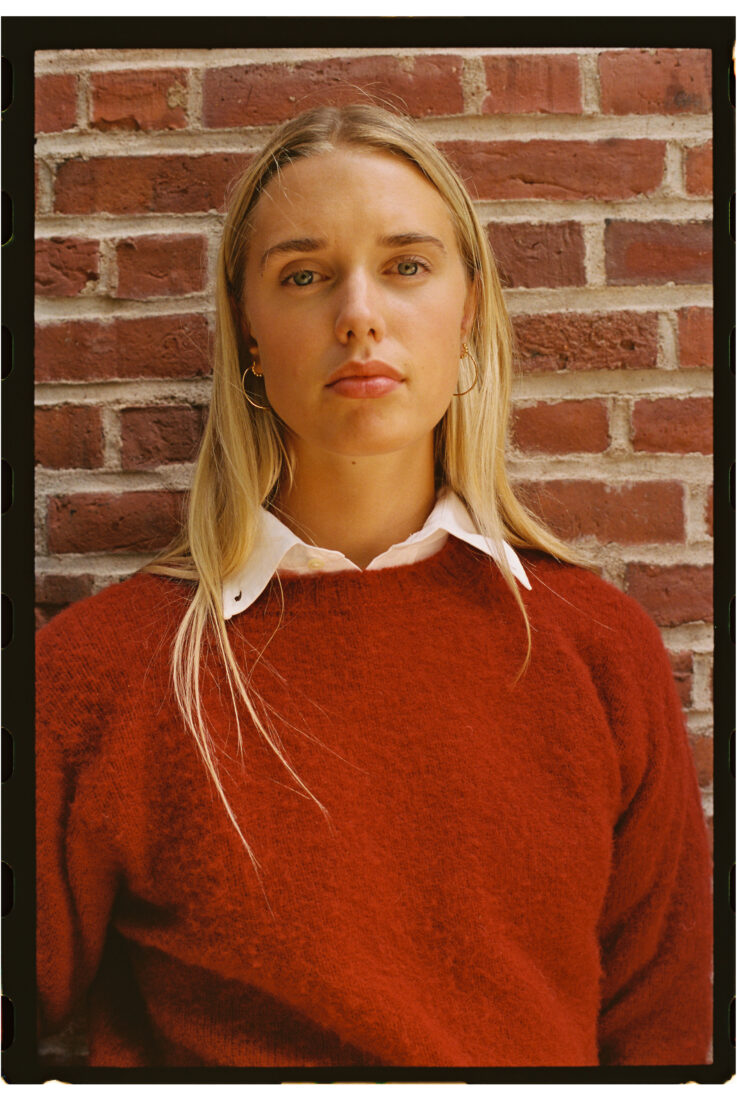
Yale University senior Imogen Cabot in the J. Press FW25 Lookbook
Matthew Longcore:
J. Press is still considered a menswear brand. However, some of the models in the latest collection like Yale senior Imogen Cabot are women. Are you planning an upcoming launch of a women’s line from J. Press?
Jack Carlson:
I play with the idea. Not the idea of doing a full-blown women’s collection, but instead taking our core items and making women’s versions and fits. The exact same quality, make, etc., but for women: American-made Oxford shirts, blazers, khakis; Made-in-Scotland Shaggy Dog sweaters, and so on. Just really good, classic pieces in women’s fits. The demand is there; I hear it everyday.
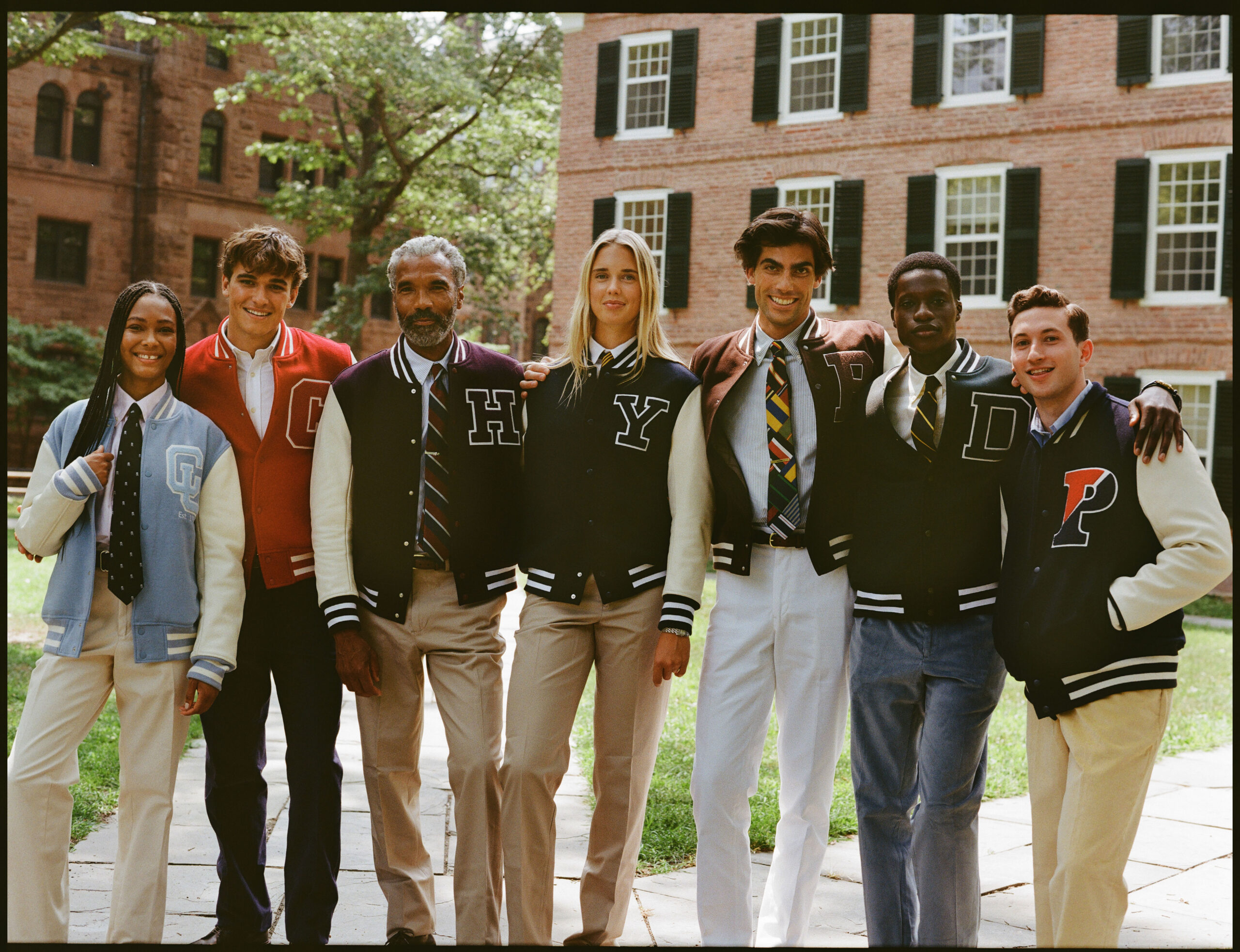
Ivy League style in the J. Press FW25 Lookbook
Dr. JackCarlson is the Creative Director and President 0f J. Press, established 1902.
FW25 Lookbook. Many moons ago, I wore a pair of pastel yellow trousers just like those. Very cool and comfortable for spring semester.
Let’s make a deal. If you were to make provisions for a pen/pencil slit in the patch and flap pocket OCBD, I will purchase one white, one blue, and one blue U-stripe to start. I’m sure the factory can easily make that adjustment. If you are not familiar with what I’m referring to, have one of your guys pick up a surplus light green US Army class A/B uniform shirt and reverse engineer the pocket flap. It’s not complicated. It may not be “Ivy” to cary a pen or a pencil, but it can be a handy option.
Agree wholeheartedly, ‘Bopper! Or better yet, leave the flap off the pocket and add a little bit to the bottom line. The bean counters always like that!
First, Matthew great interview . I like some of ideas, but also “dancing with the girl that brought him there”. The idea of not dancing with the girl can be seen when BB screwed up the OCBD shirt ( a golden goose) and also brought out the no-iron models that did not .breath. I noticed that he is bringing back the contrasting collar and the old school collar bar on the straight collar shirts. I think it was a big mistake that they closed the Cambridge store and didn’t find another location in Cambridge. I wish him well.
Not a comment but a question, preceded by a recitation. Clearly the Ivy League look is closely linked to the UK and still is because her woolens, especially tweeds and Shetlands, are simply exquisite. There is also the sartorial vibrancy of the repp tie. Now for the question: Was there ever, in the UK or Ireland, a tweed jacket cut as comfortably as a 3/2 sack? I take it as an assumption that no British shirt ever approached the billowy comfort of the unironed OCBD of Mercer or Brooks of old. (Sorry, Press, but your exquisite OCBDs have always felt the tiniest bit more trim, not necessarily a bad thing.)
The uniquely American take on the “civilian sack coat” is a salute to the British soft tailoring tradition, which, these days, receives very little attention in comparison/contrast with the more military-tending and urban (London) professional tailoring that dominates Savile Row. The Scholte drape (Anderson & Sheppard) is marketed as soft because of the padless construction, but the intentionally wide shoulders and emphasis on pronounced tracing through the middle render it something altogether different than the American take on the sack. The early twentieth century Brooksy sensibility was a marriage of sport and country, guided by an obsessive focus on comfort. Hence the “billowy comfort” of the Scottish Cheviot (oxford cloth) “polo collar” shirts. The American innovation, a feature of neither British nor Italian tailoring, was the utter lack of tracing/tapering through the chest and waist. By contrast, the shape of the narrow-shouldered sack, appears almost convex. Menswear snobs will insist that it looks horrible because of the ample dimensions through the middle. So be it –and who cares.
The idea is to create a straight vertical line from the armpit to the widest part of the hips. If your shoulders are wider than your hips it may result in a **slight** V-shape. The hour-glass figure or the adolescent boy figure took over menswear in the late 90s as I recall. It was prominent on variety TV shows of the time, and I can think of no constructive purpose for it, other than it was an extreme reaction against the 80s shoulder pads. It certainly could not have been comfortable.
Mr. Johnson: Richard Press at the moment is alive and well in fruitful retirement thrilled by Jack Carlson’s interpretation of the unique requirements moving the brand forward in these challenging times.
I was never a loyal, committed J. Press customer in any sense of this phrasing. The men in my family loitered at a half a dozen “southern collegiate” men’s shops, many of them adjacent to campuses, throughout the latter part of the twentieth century. Those suits, jacket, pants, and topcoats, all remarkably well made of superb cloth, are still serving me well. Presbyterian thrift remains a nurtured value, so, if/when I indulge, it will be sale time. Which is to say: from a purely marketing perspective, I am not J. Press’ target audience.
If Mr. Carlson and his team have the backing of the Japanese firm that owns J. Press, I’m not sure how he can fail. The current “preppy revival,” now a cyclical thing in America thanks to advertisers and designers, will last for at least a few more years — and the brand is fairly well-known because of the circa early 2000s “American Trad” reformation by way of internet forums. Add to this the locations (D.C. and New York), where lots of ascendant and already well-off alums of the preppier schools live. They, well educatedd and equally well connected, can (and will) spend $ on stuff they want but don’t need. Seems a recipe that, to repeat, cannot fail.
I’m too old school/fogey to bend, adjust or compromise, and, thanks to my NYC tailor’s connections, I’m full-go MTM (discounted, thanks very much). Which further confirms I’m not J. Press’ target audience — if I ever was. I think I know too much about cloth and cut to ever return to off-the-rack/shelf, and thankfully I’ve found local tailors who seem pleased to accommodate my admittedly old-fashioned requests (“make the lapped seams bigger”).
I’d welcome broader ranges of Irish Poplin (Atkinsons), Donegal Mist (Magee), and maybe a few cloth books unique to J. Press — unfinished worsted, perhaps?
In this late (stage) capitalism moment for humanity, this is an … “interesting” time to put one’s know-how to work — as an historian/archaeologist/archivist who enjoys excavating “the good goods.” Best of luck.
Dear Ivy-Style friends,
I am personally very happy to see Jack at the the head of this American monument, called J.Press. I know Jack personally and am sure that he will do a wonderful job at J.Press. Just because he has the cultural background and the education to do so. All the best Jack, from my side. Amtiés, René
Encouraging interview for sure! And boy do I miss the days of perusing the Harvard Square shop.
There was talk a few years ago of bringing J. Press back to the Boston area. I hope it’s still in the works.
Great in-depth interview. I appreciated hearing about Jack’s reasoning for offering shaggy dogs with the patch and other ways, as whiskeydent put it, “make your lane wider” while retaining the core items of the brand. His vision for returning the OCBD to its iconic design is a smart move. This year’s lookbook and runway pictorial are both aspirational and relatable. Very tasteful, fun, and full of energy. A quick comparison to the lifeless lookbook of Brooks shows that J Press is the one that knows how to honor older customers, bring in new ones, and continue what Ralph Lauren did with creating a world a person would want to be part of.
Good work! Keep it coming!
Mr. Carlson needs/requires zero assistance from amateurs (like me). This admitted, here are few thoughts:
1. Bring back interesting blazer cloth. There’s no good reason why the old, tried-and-true blazer must necessarily be humdrum. The Press family’s innovations included the bold, steep-ribbed ‘Reefer Twill’ and flannel finished worsteds, so this would comprise a resurrection of a venerated tradition.
2. Broaden the range of Donegal Mist, including stripe and glen check designs. I feel sure the worsted-mohair-cashmere blend is plentiful, and there’s enough for a weaving of dark navy hopsack (see #1). Yet another salute to the glory of a bygone era.
3. Offer a reasonably priced worsted flannel “chino” in a couple of shades of gray. Unlike dressier styles, which usually include welted pockets and hook clasp, this would be lightweight flannel (9/10 oz.?) constructed with specifically chino details: patch pockets, button fly, larger belt loops, full-fitting and comfortable. Bill Thomas (Bills Khakis) offered this sort of pant for several years — to great acclaim.
4. Invite a weaver/mill to produce an 11/12 oz. Shetland cloth book that’s unique (exclusive) to J. Press. Having dabbled in the business, I’m aware that the weaver who weaves Shetland for Harrisons Ltd. could (would) do this. We would leave it to Mr. Carlson, archaeologist and historian, to excavate the J. Press archives for the herringbones, checks (glen, club) and hopsacks that will stand the test of time. Yesteryear J. Press was famous for the impressive array of homespun Shetlands.
5. Broaden the range of Atkinsons Irish Poplin. J. Press is one of only a very few (less than half a dozen) American stockists of this unique worsted wool/silk blend, and likely the best known of the bunch. Creatively redesign some of the better-known stripes presently lacking, including Fife & Forfar Yeomanry (Ben Silver’s bestseller for decades), British Olympic (a salute to ‘Chariots of Fire’), Royal Cruising Club (a personal favorite), and Old Downside.
6. Introduce a range of Shaggy Dog colors (yarns) that are heathery/mottled. One of my favorites is ‘Ugie Pearl.’
7. Advise that highly esteemed New England shirt maker to replicate the Mercer collar circa early 2000s. The desired collar roll demands zero lining/fusing, but also a pre-wash length of app. 3.625″. This harkens back to the 1980s era Brooks “Paterson, NJ OCBDs.” (Thankfully I stocked up around 1987).
I like all of these suggestions. In the mid-1960s my “go to” school pants were a very lightweight grey flannel with the same fit and detailing as my khakis. They were great with tweed jackets or flannel blazers in overheated classrooms.
Over the years, especially the working years after the demise of Brooks in the early 1980s, I wore a lot of things from Press, but they were mostly business suits. Being a guy who always had his fountain pen with him, I was not a fan of the flap pocket OCBDs, but I wore a fair number of their broadcloth shirts. I have always had at least one or two Irish poplin ties in my rotation. I would welcome more, especially bows, in stripes that popped. As for the Shaggy Dogs, I think they are lovely, but to buy one when I could get a couple of Harleys and get change back borders on non-sensical to me and the ghosts of my Scottish forefathers on my shoulder.
Ditto. During college I wore the hell out of a few pairs of gray lightweight flannel (wool) pants — tailored by Bills Khakis with chino specs (zipper fly with button at waist, back flap pockets, large belt loops). Another similar pant was L.L. Bean’s legendary “Town & Field Pant.” At least one American (southern) manufacturer could manage this frugally.
* Addendum: do please bring back the classic ‘Shaggy Dog’ brushed Shetland crewneck in ‘Welsh Black,’ a rich, deep, dark brown with some mottling. Yes, another homage to yesteryear Squeeze.
FWIW: new striped OCBD collars are short(and overall small). 3” new, less after laundering. No roll. After several years, I’d imagine they’d be quite short. Mr. Carlson, this is a significant detail to be corrected.
Considering Dr. Carlson’s archaeological and anthropological understanding of clothing in general, and, presumably, its original purpose, it becomes clear that the skinny fit and other abominations are purposely counterintuitive as well as being in poor taste, whereas what we have been given to understand as comfortable as well as in good taste, is in fact a good gift for which we are thankful. God created a variety of sheep, (and cotton and silk), from which we manufacture functional and aesthetically pleasing garments in order to lessen the blow of our predicament whilst exercising our creativity to the best of our ability. For next year’s Thanksgiving Day, I hope to have thankfully acquired a somewhat subdued, 9 oz., autumn colored, smaller scale, gun-club check jacket.
Also bring back a Press favorite nailhead cloth in grey and navy blue for suits.. The reversible tweet and poplin outer coat. was a big seller along with the covert cloth in green top coat with the darker green valet collar
Jack clearly understands that J. Press should do for ivy style what The Real McCoy’s and Buzz Rickson’s and the many other excellent Japanese repro brands have spent decades doing for midcentury American military garb and civilian workwear. Japan has proven that the appeal of meticulously reproduced classic clothing isn’t nearly as niche as the doofuses running Brooks Brothers think it is. Not that J. Press has to be ONLY repro. A Shaggy Dog with the logo on the tag and the front isn’t my thing, but it’s cute–and I’m glad it’s the old logo. The ‘Old Enough to Know Better’ sweater? Less cute, but not bad. Good for Onward for putting Jack at the helm (or in the bow, if he prefers a coxswain metaphor).
Well stated and thank you for the mention of a couple of great Japanese brands who understand and appreciate the appeal of “repro.” This can be done exceedingly well, particularly if close attention is paid to cloth and tailoring specs. Previously I admitted that I may not be J. Press’ target audience because of established loyalties to other tailors and (smaller, family-owned) retailers, but it’s equally true that I (proudly) own a lot of vintage of J. Press clothing. I stocked up during Jay Walter’s brief yet first-rate visitation. Some of you know that Jay not only managed the custom clothing, but also supervised several Pressidential-tier (label) tweed jackets, blazers, and suits for the “floor stock” (off-the-rack/shelf). J. Press benefited from Jay’s longstanding relationship with Greenfield (Brooklyn). If you come across any of those pieces, invest without hesitation.
The repdroduction (“repro”) movement is robust in/among a variety of arenas, including watches and accessories. Only a few brands enjoy the opportunity for archaeological excavation that J. Press does, since there are plenty of yarn spinners, cloth weavers, and tailors who, if asked, would be eager to oblige. I would begin with asking Magee to reweave the tan/oatmeal/brown ‘Donegal Mist’ that Dick Press favors, as well as solid Navy ‘Donegal Mist’ version of steep-twilled “Reefer Twill.”
This is exactly the course that J. Press should set. Use the archives. Tell the stories of these unique, time-honored pieces/mills/fabrics–and make them exactly as they used to be made (within reason; keep lapel width and tie width at or near 3.25″). More specific, not more generic.
Exciting new energy is being infused into the J. Press brand. I appreciate that they chose actual Ivy League students as models. Part of what makes Take Ivy such a remarkable book is the effortless confidence those students convey — their posture, athleticism, and presence captured in each image radiate authenticity and style.







OK, Dr. Jack. I like your attitude.
FW25 Lookbook. Many moons ago, I wore a pair of pastel yellow trousers just like those. Very cool and comfortable for spring semester.
Let’s make a deal. If you were to make provisions for a pen/pencil slit in the patch and flap pocket OCBD, I will purchase one white, one blue, and one blue U-stripe to start. I’m sure the factory can easily make that adjustment. If you are not familiar with what I’m referring to, have one of your guys pick up a surplus light green US Army class A/B uniform shirt and reverse engineer the pocket flap. It’s not complicated. It may not be “Ivy” to cary a pen or a pencil, but it can be a handy option.
Thanks,
Bop
Agree wholeheartedly, ‘Bopper! Or better yet, leave the flap off the pocket and add a little bit to the bottom line. The bean counters always like that!
First, Matthew great interview . I like some of ideas, but also “dancing with the girl that brought him there”. The idea of not dancing with the girl can be seen when BB screwed up the OCBD shirt ( a golden goose) and also brought out the no-iron models that did not .breath. I noticed that he is bringing back the contrasting collar and the old school collar bar on the straight collar shirts. I think it was a big mistake that they closed the Cambridge store and didn’t find another location in Cambridge. I wish him well.
A good interview. What happened to Richard Press?
Not a comment but a question, preceded by a recitation. Clearly the Ivy League look is closely linked to the UK and still is because her woolens, especially tweeds and Shetlands, are simply exquisite. There is also the sartorial vibrancy of the repp tie. Now for the question: Was there ever, in the UK or Ireland, a tweed jacket cut as comfortably as a 3/2 sack? I take it as an assumption that no British shirt ever approached the billowy comfort of the unironed OCBD of Mercer or Brooks of old. (Sorry, Press, but your exquisite OCBDs have always felt the tiniest bit more trim, not necessarily a bad thing.)
The uniquely American take on the “civilian sack coat” is a salute to the British soft tailoring tradition, which, these days, receives very little attention in comparison/contrast with the more military-tending and urban (London) professional tailoring that dominates Savile Row. The Scholte drape (Anderson & Sheppard) is marketed as soft because of the padless construction, but the intentionally wide shoulders and emphasis on pronounced tracing through the middle render it something altogether different than the American take on the sack. The early twentieth century Brooksy sensibility was a marriage of sport and country, guided by an obsessive focus on comfort. Hence the “billowy comfort” of the Scottish Cheviot (oxford cloth) “polo collar” shirts. The American innovation, a feature of neither British nor Italian tailoring, was the utter lack of tracing/tapering through the chest and waist. By contrast, the shape of the narrow-shouldered sack, appears almost convex. Menswear snobs will insist that it looks horrible because of the ample dimensions through the middle. So be it –and who cares.
An obsessive focus on comfort…sounds terrific.
The idea is to create a straight vertical line from the armpit to the widest part of the hips. If your shoulders are wider than your hips it may result in a **slight** V-shape. The hour-glass figure or the adolescent boy figure took over menswear in the late 90s as I recall. It was prominent on variety TV shows of the time, and I can think of no constructive purpose for it, other than it was an extreme reaction against the 80s shoulder pads. It certainly could not have been comfortable.
Love to hear these things from Jack Carlson. Much love from the heartland.
Mr. Johnson: Richard Press at the moment is alive and well in fruitful retirement thrilled by Jack Carlson’s interpretation of the unique requirements moving the brand forward in these challenging times.
Encouraged by Mr. Carlson’s vision for the brand.
I was never a loyal, committed J. Press customer in any sense of this phrasing. The men in my family loitered at a half a dozen “southern collegiate” men’s shops, many of them adjacent to campuses, throughout the latter part of the twentieth century. Those suits, jacket, pants, and topcoats, all remarkably well made of superb cloth, are still serving me well. Presbyterian thrift remains a nurtured value, so, if/when I indulge, it will be sale time. Which is to say: from a purely marketing perspective, I am not J. Press’ target audience.
If Mr. Carlson and his team have the backing of the Japanese firm that owns J. Press, I’m not sure how he can fail. The current “preppy revival,” now a cyclical thing in America thanks to advertisers and designers, will last for at least a few more years — and the brand is fairly well-known because of the circa early 2000s “American Trad” reformation by way of internet forums. Add to this the locations (D.C. and New York), where lots of ascendant and already well-off alums of the preppier schools live. They, well educatedd and equally well connected, can (and will) spend $ on stuff they want but don’t need. Seems a recipe that, to repeat, cannot fail.
I’m too old school/fogey to bend, adjust or compromise, and, thanks to my NYC tailor’s connections, I’m full-go MTM (discounted, thanks very much). Which further confirms I’m not J. Press’ target audience — if I ever was. I think I know too much about cloth and cut to ever return to off-the-rack/shelf, and thankfully I’ve found local tailors who seem pleased to accommodate my admittedly old-fashioned requests (“make the lapped seams bigger”).
I’d welcome broader ranges of Irish Poplin (Atkinsons), Donegal Mist (Magee), and maybe a few cloth books unique to J. Press — unfinished worsted, perhaps?
In this late (stage) capitalism moment for humanity, this is an … “interesting” time to put one’s know-how to work — as an historian/archaeologist/archivist who enjoys excavating “the good goods.” Best of luck.
Don’t get out of your lane. Instead, make your lane wider.
That’s the Jack I know.
Dear Ivy-Style friends,
I am personally very happy to see Jack at the the head of this American monument, called J.Press. I know Jack personally and am sure that he will do a wonderful job at J.Press. Just because he has the cultural background and the education to do so. All the best Jack, from my side. Amtiés, René
Encouraging interview for sure! And boy do I miss the days of perusing the Harvard Square shop.
There was talk a few years ago of bringing J. Press back to the Boston area. I hope it’s still in the works.
Of course the preppiest college (by far) in the neighborhood is Boston College. Venturing westward a bit, Holy Cross.
Great in-depth interview. I appreciated hearing about Jack’s reasoning for offering shaggy dogs with the patch and other ways, as whiskeydent put it, “make your lane wider” while retaining the core items of the brand. His vision for returning the OCBD to its iconic design is a smart move. This year’s lookbook and runway pictorial are both aspirational and relatable. Very tasteful, fun, and full of energy. A quick comparison to the lifeless lookbook of Brooks shows that J Press is the one that knows how to honor older customers, bring in new ones, and continue what Ralph Lauren did with creating a world a person would want to be part of.
Good work! Keep it coming!
Mr. Carlson needs/requires zero assistance from amateurs (like me). This admitted, here are few thoughts:
1. Bring back interesting blazer cloth. There’s no good reason why the old, tried-and-true blazer must necessarily be humdrum. The Press family’s innovations included the bold, steep-ribbed ‘Reefer Twill’ and flannel finished worsteds, so this would comprise a resurrection of a venerated tradition.
2. Broaden the range of Donegal Mist, including stripe and glen check designs. I feel sure the worsted-mohair-cashmere blend is plentiful, and there’s enough for a weaving of dark navy hopsack (see #1). Yet another salute to the glory of a bygone era.
3. Offer a reasonably priced worsted flannel “chino” in a couple of shades of gray. Unlike dressier styles, which usually include welted pockets and hook clasp, this would be lightweight flannel (9/10 oz.?) constructed with specifically chino details: patch pockets, button fly, larger belt loops, full-fitting and comfortable. Bill Thomas (Bills Khakis) offered this sort of pant for several years — to great acclaim.
4. Invite a weaver/mill to produce an 11/12 oz. Shetland cloth book that’s unique (exclusive) to J. Press. Having dabbled in the business, I’m aware that the weaver who weaves Shetland for Harrisons Ltd. could (would) do this. We would leave it to Mr. Carlson, archaeologist and historian, to excavate the J. Press archives for the herringbones, checks (glen, club) and hopsacks that will stand the test of time. Yesteryear J. Press was famous for the impressive array of homespun Shetlands.
5. Broaden the range of Atkinsons Irish Poplin. J. Press is one of only a very few (less than half a dozen) American stockists of this unique worsted wool/silk blend, and likely the best known of the bunch. Creatively redesign some of the better-known stripes presently lacking, including Fife & Forfar Yeomanry (Ben Silver’s bestseller for decades), British Olympic (a salute to ‘Chariots of Fire’), Royal Cruising Club (a personal favorite), and Old Downside.
6. Introduce a range of Shaggy Dog colors (yarns) that are heathery/mottled. One of my favorites is ‘Ugie Pearl.’
7. Advise that highly esteemed New England shirt maker to replicate the Mercer collar circa early 2000s. The desired collar roll demands zero lining/fusing, but also a pre-wash length of app. 3.625″. This harkens back to the 1980s era Brooks “Paterson, NJ OCBDs.” (Thankfully I stocked up around 1987).
Again, the very best of luck.
I like all of these suggestions. In the mid-1960s my “go to” school pants were a very lightweight grey flannel with the same fit and detailing as my khakis. They were great with tweed jackets or flannel blazers in overheated classrooms.
Over the years, especially the working years after the demise of Brooks in the early 1980s, I wore a lot of things from Press, but they were mostly business suits. Being a guy who always had his fountain pen with him, I was not a fan of the flap pocket OCBDs, but I wore a fair number of their broadcloth shirts. I have always had at least one or two Irish poplin ties in my rotation. I would welcome more, especially bows, in stripes that popped. As for the Shaggy Dogs, I think they are lovely, but to buy one when I could get a couple of Harleys and get change back borders on non-sensical to me and the ghosts of my Scottish forefathers on my shoulder.
Ditto. During college I wore the hell out of a few pairs of gray lightweight flannel (wool) pants — tailored by Bills Khakis with chino specs (zipper fly with button at waist, back flap pockets, large belt loops). Another similar pant was L.L. Bean’s legendary “Town & Field Pant.” At least one American (southern) manufacturer could manage this frugally.
* Addendum: do please bring back the classic ‘Shaggy Dog’ brushed Shetland crewneck in ‘Welsh Black,’ a rich, deep, dark brown with some mottling. Yes, another homage to yesteryear Squeeze.
Addendum to #3 above: rear flap pockets (not patch) for the lightweight wool flannel “chino”
FWIW: new striped OCBD collars are short(and overall small). 3” new, less after laundering. No roll. After several years, I’d imagine they’d be quite short. Mr. Carlson, this is a significant detail to be corrected.
Considering Dr. Carlson’s archaeological and anthropological understanding of clothing in general, and, presumably, its original purpose, it becomes clear that the skinny fit and other abominations are purposely counterintuitive as well as being in poor taste, whereas what we have been given to understand as comfortable as well as in good taste, is in fact a good gift for which we are thankful. God created a variety of sheep, (and cotton and silk), from which we manufacture functional and aesthetically pleasing garments in order to lessen the blow of our predicament whilst exercising our creativity to the best of our ability. For next year’s Thanksgiving Day, I hope to have thankfully acquired a somewhat subdued, 9 oz., autumn colored, smaller scale, gun-club check jacket.
Would also be great to see the return of Shaggy Dog crewnecks in argyle (traditional colors) and a candy/stripe ocbd of navy/ivory.
Also bring back a Press favorite nailhead cloth in grey and navy blue for suits.. The reversible tweet and poplin outer coat. was a big seller along with the covert cloth in green top coat with the darker green valet collar
Jack clearly understands that J. Press should do for ivy style what The Real McCoy’s and Buzz Rickson’s and the many other excellent Japanese repro brands have spent decades doing for midcentury American military garb and civilian workwear. Japan has proven that the appeal of meticulously reproduced classic clothing isn’t nearly as niche as the doofuses running Brooks Brothers think it is. Not that J. Press has to be ONLY repro. A Shaggy Dog with the logo on the tag and the front isn’t my thing, but it’s cute–and I’m glad it’s the old logo. The ‘Old Enough to Know Better’ sweater? Less cute, but not bad. Good for Onward for putting Jack at the helm (or in the bow, if he prefers a coxswain metaphor).
Well stated and thank you for the mention of a couple of great Japanese brands who understand and appreciate the appeal of “repro.” This can be done exceedingly well, particularly if close attention is paid to cloth and tailoring specs. Previously I admitted that I may not be J. Press’ target audience because of established loyalties to other tailors and (smaller, family-owned) retailers, but it’s equally true that I (proudly) own a lot of vintage of J. Press clothing. I stocked up during Jay Walter’s brief yet first-rate visitation. Some of you know that Jay not only managed the custom clothing, but also supervised several Pressidential-tier (label) tweed jackets, blazers, and suits for the “floor stock” (off-the-rack/shelf). J. Press benefited from Jay’s longstanding relationship with Greenfield (Brooklyn). If you come across any of those pieces, invest without hesitation.
The repdroduction (“repro”) movement is robust in/among a variety of arenas, including watches and accessories. Only a few brands enjoy the opportunity for archaeological excavation that J. Press does, since there are plenty of yarn spinners, cloth weavers, and tailors who, if asked, would be eager to oblige. I would begin with asking Magee to reweave the tan/oatmeal/brown ‘Donegal Mist’ that Dick Press favors, as well as solid Navy ‘Donegal Mist’ version of steep-twilled “Reefer Twill.”
This is exactly the course that J. Press should set. Use the archives. Tell the stories of these unique, time-honored pieces/mills/fabrics–and make them exactly as they used to be made (within reason; keep lapel width and tie width at or near 3.25″). More specific, not more generic.
“…restoring the original color length and collar roll on our O.C.B.D. shirts, which is underway now…”
Commendable…but when can we hope to see these?
Exciting new energy is being infused into the J. Press brand. I appreciate that they chose actual Ivy League students as models. Part of what makes Take Ivy such a remarkable book is the effortless confidence those students convey — their posture, athleticism, and presence captured in each image radiate authenticity and style.