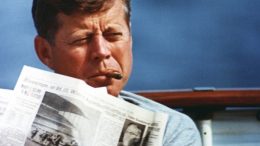
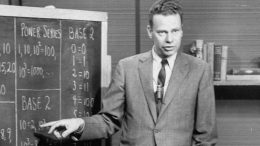
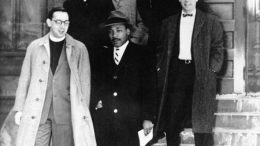
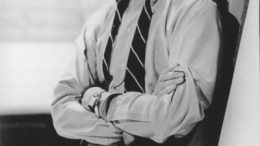
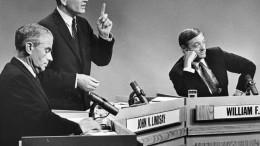
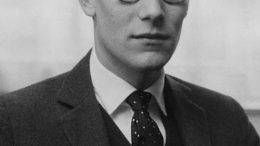
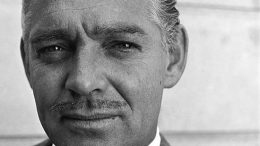
Forty-eight years ago today, President John F. Kennedy was assassinated in Dallas, TX. Richard Press remembers this icon of American politics and who won the battle to dress him.
The epic saga of President John F. Kennedy’s individual travail and public triumph is recounted with explicit and captivating detail by Chris Matthews in his new best-selling anecdotal biography, “Jack Kennedy: Elusive Hero.”
Scant attention is paid in the book to the candidate’s wardrobe, but Matthews included a revealing moment from the 1959 Wisconsin primary. Kennedy’s local operatives wanted him outside the factory gates at six in the morning in sub-zero temperature, and figured he would wear his heavy blue overcoat topped with a fur-trimmed aviator hat. Instead, JFK threw out the hat and braved the cold in his favorite H. Harris custom-tailored Shetland Tweed Herringbone Topcoat.
Matthews failed to include JFK’s dumping of H. Harris, his longtime Savile Row tailor who maintained a New York branch on 57th Street run by third-generation family member Sam Harris.
Seven months after the inauguration, “Tailor” Sam Harris, as he was condescendingly described in LIFE Magazine, disclosed the intimate wardrobe details of his most prominent customer. Harris concluded his comments with a benediction from hell, “He is the best dressed president since Grover Cleveland. We made his suits, too.”
There were no more “happily-ever-afterings” in Camelot for Sam Harris.
This was all undisclosed to the public, but Frank Brothers/Fenn Feinstein leaked to a Connecticut newspaper that the president got rid of his tailor because of the LIFE article. Fenn Feinstein, whose client roster included Kennedy brother-in-law Sargent Shriver and Gov. Abe Ribicoff, speculated that JFK might come on board.
Irving Press and my father, Paul, reached out to our J. Press regulars. The Kennedy circle included Charlie Bartlett, who introduced Jack to Jackie, longtime JFK intimate Chuck Spalding, Arthur Schlesinger, Jr., FAA head Jeeb Halaby, foreign affairs advisor Bill Bundy, Kennedy personal photographer Mark Shaw, and his chief economic advisor Walter Heller.
Chipp, however, won the contest by default. Their stalwart customers included JFK’s brother Bobby, brothers-in-law Peter Lawford and Steve Smith, and Defense Secretary Robert McNamara. Sid Winston, his son Paul and master fitter Bob DiFalco began to include the White House on their finished-garment schedule.
These tailoring tidbits were admittedly incidental to Matthews’ great new addition to Kennedy lore.
The night Marilyn Monroe delivered her allegedly drunken rendition of “Happy Birthday, Mr. President” to JFK in Madison Square Garden, Jimmy Durante also croaked his birthday tribute to the president in raspy Brooklynese, “The song’s gotta come from the heart.”
Chris Matthews’ book comes from the heart. — RICHARD PRESS
Brooks Brothers has historically taken its inspiration from across the pond — England, to be precise. Now it’s looked across a smaller, home-grown pond and found an amphibian celebrity to outfit.
Today the company announced that in addition to its roster of presidents, captains of industry and rogues and gentlemen, it has now dressed a Muppet.
Brooks provided a Fitzgerald-cut dinner suit to Kermit The Frog for his latest Muppet movie, which opens November 23rd.
Ivy-Style.com will pay for two (2) movie passes for the cleverest amphibian-pun comment. — CC
Norman Hilton, who ran an eponymous Ivy League clothing brand and was Ralph Lauren’s first investor, died yesterday at the age of 92, his son Nick told Ivy-Style.com.
Hilton’s motto was “Doing One Thing Well” and his logo features a weathervane. Tonight it points not north or south, east or west, but towards the sky.
Below is a copy of Hilton’s obituary, provided by his son:
Norman Joseph Hilton, 92, passed away peacefully at his residence on St. Simons Island, on Monday October 31, 2011. Formerly a resident of Rumson, New Jersey, Mr. Hilton resided at Sea Island and St. Simons Island since 1995.
Born April 13, 1919 in Newark, New Jersey to Alexander and Lillian G. Hilton, Mr. Hilton attended Newark Academy and Princeton University. Upon graduation from Princeton in June, 1941, Hilton enrolled in graduate school, at Harvard Business School, in Cambridge. Mr. Hilton entered the U.S. Navy, achieving rank of Lieutenant, during World War II. He met Constance Carens of Wellesley, Massachusetts, in that period and the couple were wed in July, 1947.
Mr. Hilton entered his family’s 80-year-old clothing manufacturing and retail business and quickly became a pioneer of the emerging “Ivy League” look in menswear. His Norman Hilton brand of fine, traditional suits and sport jackets achieved nation-wide renown for quality and style, and his collection thrived for nearly five decades in men’s clothing stores from coast to coast.
In 1967, Mr. Hilton made the first significant investment in a business venture begun by a then-young employee by the name of Ralph Lauren, effectively making Hilton the man who helped to found Polo Ralph Lauren, now a multi-billion-dollar, worldwide enterprise.
Hilton was selected by Burberry of London to lead their efforts in the US, overseeing the growth of sales of the Burberry brand in America thirty-fold between 1975 and 1987. His ability to see the marketing potential of a brand and an idea were responsible for the continuing series of successful ventures to which he dedicated himself.
Mr. Hilton participated in the Board of Directors of Riverview Hospital in Red Bank, New Jersey. He was an avid golfer and member of elite clubs, including Sea Island, Ocean Forest, Pine Valley, and the Royal Company of Edinburgh Golfers, at Muirfield, Scotland. He also was an avid New York Giants football supporter, and enjoyed walking for relaxation. Mr. Hilton was also a member of St. William Catholic Church on St. Simons Island.
Survivors include his wife of 64 years, Constance Hilton of St. Simons Island, three sons, Norman Junior (Nick) of Skillman, NJ, Alexander, of Oklahoma City, OK, and Dr. Thomas Hilton of Jacksonville, FL, as well as one daughter, Laura Hilton of Brunswick, GA, and thirteen grandchildren.
A memorial Mass will be held at 2PM Thursday at St. William Catholic Church on St. Simons Island with Monsignor John Kenneally and Father George Greenway officiating. Memorials may be made to Amity House or the charity of your choice. Edo Miller and Sons Funeral Home is in charge of arrangements.
If you’re a sucker for the “Mad Men” vibe of cool dudes, sexy chicks and midcentury style, you should really check out “Playboy’s Penthouse,” Hugh Hefner’s variety show from the early days of his budding Playboy empire. Episodes are available on DVD, including through Netflix.
The episodes were taped in a party atmosphere that brought together a cross section of fashionable society (the kind of crowd seen in our post “A Swellegant, Elegant Party“), and adult music (jazz, vocalists) that’s a far cry from the musical acts featured on today’s late-night shows.
And then there’s everybody smoking, including the singers while they perform. Is smoking glamorous? Don’t be daft: Of course it is.
In a February 1960 episode, a young beauty from Hef’s harem asks him about the turnback cuffs on his dinner jacket. Hefner, who had previously donned the Ivy League Look, proceeds to bore the girl to death with a dissertation on men’s tailoring, pointing with his Dunhill shell briar for effect.
Here’s what he says:
Well, this suit is Continental, Elsa. It’s a new style in America. Look, Tom’s formal is Ivy, which has been very popular. The difference is in the cuff. This has a little more cut to the jacket; it’s a shorter jacket. You’ll notice Tom has flaps on his pockets. These pockets are slanted.
After the war, when everybody was wearing full shoulders and full suits, Ivy came in. Ivy had been with us in the East for a long time, but it became very popular on a national level. Ivy has enjoyed a strong popularity, but just this last season something new has come over from Italy, and it’s Continental. It’s like Ivy in that it’s slim, but it’s a little more trimmed at the waist, a little more padding in the shoulder, the pockets are often slashed, and in addition the jacket is a little shorter, and you get accessories sometimes like the cuff and no belt.
Then Tom (the Ivy-clad fellow pictured above at left), perhaps concerned that the fashionableness of his attire may be nearing its expiration date, asks “Do you think Continental will replace the Ivy League style?”
Hef replies:
Playboy doesn’t think so. We did an article on it a couple of months ago. Ivy is so fundamental that I think it’s going to be with us. It’s basic, good conservative dress, and we think it’ll stay with us always. But Continental has a little more flair, it’s a little more elegant, and we think it fits those occasions when a man wants to dress up. We think there’s a place for both.
Ditching Ivy for Continental may be an error in judgment for us natural shoulder fans, but it’s not as bad as ditching clothing altogether in favor of pajamas.
After Hef’s style speech, he introduces Cal Tjader, who goes on to play the vibes in a gray sack suit and black knit tie (and with his specs and receding hairline, kinda looks like Newton Street Vintage circa 2009).
Here’s Tjader doing the lovely “Shina no yoru,” originally a Japanese propaganda song from the ’30s.