
 When I was an undergraduate at Moravian College in Bethlehem, PA, there was a wonderful campus shop on Main Street called Tom Bass. It served three colleges and a university (Moravian, Muhlenberg, Lafayette and Lehigh University), and it stocked many of the iconic Ivy League labels: suits by Southwick, buttondowns by Gant and Sero, Pringle and Alan Paine sweaters, flannel and khaki trousers by Corbin, and raincoats by London Fog. Anyone old enough to remember will tell you these manufacturers produced clothing of the highest standards in those days (the ’50s and early ’60s).
But when I went to graduate school at Lehigh in 1963, I moved up a notch, to what was arguably one of the three or four best campus clothing shops in the country. There were of course J. Press in New Haven, The Andover Shop in Cambridge, Chipp in Manhattan… and then there was Langrock on Nassau Street in Princeton.
I don’t want to go into the history of that esteemed firm at the moment, merely give a few fleeting impressions of that sublime outfitters. The owner of Langrock at the time was Alan Frank, a man of impeccable taste who looked as though he could have walked across the street and stepped onto the podium of a lecture hall. In my memory he tended to wear charcoal suits most of the time: flannel in winter, tropical worsted in summer, with the occasional nod to a seasonal Harris Tweed or seersucker sports jacket. Usually a white oxford cloth buttondown, and a dark silk club tie. Very proper, yet he always looked perfectly comfortable and at ease.
The shop itself occupied a regal, colonial-looking brick building on a corner, so the large floor-to-ceiling plate glass display windows (obviously not original because the building had originally been a home) could be seen from two sides. Inside were a series of rooms, each paneled in dark walnut wainscoting and with old Persian rugs on the well worn wooden floors. Hunting prints of course and college shields. Everything to reflect the hushed and slightly dusty ambiance of a gentleman’s club or dining hall. It seemed impervious to time.
In the center of the main room, as one entered from the street, was a large round table, a good five-to-six feet in diameter, laid out with rep striped ties: hundreds of them in military, university and club stripes of the most vivid colors, a wheel of shimmering silk afloat in the dimly polished ambience. To the right was a glass-and-mahogany case which held the club and paisley neckwear. All from England. Also from England and Scotland, in a similar case to the left were the crewneck sweaters (with saddle shoulders), and wool hosiery, as well as cashmere V-necks and beautiful cashmere hosiery in heathery tones of lovat and fawn and tobacco brown and Cambridge grey.
Shirts — mainly buttondowns, with some straight point and rounded club collars mixed in — were stacked on shelves running the length of the left-hand wall from waist to within a foot or so of the ceiling. It was at Langrock that I first saw — and bought — a true royal oxford cloth shirt. It happened to be in a lustrous pale yellow, not quite cream. It was light as a cloud without being delicate, and I got years of wear out of it.
The two other rooms held the tailored clothing: suits, sports jackets, odd trousers, topcoats and raincoats. And there was a real tailor, not just an alterations tailor but a man who worked a pattern, and who had swatch books of handsome Cheviot and Hebrides tweeds, flannels from the West of England, and Irish linens. I once extravagantly commissioned a hearty tweed sports jacket in a camel-and-olive check with an orange windowpane. The tailor put a special sweat-proof lining in the back skirt panel of the jacket, “just in case you want to do some riding, Sir.”
My purchases in this sartorial arcadia were actually few and far between because Langrock was violently expensive, particularly for a young man in grad school. But funnily enough, I still have several of their ties today, and always felt I’d gotten my money’s worth. Since I was an English Studies student, I was thrilled to hear from Mr. Frank that John O’Hara was a customer, although I never had the luck to see him on my rare Saturday appearances. O’Hara’s not read much these days, but in his time he was a literary giant. And he wallowed in campus clothes: Jacob Reed (Philadelphia’s best Ivy League store in its day), J. Press and his beloved Brooks Brothers were his haberdashery haunts. He once invited the dandy columnist George Frazier to drink with him simply because Frazier was wearing a Brooks buttondown. O’Hara lived in Princeton at the end of his life, and is buried there. His epitaph, written by himself:
Better than anyone else, he told the truth about his time,
the first half of the twentieth century.
He was a professional.
— G. BRUCE BOYER


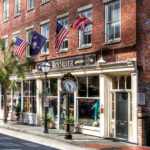




The label says New Haven. What is Longrock’s history vis-a-vis New Haven?
Finding an image for this story was such a nightmare I didn’t even realize the one I settled on doesn’t say Princeton on it.
From what I’ve been told, Langrock began in New Haven.
Very nice article.hope nobody turns THIS into political rants.
Hey, those are Alan’s ties!
Indeed. Image changed.
When I was at Princeton in the early 60s, one could even buy proper Oxford buttondowns at the on-campus student store.
Here’s what they have now:
http://www.pustore.com/Wovens/Princeton—White—Left-Chest-Shield—Long-Sleeved—Dress-Shirt/PAAAAALMJPIOICGB/3458-3459-3463/Product
Here are young gents wearing those repp striped ties
(very likely from Langrock) at Princeton in 1962:
http://thetrad.blogspot.com/2009/11/princeton-1962.html
I found this wonderful Princeton Alumni Weekly article about Langrock on the University’s web-site:
http://paw.princeton.edu/issues/2008/01/23/pages/4148/index.xml?page=1&
A search for Langrock reveals a law firm in Vermont by the name of Langrock, Sperry, and Wool. How about that?
Campus shops in the 1960s were fantastic.
By pure happenstance on a business trip in the mid-1990s I found a campus shop that had the look and feel – down to the old English-looking building style – of having been preserved in a time warp the prior 30 years. I was so charmed I bought a sweater and some socks that I didn’t need just to support the cause.
Where was it? Across the street from the Ball State University campus book store in Muncie, Indiana. Go figure.
The David T. Langrock Foundation still contributes to the New Haven Cultural Community. See cfgna.org or google Langrock New Haven.
His store occupied the wonderful building still existing at York & Broadway, New Haven, one building away from J. Press
Wonderful information in the comments here, guys. Many thanks.
I eent to Lehigh in the 80’s and recall a professor mentioning the store you reference…sadly gone by the time I got there.
Great post!
I don’t recall the shop LANGROCK, but I do remember growing up in PHILLY at a time when their were great men’s shops downtown Center City as G.B.B. spoke about like J.REED & SON; MORVILLE, and JOHN WANAMAKER had at one point the University Shop on the 6th flr. with all classic Tweeds, Classic Repp ties, Flannel trousers. The one shop that inspired me into men’s haberdashery was DIMENSIONS on Chestnut St. All of those shops are gone… Their needs to be a books to recapture the authentic men’s haberdashery shops of years ago.
I regularly see jackets from Langrock at Princeton-area rummage sales. Great to read a bit about the establishment. No doubt its building is now inhabited by one of the Princeton’s many fine body-lotion or handbag stores.
Talbot’s, the women’s clothing chain, now occupies the old Langrock site.
Actually, it’s not an old home, as mentioned in Boyer’s piece, but part of the Palmer Square complex designed and built in the 1930s by Edgar Palmer to “re-create” an 18th century town square… or what he thought one should look like.
There will never be another Langrock, sadly, but does anyone also remember the other great Princeton stores: The English Shop, Harry Ballot, and The Country Squire? Those were the days…
Tom Bass, Langrock and John O’hara all presented by Bruce Boyer this is great. I really like the first hand account of Langrock. A postive story about them was really missing from the record. Another score for Ivy Style.
Bought suits and jackets from Eric at the English Shop in Princeton. They’ve been gone a while and I need new suits and jackets. Has anybody in the area taken up the mantle?
Yes… there’s a lone holdout left in Princeton for good men’s clothes: Nick Hilton at 221 Witherspoon Street. They carry Norman Hilton, Alden, Gitman Brothers, Hickey Freeman, Bill’s Khakis and others.
Princeton’s high point for good men’s and boy’s clothes was in the mid to late ’60s: The Prep Shop (on lower Palmer Square), Maurice Pearce (who carried very beautiful Scottish woolens)… and even Saks Fifth Avenue had a tiny sliver of a branch store which they called The Men’s Shop… I think it was right next to The English Shop. Most of these stores, and the others listed above, were gone by the late ’80s… The English Shop was one of the last to go.
Landau’s is still around, if you need a new coat and scarf.
I second the recommendation for Nick Hilton. Ivy Style should consider a story on his family’s remarkable history in American clothing and his ongoing efforts, on which more here: http://www.nickhilton.com/blog/?p=72
I was in the shop this week and he told me that for fall 2010 they are planning a line of all English/Scottish tweeds, made in America, with classic Norman Hilton style and the 3/2 roll. Exciting stuff.
Thanks for the tip. Believe me, Nick and Norman Hilton have been on the editorial calendar for some time. We’ll get to them soon.
A reader named Joe Redino had tech glitches trying to leave a comment and sent me this:
During the Fall of 1959, Alan Frank contacted a man named James Rendino, who was the head tailor for D’Andrea Brothers in New York City. Mr. Frank had heard of Mr. Rendino’s reputation ( having fashioned several custom made suits for gentlemen such as Guy Lombardo, Boris Karloff and other celebrities of that period ) and was very interested in having him come to work at Langrock.
After carefully considering Mr. Frank’s magnificently generous offer, Mr. Rendino and his family gladly traded the frenetic pace of the city for the atmospheric therapy of Princeton in the summer of 1960.
Mr. Boyer, the tailor you described in your article was, more than likely, James Rendino. However, do actually remenber
him ? Can you confirm that it was him ? Although there were other tailors at Langrock, James Rendino was the only one with the expertise, character and demeanor you mentioned.
I knew the man personally and to say the least, his tailoring prowess was well known and sought after. I am proud to say that the last suit he made, prior to his retirement, was for me and while I reflect a certain bias, facts are facts. When he touched any fabric, he would make it “sing”.
From my vantage point, referring to James Rendino as a custom tailor, somehow diminished his credentials. On numerous occasions I called him the Sartorial Architect, but most of the time, I just called him Pop.
To respond to the question about Mr. Rendino at Langrock. Unfortunately I met the gentleman only twice — once to be measured, and once for a forward fitting — but my memory tells me that Rendino was in fact his name. He was a very proper tailor, taking all my suggestions into consideration, and produced a lovely sports jacket for me. My only criticism was that the armhole was too large and low, which was the American style at the time. Thanks for jogging my memory. G. Bruce Boyer
So I guess I am late to the party… I grew up in Princeton… and graduated from Lehigh in 2008… and there was not a store such as Tom Bass in Bethlehem… Shoot.
I am the grandson of Hy Decker, originator with Alan Frank of the Princeton Store. I grew up with visiting pop-pop on Saturday mornings at Langrocks.
I have numerous letters, memoirs and collectibles from the store addressed to Hy Decker – including a personal letter from T.S. Eliot (the suite he is wearing on the cover of his book – The Complete Poems and Plays 1909-1950) was made personally by my grandfather.
Also, have letters from William Faulkner who visited every once in a while and had written to Hy asking “please save this years green Scotland pelt for him to make a new blazer for a speech” he was giving in Tennessee. He would mail my grandfather his measurements…
Memories of Langrock are very different for me than the public, but I always will remember the class, professionalism and that Langrock smell when you walked through the door….
Scott
have a collapsible top hat with the Langrock label…going to donate it to our local theater….catherine
My father and uncle loved going to Langrock and were happier than most ladies with the ties and suits they proudly bought. Seeing the Langrock label brings back fond memories.
I AM a Langrock, and this is the coolest find ever. There aren’t many of us Langrocks out there… and if you knew my family, you would think there being an upscale clothing store with our name on it is hilarious. I would LOVE to get my dad something from this store with the name Langrock on it. Does anyone know the phone number of this place, or a website. Thank you!
Hello, I live in the Princeton area and collect Langrock clothing. If anyone has anything from Langrock please contact me. Catherine I would love to buy that top hat off you. My e-mail address is rickvalentin88@gmail.com
Thank you!
Rick
Reference was made to the fact that the tailor,Mr. Rendino was recruited by Langrock from D ‘Andrea Bothers in New
York. My late uncle, who died in the mid 80s, wore bespoke clothing from a Manhattan tailor named D’Andrea. My
uncle’s style was definitely not Ivy, but late 50s early 60s contemporary, a more conservative version of the Oceans
11 look. Anyone have information on D’Andrea?
As Mr. Boyer so clearly pointed out, Alan Frank, a man of a impeccable taste, usually wore a WHITE oxford cloth button down.
Those who think that blue is the only de rigueur color for an OCBD should take heed.
And for those who may be interested in John O’Hara, a recent article regarding his relevance today:
https://home.isi.org/creative-destruction-fiction
Ah memories of the Lehigh Valley! This Mule entered college suffering from a personal style of football jerseys, tee shirts and jeans. My sophomore year I was saved by a Cedar Crest College freshman who introduced me to ivy style. Alas, my affection for ivy has lasted longer than her affection for me.
D.P.
Didn’t they name a college after your family?
Sorry. I couldn’t pass it up.
Such posts are why I check Ivy Style before I read the morning news or my email.
whiskeydent,
Some people think of the publishing house rather than Animal House when they see the surname Faber.
As you are probably aware, Ashley: “Faber est suae quisque fortunate”…
Do yourself a favour and buy some John O’Hara books, if you haven’t already. Appointment in Samarra is a great read, particularly around Christmas time.
I like this O’Hara quote,
“If Yale had given me a degree, I could have joined the Yale Club, where the food is pretty good, the library is ample and restful, the location convenient, and I could go there when I felt like it without sponging off friends. They also have a nice-looking necktie.” 😉
The tailor’s name was Antonio, and he ran a tailoring and dry cleaning shop in Lawrenceville from 1989 until he retired last year. We were sorry to see him go. You can always get your clothes cleaned, but finding an expert tailor is a challenge.
I applaud this excellent article by Mr. Boyer and the interesting comments.
What I recall of Langrock ca 1974 is visible at the left margin of photo of the tie table. The library tables where merchandise was shown were draped with tartan plain blankets. I wish I knew why that image stuck with me.
The shop in my college town was The House of Walsh. There was one in Amherst and another out in the boondocks of far northwestern Massachusetts. HOW carried the standard assortment of Hilton, Corbin, Alden, etc., and had a department in the basement that sold and strung tennis and squash racquets.
A few years after graduating, I went back (from Chicago) for the Williams (there, I said it) game. The day was rainy, so, I went to the HOW to buy the standard issue purple-and-white golf umbrella. While I was waiting at the register, I saw another alum who’d taken a different strategy. He was buying a Burberry robe coat, just the kind of practical decadence to which a young alum could aspire.
I picked up a vintage Langrock Dinner Jacket set at Keezer’s while in Boston a year ago. Love it!
Here’s a fact that seems to be lost in the mists of history – for a while Langrock also had a store in Providence, on Thayer across the street from Brown University. The only reason I know this is that my father moved his menswear business Hillhouse Ltd into the former Langrock building around 1951.
Currently researching the Langrock family. Please drop me a line if you have any info or pics to share. THANK YOU. Naomi at: jomi6666@gmail.com
When I was at Tufts University in about 1965, a friend from Princeton gave me the most luxurious, patrician looking tie I’ve ever had, as a birthday gift. It was from Langrock. Soft mustard colored wool challis with scattered pastel brown pheasants with red heads and soft blue trimmed wings. Nothing of its opulence and serene quality could probably be conceived or manufactured today, because our culture has lost its instinct to produce or appreciate that kind of goods. I still wear it with the elan it requires.
I just read this article for the first time and walked back in time …. My name is Frank Mennella is am 64 years old and lived in Princeton from the age of 6 till 55.. I worked at Langrock (1965-1978) from the age of 10 (yes 10) getting coffee for Mr. Decker and Alan Frank till the age of 21 to where I was one of the salesman and probably met most of you. My brother Louis was there for 25+ years and was VP till 1984. Both my father (Pasquale Mennella) and uncle (Camillo) were tailors in the back room along with James Rendino who also was my uncle on my mothers side. I put out and setup all those ties on that very table, shirts and argyle socks and sweaters. Although I didn’t meet most of them but we had clients like T.S. Elliott, Oppenheimer, Einstein, Andy Rooney.. I met James Stewart every year when he returned for the reunions and Rosie Grier when he came for the Giant Eagle games played in Princeton. Hymie Decker was my mentor and Alan Frank was all business. I credit my career to all that I experienced there. I still have ties, cashmere sweaters from there and remember all the custom made clothes I had made at age 16 since I had an inside connection to the tailor shop (unbeknownst to Decker and Frank. lol)—Great Memories.. thank you.
I love these stories of reminiscing of an era past,being in my 70s,I remember such stores where you are known by your name when you walked in.My small town had three,of different levels of clothing and price range,each served a niche. A lovely time of personal service and quality clothing.
I still enjoy wearing my Langrock cranberry red lambswool crewneck sweater with saddle shoulders. It is more than 55 years old. Its collar trim and other details are of better design and quality than newer and exceedingly more expensive models sold elsewhere today. My compliments to those who promoted this modest piece of perfected refinement in contrast to the rough look chosen by so many today.