In May of 2024, I had the opportunity to visit the beautiful campus of St. George’s School in Middletown, Rhode Island for a tour of the historic chapel designed by architect Ralph Adams Cram. The event took place over Alumni Weekend and was scheduled in celebration of 100 years of the chapel. The tour was led by my friend Ross Cann, a Newport based architect and Managing Director, A4 Architecture. I made a presentation titled St. George’s School Chapel: The Cathedral on the Hill which drew from my research on Collegiate Gothic architecture as a student in the Ph.D. in Humanities program at Salve Regina University.
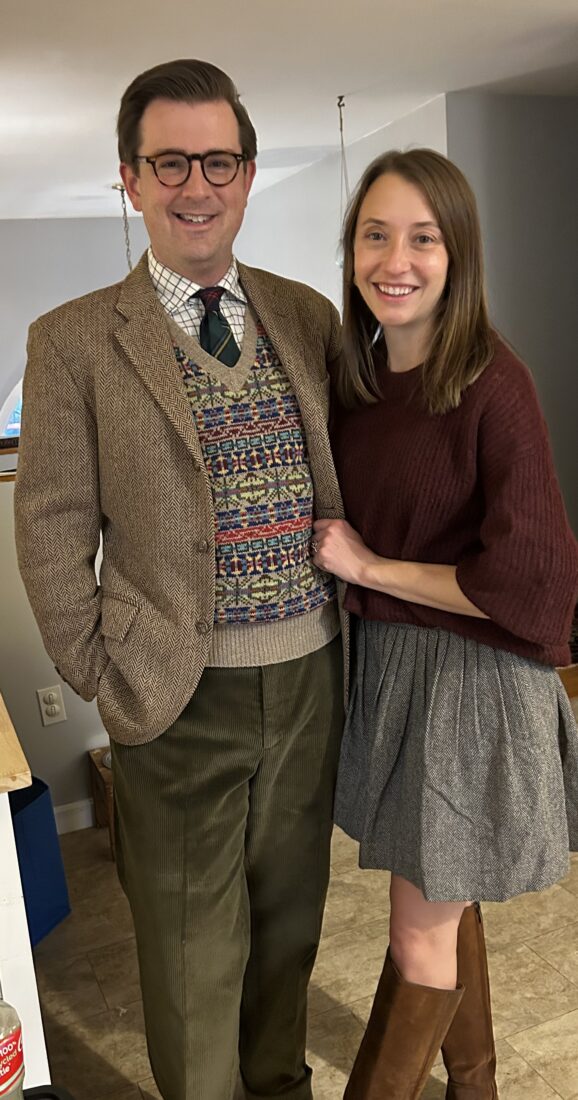
We were welcomed at St. George’s School by a well-dressed gentleman named Ryan Kirk, Director of Leadership Giving. If I recall correctly, he was wearing a three button sack jacket, a pink OCBD, and a navy and white striped knit silk tie. He had a great haircut, very Ivy-ish, and a pair of sharp looking horn-rimmed glasses. Ryan looked as if he had just stepped off the set of Dead Poets Society. I thought to myself, “This fellow knows how to dress.” I was not yet the editor of Ivy Style at the time, but I considered mentioning the Preppy Handbook Fan Club. I decided that this would be odd to mention to a person whom I had just met, so I refrained.
Fast forward several months and I noticed this same name – Ryan Kirk – in the Facebook group for Ivy Style. Lo and behold, Ryan has been a longtime Ivy Style reader and follower. That made perfect sense to me.
I decided to reach out to Ryan for an Ivy Style Reader Interview, what I hope will be the first of many. Here is our conversation.
Matthew: Ryan, thank you for talking with me today. As you know, I admire your sense of style. Can you please tell us more about how it developed?
Ryan: My father was a pretty sharp dresser, and he has exercised an ongoing influence on how I choose to attire myself. He did not necessarily dress strictly Ivy, but he was born in 1947 – in the first wave of the Boomer Generation – and so he grew up in that post-war halcyon period when the confluence of classic American style and the Silver Age Ivy Look was really being codified. Growing up, I remember him wearing a lot of oxford shirts and tassel loafers to the office, and I followed his lead when I started working, as well. When he retired, he gifted me all but a few of his ties, which were predominantly striped repp and crest ties from Ben Silver, nearly all of which I have fond memories of him wearing. He dressed me in fairly traditional clothing when I was a kid. After a brief period of rebellion in high school, I returned to classic dressing when I started college, circa 2005. Right around that same time, there was a renaissance of the 1980s preppy look which was seemingly taking place everywhere. Rugby Ralph Lauren launched in 2004, followed shortly thereafter with a host of other similar brands, many of which were influencing me as an impressionable young man. At the same time, there was an explosion of blogs centered around Ivy and traditional style, including this site, which I tuned into regularly shortly after its launch in 2008. Taken together, those blogs played an important role in shaping my style preferences, and Ivy-Style.com had an outsized role in driving my interest in ivy style, in particular.
Matthew: Your wardrobe has its fair share of Ralph Lauren, including vintage pieces. What are some of your favorite brands and clothing items?
Ryan: Old Brooks Brothers and Ralph Lauren comprise around 90% of my present wardrobe, including shoes via Alden and Crockett & Jones produced through partnerships with those brands. Aside from one pair of C&J short wing cordovan lace-ups, nearly all of my dress shoes are loafers. I tend toward shell cordovan and suede, and I find these work well in our ever more casual world. I know a lot of ink has already been spilled on this topic, but it’s hard to beat old Brooks items from their “Made-in-the-US” heyday. The tailoring was incredible, and the US-made oxford shirts are the backbone of my wardrobe. I wear one nearly every day, save for those hottest of summer days when I resort to a polo shirt. I love old US-made Ralph Lauren, as well, although an increasing share of tailored items in my wardrobe are from Polo made in Italy, Slovakia, and Portugal, as that’s what’s mostly on the secondhand market these days. Most of the non-Brooks or RL items in my wardrobe at this point are sweaters. I’ve been sourcing my brushed Shetlands from “Shetland Woolen Company.”
Ryan: I suppose it’s more of a coincidence than anything. The primary driver of my choices to enroll or work at any of these given institutions was the right opportunity at the right time. However, I have certainly appreciated living and learning in such beautiful environs. If anything, my appreciation for the Collegiate Gothic style has been sharpened and honed as a result of near-daily exposure for the better part of the last 20 years or so. I’ve been very lucky.
Matthew: You have worked at two independent schools affiliated with the Episcopal Church. Do you see any connection between the values imparted at these schools and an ethos for Ivy Style?
Ryan: We’re treading in deep waters here, and certainly outside of my area of expertise; however, I’ll venture a response. First, let me back up and state – at the risk of sounding obvious – that all clothing carries with it certain associations. In addition to that, boarding schools are rarified spaces, and carry a lot of cultural associations, as well. Whether these associations are right or wrong, fair or unfair, is almost irrelevant. Now, all this being said, I do think there’s a through line that connects the values these old Episcopal boarding schools are trying to inculcate, to the values manifest in Ivy Style. A great many of the young men who wore and codified the look in the early and middle decades of the 20th century were Episcopalians, and I would venture that a fair share of them also attended Episcopalian schools – boarding or day – before continuing on to the Ivy League. It’s only natural, then, for us to associate Episcopalian values with Ivy values, and vice versa.
Matthew: How did you discover the Ivy Style website and what inspired you to join the Facebook group?
Ryan: It’s so long ago now that it’s hard to remember exactly how I discovered Ivy-Style.com, but I think it might have been through the Rugby Ralph Lauren blog. Christian Chensvold may have written a piece for them, or perhaps the Rugby Blog editors linked to Ivy-Style.com in one of their posts. The Rugby Blog was one of the other heavy influences on me at the time.
Matthew: Ivy versus Preppy. The same? Different? Overlapping? What do you think?
Ryan: This is another topic on which I know much ink has already been spilled. In my view, preppy is an…extension?…evolution?…offshoot? of Ivy when classic dressing and decor were cycling back into fashion in the late ’70s and early ’80s. Although The Official Preppy Handbook did more to put the word “preppy” into Americans’ lexicons than probably any other media, I think the culture was already moving in that direction even before the handbook was published. The Atlantic article by Nelson Aldrich that you shared recently, and the “Are You A Preppie?” poster from Tom Shadyac, both released in 1979, tapped into a nascent national interest in a return to more conservative dressing, as well as what would become Reagan-era aspirationalism.
Matthew: What topic do you think we need to cover on Ivy Style? Would you be interested in writing an article on that topic?
Ryan: Some years ago, I had offered to write a piece for the site about the origin of the grosgrain striped watch band, and how and why it made its way into the Ivy (and later Preppy) canon. Perhaps unsurprisingly, this proved a niche subject area, and I had terrible luck finding any source material beyond pure speculation. Most people cite, incorrectly, the creation and use of the grosgrain watch strap with the invention of the G-10 “NATO” strap developed by the British Ministry of Defense in 1973. This misnomer has further complicated my research, as most advice or insight offered was actually more of a misdirection than it was helpful. All this to say, if any of our readers have knowledge on this topic, I’d be very interested to correspond with them.
Matthew: Is there anything else you would like to share with the Ivy Style community?
Ryan: I’m so glad that the website and the Facebook page have both survived as long as they have, when many other such blogs eventually went defunct. It’s a great community, and I’ve come to know many wonderful people through the years. I hope things continue, and a big thank you to you, Matthew, for carrying on the good work!
This was a great interview and my compliments to the interviewee’s tailor ! Things either go forward or they go backward. This site has definitely gone forward since you took over. I think you have raised the ‘level’, for want of a better word.
Incidentally, I too love Poland and have visited a number of times although never up as far north as your wife’s hometown. Her grandparents certainly were good looking people. If I may I’d like to recommend an online news site which will keep you up to date on news from Poland. In English, that is. It is called ‘Notes from Poland’ and I have attached a link below.
Ryan: I am sure you have seen the information on the Internet about solid black grosgrain watch bands as early as 1923. I distinctly remember striped grosgrain watch bands at better men’s clothing shops in the early 1960’s. In fact, I owned a navy with yellow band and a navy with burgundy when I went off to college in 1963. Of course, the idea was to coordinate the colors with the outfit you were wearing that day. As it turned out, that was just too much trouble — particularly if you were in a hurry. There were lots of olive drab grosgrain military watch bands during the Vietnam era (late 60’s and early 1970′). Grosgrain bands are a great look, but just tedious to be changing them all the time.
James, thanks for the input. I do remember seeing an article citing the use of black silk grosgrain watch straps for men with evening wear in the 1920s. That makes perfect sense, as it would have complimented grosgrain facings on the jackets and the braid on the trousers. At some point, I assume, production switched almost entirely to nylon (perhaps in the late-40s?), as it would have been more durable and much, much cheaper than silk. What’s less clear to me is when stripes became introduced. Were they first made for military units? Veterans of said units? Some other purpose or reason? I can’t seem to find anything that sheds light on this. What is clear, however, is that they were widely available by the 1950s and early-60s, sold everywhere from men’s shops to drugstores. I’d love to find some information that helps to bridge the knowledge gap between the 20s and the 50s!
Not sure when exactly stripes were introduced, but they were not authorized for wear with a field uniform. Only black or olive cotton-canvass was authorized for the field, and was sold in Military Clothing Sales Stores throughout NATO territory. For wear with civies, stripes of various symbolic and/or patriotic colors were made available on the economy.
My guess as to a timeline for colors would synch with NATO (1949) or the high Ivy Style period, 1953ish. And nylon? I wore an olive cotton canvass field-watch strap until 2002. (Nylon can make for a nasty burn)
Great article, great pics, great links! Great architecture, (although I don’t care for chandeliers in the Sanctuary). Great navy blazers, both! Great grey herringbone! Great brown herringbone! There is a world of difference between a pink ocbd and a pink/white u-stripe ocbd. I can’t explain why, but the stripe just works! I wouldn’t have learned that but for I-S. Great post!
Great interview. Mr. Kirk seems like a conspicuously conventional guy – in education, employment, and dress/appearance – and I’d be interested in hearing more about how he became that person and why.
If Ivy has a future beyond costume-ish parody, this sort to subtlety will prove essential. I note the absence of loud pastels (pink oxford shirt is tasteful), patch(ed) fabric, and other preppy excesses/extravagances.
The vibe is reticent, unpretentious old New England.
S.E., thanks for weighing in. I agree about the future of Ivy – it hinges on understatement. My residence in New England the past two years has certainly toned down my color choices – more blue and white shirts, less pink, and tending toward darker and more muted ties, etc. I’d also add that a tendency toward elegance and comfort will help keep Ivy relevant. I appreciate that elegance is elusive, and I don’t mean to imply that I possess any myself, but the ease of the clothes bends toward this, and I think it’s an important part of why it continues to appeal to new generations.
I, too, believe in keeping things more understated. I want everyone I encounter to find my mode of dressing something with which they are comfortable, something they might even try. My two exceptions are the pop of color from repp ties in the colors of my old schools and the Navy blue and gold and the garish comfort of old Madras in the heat of summer. Even my clothing on the golf course is khakis and a white or blue polos. I happily note glimpses here and there of non-patch Madras in subdued darker tones.
Terrific interview and insightful interviewee. Thanks. Being the product of an Episcopal school, having graduated in 1967, I especially enjoyed his treatment of Episcopal school values. Like all institutional values, they have evolved, but my daughter’s experience in such a school still seemed pretty solid in its values. One very positive change I note is diversity. My class was about 95% Episcopalian. My daughter’s class was far more diverse, not just in terms of faith but in many other ways, and that certainly balanced and strengthened her values.
Tim, you’re absolutely right about the diversity in US Episcopalian schools today. They are far different in their make-ups than they were even 30 years ago. Much more diverse in every sense of the word: race, ethnicity, religion, nationality, geography (hometown), and socio-economic background. Also, there is much more New Money present (especially from Chinese families), but still plenty of Old Money around. I agree with you in your assessment that this is a good thing. Everyone benefits.
Interesting that, in a post Ivy Heyday world, a lot of dressed-up Ivy is a version of parody. Not pejorative. Parody in the best sense — a modern-day, functional remake of goods that were once (upon a time) ubiquitous. Parody as Imitation, and, since (probably) fewer than 0.5% of the population prefer/wear this style consistently, idiosyncratic. Tastefully atypical.
It may well be parody, but parody is generally perceived to have an element of mockery. Increasingly these clothes speak to me as pushback to fast fashion and the environmental benefits of using materials that do not contain plastics.
“Episcopalian” is a noun, not an adjective. No two ways about it. It’s surprising, to say the least, that the individual being interviewed, as if he were an expert on the matter, is ignorant of that fact.
In the first sentence of my answer you’re referencing, I state it’s “certainly outside of my area of expertise,” but you are right: Episcopal is the adjective, and Episcopalian in the noun. Perhaps we can make a correction. Thanks for weighing in with your nice comment.
The clothing images and content of this article is what continues to bring me back to this site. For years I have used this site as my reference for mixes and matches of colors and items. Social Media and its rabbit holes are fuel for burning precious time – so I work to avoid them at all costs. Having a page to visit – for inspiration, humor, and heritage – perfectly fits my restrained exploring habits.
Being in FLA full time eliminates the possibility of a full season of wool and corduroy – so the mixes and matches of ties and stripes and pink and green and blue helps fill my “idea” notes with combinations I wouldn’t think to up on my own.
Chris, thanks so much for the positive feedback about Ivy Style. Like you, I have found this site to be a repository of good taste and inspiration for many years, so I was thrilled to take over running the site last year. Despite being a lifelong New Englander, I am a warm weather person, and I often wonder how my wardrobe would change if I lived somewhere like where you do. Less tweed and more poplin, for sure.
We need more encounters and interviews like this. “Found in the wild”, as it were. Men like ourselves carrying on with this unique sense of style whilst living out our personal and professional lives still exist. (Not that I would ever offer up myself as an interview subject; many are more qualified and especially better dressed…)
This interview, along with my morning coffee, gave my day a fabulous start. Cheers.
Thank you for the positive feedback about the interview, and I agree completely about Ryan’s glasses. I noticed them too when we first met at St. George’s School and would like to know the maker.
Thanks, Amory, for the kind words. My glasses are from a few different makers. The small round tortoise shell frames were from Ben Silver via Francois Pinton. I think it was from some sort of archival collection. The modified P3 frames that I’ve been wearing more recently are the “Fairmount” model from Cult Eyewear. Cult based their design on the defunct Universal Optical “Mansfield Square” model, which were famously worn by James Dean, Jack and Bobby Kennedy, and Truman Capote, amongst others.
Many thanks for the rundown, Ryan. I’ve always worn traditional frames from various sources, but didn’t know about Cult Eyewear. Just checked out the Fairmont frame—absolutely brilliant! Thanks again.
Unfortunately there’s no avoiding parody when it comes to the more ostentatious and “upper class lifestyle”-inspired aspects of this style. Following the demise of the old liberal Protestant establishment (the first and primary market for the clothes), the style was up for grabs — and vulnerable to branding, logo worship, and lifestyle-driven advertising. There’s no shame or embarrassment anymore: Island-shaped logos, and country club shield embroidery, and car hood ornaments are displayed eagerly and proudly as totems of class superiority. The quality of clothing went downhill and everything was all-of-a-sudden ridiculously expensive. Campus shops found themselves competing with PoloRL and Brooks Bro. stores at giant shopping malls and seasonal J. Crew catalogs. There are ways to subvert the silliness of retail markups, but diligence is required.















Hello Matthew,
This was a great interview and my compliments to the interviewee’s tailor ! Things either go forward or they go backward. This site has definitely gone forward since you took over. I think you have raised the ‘level’, for want of a better word.
Incidentally, I too love Poland and have visited a number of times although never up as far north as your wife’s hometown. Her grandparents certainly were good looking people. If I may I’d like to recommend an online news site which will keep you up to date on news from Poland. In English, that is. It is called ‘Notes from Poland’ and I have attached a link below.
Keep up the good work.
David.
https://notesfrompoland.com/category/news/
Ryan: I am sure you have seen the information on the Internet about solid black grosgrain watch bands as early as 1923. I distinctly remember striped grosgrain watch bands at better men’s clothing shops in the early 1960’s. In fact, I owned a navy with yellow band and a navy with burgundy when I went off to college in 1963. Of course, the idea was to coordinate the colors with the outfit you were wearing that day. As it turned out, that was just too much trouble — particularly if you were in a hurry. There were lots of olive drab grosgrain military watch bands during the Vietnam era (late 60’s and early 1970′). Grosgrain bands are a great look, but just tedious to be changing them all the time.
James, thanks for the input. I do remember seeing an article citing the use of black silk grosgrain watch straps for men with evening wear in the 1920s. That makes perfect sense, as it would have complimented grosgrain facings on the jackets and the braid on the trousers. At some point, I assume, production switched almost entirely to nylon (perhaps in the late-40s?), as it would have been more durable and much, much cheaper than silk. What’s less clear to me is when stripes became introduced. Were they first made for military units? Veterans of said units? Some other purpose or reason? I can’t seem to find anything that sheds light on this. What is clear, however, is that they were widely available by the 1950s and early-60s, sold everywhere from men’s shops to drugstores. I’d love to find some information that helps to bridge the knowledge gap between the 20s and the 50s!
Not sure when exactly stripes were introduced, but they were not authorized for wear with a field uniform. Only black or olive cotton-canvass was authorized for the field, and was sold in Military Clothing Sales Stores throughout NATO territory. For wear with civies, stripes of various symbolic and/or patriotic colors were made available on the economy.
My guess as to a timeline for colors would synch with NATO (1949) or the high Ivy Style period, 1953ish. And nylon? I wore an olive cotton canvass field-watch strap until 2002. (Nylon can make for a nasty burn)
Great article, great pics, great links! Great architecture, (although I don’t care for chandeliers in the Sanctuary). Great navy blazers, both! Great grey herringbone! Great brown herringbone! There is a world of difference between a pink ocbd and a pink/white u-stripe ocbd. I can’t explain why, but the stripe just works! I wouldn’t have learned that but for I-S. Great post!
Thank you so much! I appreciate the compliments.
Great interview. Mr. Kirk seems like a conspicuously conventional guy – in education, employment, and dress/appearance – and I’d be interested in hearing more about how he became that person and why.
Very nice! Thank you for the interview. What an eloquent and elegant gentleman!
Yes indeed, eloquent and elegant describe Ryan perfectly!
That’s very kind of you both, and thanks again, Matthew, for the chance to be interviewed for the site!
I appreciate the understated approach.
Westminster — very good Presbyterian college.
If Ivy has a future beyond costume-ish parody, this sort to subtlety will prove essential. I note the absence of loud pastels (pink oxford shirt is tasteful), patch(ed) fabric, and other preppy excesses/extravagances.
The vibe is reticent, unpretentious old New England.
S.E., thanks for weighing in. I agree about the future of Ivy – it hinges on understatement. My residence in New England the past two years has certainly toned down my color choices – more blue and white shirts, less pink, and tending toward darker and more muted ties, etc. I’d also add that a tendency toward elegance and comfort will help keep Ivy relevant. I appreciate that elegance is elusive, and I don’t mean to imply that I possess any myself, but the ease of the clothes bends toward this, and I think it’s an important part of why it continues to appeal to new generations.
I, too, believe in keeping things more understated. I want everyone I encounter to find my mode of dressing something with which they are comfortable, something they might even try. My two exceptions are the pop of color from repp ties in the colors of my old schools and the Navy blue and gold and the garish comfort of old Madras in the heat of summer. Even my clothing on the golf course is khakis and a white or blue polos. I happily note glimpses here and there of non-patch Madras in subdued darker tones.
Since our writing is critiqued, please consider the s on polos to be deleted. Sincerely, An Episcopalian 🤪
Terrific interview and insightful interviewee. Thanks. Being the product of an Episcopal school, having graduated in 1967, I especially enjoyed his treatment of Episcopal school values. Like all institutional values, they have evolved, but my daughter’s experience in such a school still seemed pretty solid in its values. One very positive change I note is diversity. My class was about 95% Episcopalian. My daughter’s class was far more diverse, not just in terms of faith but in many other ways, and that certainly balanced and strengthened her values.
Tim, you’re absolutely right about the diversity in US Episcopalian schools today. They are far different in their make-ups than they were even 30 years ago. Much more diverse in every sense of the word: race, ethnicity, religion, nationality, geography (hometown), and socio-economic background. Also, there is much more New Money present (especially from Chinese families), but still plenty of Old Money around. I agree with you in your assessment that this is a good thing. Everyone benefits.
Interesting that, in a post Ivy Heyday world, a lot of dressed-up Ivy is a version of parody. Not pejorative. Parody in the best sense — a modern-day, functional remake of goods that were once (upon a time) ubiquitous. Parody as Imitation, and, since (probably) fewer than 0.5% of the population prefer/wear this style consistently, idiosyncratic. Tastefully atypical.
It may well be parody, but parody is generally perceived to have an element of mockery. Increasingly these clothes speak to me as pushback to fast fashion and the environmental benefits of using materials that do not contain plastics.
“Episcopalian” is a noun, not an adjective. No two ways about it. It’s surprising, to say the least, that the individual being interviewed, as if he were an expert on the matter, is ignorant of that fact.
In the first sentence of my answer you’re referencing, I state it’s “certainly outside of my area of expertise,” but you are right: Episcopal is the adjective, and Episcopalian in the noun. Perhaps we can make a correction. Thanks for weighing in with your nice comment.
Matthew, Ryan –
The clothing images and content of this article is what continues to bring me back to this site. For years I have used this site as my reference for mixes and matches of colors and items. Social Media and its rabbit holes are fuel for burning precious time – so I work to avoid them at all costs. Having a page to visit – for inspiration, humor, and heritage – perfectly fits my restrained exploring habits.
Being in FLA full time eliminates the possibility of a full season of wool and corduroy – so the mixes and matches of ties and stripes and pink and green and blue helps fill my “idea” notes with combinations I wouldn’t think to up on my own.
Thank you for a 2x published follower.
Chris, thanks so much for the positive feedback about Ivy Style. Like you, I have found this site to be a repository of good taste and inspiration for many years, so I was thrilled to take over running the site last year. Despite being a lifelong New Englander, I am a warm weather person, and I often wonder how my wardrobe would change if I lived somewhere like where you do. Less tweed and more poplin, for sure.
That was a great interview, Matthew. Thank you.
We need more encounters and interviews like this. “Found in the wild”, as it were. Men like ourselves carrying on with this unique sense of style whilst living out our personal and professional lives still exist. (Not that I would ever offer up myself as an interview subject; many are more qualified and especially better dressed…)
This interview, along with my morning coffee, gave my day a fabulous start. Cheers.
Many thanks for the terrific feedback. Ivy Style will have more reader interviews and you are most welcome to be among them.
Wonderful interview. I love Ryan’s glasses. Where does he get them? Many thanks!
Thank you for the positive feedback about the interview, and I agree completely about Ryan’s glasses. I noticed them too when we first met at St. George’s School and would like to know the maker.
Thanks, Amory, for the kind words. My glasses are from a few different makers. The small round tortoise shell frames were from Ben Silver via Francois Pinton. I think it was from some sort of archival collection. The modified P3 frames that I’ve been wearing more recently are the “Fairmount” model from Cult Eyewear. Cult based their design on the defunct Universal Optical “Mansfield Square” model, which were famously worn by James Dean, Jack and Bobby Kennedy, and Truman Capote, amongst others.
Many thanks for the rundown, Ryan. I’ve always worn traditional frames from various sources, but didn’t know about Cult Eyewear. Just checked out the Fairmont frame—absolutely brilliant! Thanks again.
I’ll recommend the p3 Fulvue by Tart:
https://tartoptical.com/products/p3-italy?variant=44584089714924&country=US¤cy=USD&utm_medium=product_sync&utm_source=google&utm_content=sag_organic&utm_campaign=sag_organic&gad_source=1&gad_campaignid=17786480580&gbraid=0AAAAACSokfTA_dF86XJNVedWA6LsmecO7&gclid=EAIaIQobChMI_ezC75qcjwMVo2ZHAR1BtDr7EAQYASABEgKe0fD_BwE
Excellent interview and style. Matthew, keep up the great work!
Unfortunately there’s no avoiding parody when it comes to the more ostentatious and “upper class lifestyle”-inspired aspects of this style. Following the demise of the old liberal Protestant establishment (the first and primary market for the clothes), the style was up for grabs — and vulnerable to branding, logo worship, and lifestyle-driven advertising. There’s no shame or embarrassment anymore: Island-shaped logos, and country club shield embroidery, and car hood ornaments are displayed eagerly and proudly as totems of class superiority. The quality of clothing went downhill and everything was all-of-a-sudden ridiculously expensive. Campus shops found themselves competing with PoloRL and Brooks Bro. stores at giant shopping malls and seasonal J. Crew catalogs. There are ways to subvert the silliness of retail markups, but diligence is required.