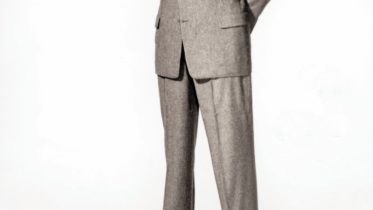
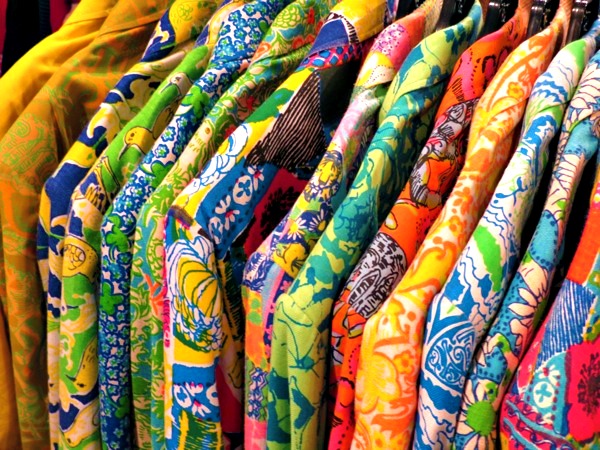
Update, 4 June, 10:23 AM: WRAL has pressed Representative Holloway on the WASP 101 story, who has said he’s just another man in a Brooks Brothers tie:
Monday night, offered the chance to reconsider his denial, Holloway declined.
“I’ve just made the only comment that I’m going to make, and that’s it. I’m going to stick by what I said. I don’t really see it as news or a story, so we’re just finished with it.”
Holloway said the coincidental similarities between himself and “Richard” prove nothing.
“One thing I would point out is how many brown dachshunds are out there, how many Brooks Brothers ties are hanging on the rack at a Brooks Brothers store,” he told WRAL. “I’m 5’10”, I have brown hair, I’m white. There’s a hundred million people who could look just like me.”
What about the North Carolina politics link?
“I haven’t even read [the blog,]” Holloway said. “Again, I stick with what I said. Do whatever you will, write whatever you will. I’m done with it.”
The similarities were discovered as a result of Google-enabled amateur sleuthing and a more-than-generous dash of Internet obsession.
Last night Ivy Style received an email from a source, who has requested anonymity, saying he had spent the past year trying to uncover the identity of the WASP 101 blogger. “I’ve been following every clue the weasel has posted for a year,” he wrote. “Sad? Yes. But what can I say, he bugs me.” (Continue)
First published April 10, 1925, F. Scott Fitzgerald’s “The Great Gatsby” gripped the American imagination and, almost a century later, has yet to relinquish its hold. Its personal, poignant narrative, fatally flawed but perfectly drawn characters, and ability to capture a particular place and time set it apart in 20th century American literature.
The story is a cautionary tale, to be sure: the illusory power of the past, the idea of money solving any or all of one’s problems, the mixed bag of virtue and foible that make up each human being, the harsh reality of having your dreams come true. But it also presents another eternal, if less examined conflict, that of Old Money vs. New Money.
Gatsby has acquired the enormous house, the garish clothes, and the fast cars. Yet his mysterious past and bizarre behavior—he has few friends and doesn’t bother to even attend the lavish parties he hosts—cement his dubious social standing, “Wealthy, but not one of us,” in status-conscious Long Island. Gatsby could have been a cliché of the nouveau riche criminal class, but Fitzgerald reveals a vulnerability and awkwardness in him, tethered to a near-universal motivation: he’s done everything he’s done just to try to get his girl back.
Tom Buchanan, on the other hand, is Old Money, but displays the worst characteristics of it. He is arrogant, self-centered, and petty. When it comes down to brass tacks, he shirks responsibility for his actions and, after tragedy befalls others, he slips away in the night, his honor tucked under his arm like stolen goods. It’s a scenario we’ve already heard or read about before: wealth and privilege, behaving badly and walking away from the consequences, unscathed.
There’s another side of Old Money, however, that makes for a less interesting story, but a more interesting study. It’s the Old Money that has integrity; that lives far below its means; that raises it children to be productive, well-adjusted adults; that uses its position and resources not just to preserve and expand its wealth, but to quietly make the world a better place for everyone.
While much of what comprises the culture of Old Money is antithetical to modern society, it has nothing to do with being a snob. Old Money dresses and behaves so that it is not obvious how much money it has or what position it holds in society. Old Money treats others without regard for how much money they have or what position they hold in society.
The geographic epicenter of this culture is Boston, where my wife was raised and educated. Tellingly, the city is also where a Beacon Hill billionaire was recently seen scraping the ice and snow off his own car one morning, just like many other citizens of the city. Make no mistake, some Boston Brahmins (more often pretenders to that throne) can be as elitist as anyone, but their core values of thrift, discretion, hard work, and public service are well-documented. In a world of professional athletes and entertainers constantly proclaiming their own greatness while bathing in bling—and just prior to filing for bankruptcy—such attitudes are refreshing.
Almost two centuries ago, the newly-minted Old Money families of Boston sought to make their city the “Athens of America”. They realized that their quality of life depended on not just their personal wealth, but on the well-being of the general population. They rightly concluded that a well educated, productive, and ethical citizenry would serve everyone well. Consequently, they put their money to work, building universities, libraries, museums, and hospitals. Walking through the city today, it’s easy to argue that they realized their vision.
The Old Money families of Boston, and of other major cities in America, personify a code of behavior: that of an educated, articulate individual who places the interests of his or her community on par with their own personal interests. They prioritize quality of life over a standard of living, eschewing vulgar displays of wealth. They pass this philosophy on to their children, and their children to their children. They act as role models for New Money and the general public.
Old Money is a culture and a philosophy that creates great people, great cities, and great nations. It holds its adherents to a higher standard of behavior, but pays great dividends. If talent does what it can and genius what it must, then Old Money does what it should.
Gatsby, for all his faults, may have understood that. Tom Buchanan, for all his money, never would. — BYRON TULLY
Byron Tully is a Los Angeles-based screenwriter happily married to a proper Bostonian. “The Old Money Book” is his first book and is available on Kindle and Nook.
In his column yesterday for the Washington Post, George Will discusses William Zinsser and the craft of writing, making a passing reference to J. Press and the formality still observed by old-school WASPs such as Zinsser:
Tooting his own trumpet is not the style of this self-effacing and decorous WASP, who never leaves his Manhattan apartment or boards a plane or train without a jacket (J. Press, of course) and tie.
Zinsser not only dresses properly before leaving the house, he’s also had himself immortalized in oil, as in the 2006 portrait by Thomas S. Buechner above, which is a lot more dignified (though not quite as social or fun) than chronicling your quotidian happenings in grainy iPhone photos on Facebook.
WASPiness, however, was always something Zinsser had trouble coming to terms with. His website includes the following excerpt from his essay “A Reluctant WASP” for Town & Country:
I was born into the Northeastern WASP establishment and have never quite stopped pretending that I wasn’t. My boyhood was spent in a big house on the north shore of Long Island that overlooked the water and had its own tennis court. But I always wanted to get beyond that narrow world. In the summer of 1936, when I was 13, my parents took my older sisters on a Grand Tour of Europe, leaving me with my grandmother. To keep me company they advertised for a ‘tutor.’
A suitable-sounding candidate was found—Harvard junior, all-around athlete, an editor of the Crimson—and was invited for Sunday dinner to be looked over. His name was Cleveland Amory. The name signified that he was a Boston Brahmin. Many years later it would become a familiar presence on the best-seller lists for his droll social histories like The Proper Bostonians.
My father explained to Amory that he would mainly be expected to play golf and tennis and go sailing with me—the usual WASP sports. His biggest problem, my father was sorry to say, would be to wrest me away from my obsessive interest in baseball. The tutor smiled the smile of a young man who has found the perfect summer job.
When summer arrived, my new friend tried at first to adhere to the conditions of his employment. But our hearts were elsewhere. Amory, it turned out, was a crazed Boston Red Sox fan, and our schedule began to tilt. We would put our golf clubs in the family Buick, head for the Piping Rock Club, and somehow wind up at Yankee Stadium.
With their mutual interest in writing, baseball, and J. Press, Will and Zinsser are certainly two of a kind. Dare we say the right kind? — CC
Last week Susan Cheever, daughter of legendary WASPdom chronicler John Cheever and a celebrated author in her own right, wrote a piece for Newsweek entitled “Gin Without The Tonic.” The URL of the digital version explains the theme a little less cryptically:
The theme of Cheever’s essay — that the uber-rich of today are not grounded in the same fixed WASP values as the great American dynasties like the Vanderbilts and Astors — ties in neatly with a comment recently left by a reader:
I hope that Lands’ End continues to be the poor man’s Brooks Brothers, so that we can continue to dress like the 1%.
Cheever’s essay also conflates the “one percent” — the elusive catchphrase that rose to prominence during the On Wall Street protests and in its strictest sense means the global uber-rich, not an old but cash-poor preppy clan trying to save its summer house — with the upper middle preppy class. Prepdom has never been the domain of the top out-of-sight, as Paul Fussell called it. The nouveaux riches — who are newer and richer than ever before — clogging up the Hamptons where respectable families once summered aren’t “modern preppies”: they’re not preppies at all.
In what universe does this line possibly make any sense?:
The 1 percent behave outwardly more like the headmaster of Groton than like their own grandparents.
Cheever is more spot on when she compares the “one percent” to the great American dynasties to come out of the Industrial Revolution, a more direct comparison:
… the Carnegies, the Vanderbilts, and more recently the Roosevelts all established foundations that made the world an extraordinarily better place. When John Jacob Astor IV gave up his seat on a Titanic lifeboat, he was acting out of a tradition of gallantry and service that was rare then and is even rarer now.
But the idea that Americans at the very top are “slavishly imitating” old WASPs is hard to swallow. The real people wearing whale-embroidered belts probably do care a lot about the old Protestant values than the jet-owning hedge-funders and technocrats. — CC
This weekend columnist Mark Oppenheimer penned an essay about prepdom for Salon that’s pegged on Whit Stillman’s new movie “Damsels In Distress.” The piece is more thoughtful than the usual stuff that gets said about the cultural phenomenon known as preppy.
Oppenheimer’s thesis is that preppy is more than a style of dress. This you already know. But the more part may surprise you:
It is more properly understood as an orientation toward power.
I don’t know about you, but my eyeballs involuntarily rolled at this. Is Oppenheimer suggesting a Marxist reading of preppy, the take on things that’s been so trendy (if not downright orthodox) in academia the past couple of decades? Though it may seem its polar opposite, claiming preppy is an “orientation toward power” actually comes from the same point of view that argues, say, that preppy is “all about marketing,” and its wearers not members of a cultural group linked by geography, education, class and taste, but fashion-following lemmings in the hands of money-grubbing business entities.
Granted, my own argument here is several decades out of date. Except for a small surviving old guard, preppy has long ceased to be an expression of the culture of the eastern elite. It is mostly — but not entirely, as well shall see — divorced from the WASPy values from which it sprung, and is primarily a fashion commodity. Nevertheless, it is a fashion commodity with certain social signifiers it will never shake.
As Oppenheimer’s essay continues, it begs further nitpicking:
Like members of other subcultures, including Deadheads or Goths or English soccer hooligans, real preppies are at least willing to proclaim allegiances.
This comparison feels dubious as preppy is — or once again, was — an expression of high culture (or something close to it), not subculture. It is disjointed for Oppenheimer to simultaneously link preppy style to the power establishment yet also compare it to goth teenagers going through adolescent angst or hippies who like to take road trips and get stoned together.
Moving on, here’s that damned word again. The sharp monosyllable “style” is so less pompous:
But the clothes are not just an aesthetic choice.
But forget my pet peeves. Here’s where things get more interesting: Despite the commodification and middle-class mainstreaming of preppy clothes, they will never shed their upper-middle connotations. One of the reasons for the failure of JC Penney’s American Living collection, I suspect, is that the company, despite trying to go upmarket, radically misjudged its lower-middle-class customer’s willingness to don critter shorts and pink oxfords, no matter how low the price point. In the documentary “People Like Us,” there’s an enlightening experiment in which working-class grocery shoppers were offered enriched white sandwich bread for 69 cents, or hearty, four-dollar artisan bread for free, and the shoppers preferred to pay for the white stuff because they liked the taste better. Likewise, in most large cities free classical music concerts are readily available, yet are sparsely attended. Beethoven, alas, is evidently something that can’t even be given away. Talk about putting the “class” in classical.
This leads us to Oppenheimer’s most insightful passage. Preppy clothing may be democratic, but it is still elitist. Like top-tier universities, just because it’s open to everyone doesn’t make it populist:
But preppy clothes have been the uniform of other products of the university, too, not just the bankers. Who loves a tweed jacket more than a humanities professor? And who loved a sack suit more than the elegant political radicals of the early 1960s? Take Malcolm X: For him, conservative attire was not ironic but proprietary. His clothes announced that he, and the Negro more generally, was entitled to the uniform and the prerogatives of power. Preppiness, in other words, is not inherently reactionary, and it is not inherently exclusionary; indeed, in a sense it is very democratic, precisely because one only needs the clothes, not a family crest. But it is not demotic; it is elitist. It is concerned with access to hierarchies, not the abolition of them. There have been left-wing preppies, but there have rarely been populist preppies.
Returning to Stillman, Oppenheimer notes the frozen-in-time aspect of preppy clothing and how the filmmaker uses it as part of the temporally vague settings of his films:
Stillman uses preppy clothes for an entirely different purpose. The clothes round out his characters, give the audience shorthand for what kind of families the characters come from, but above all take them out of time. For Stillman, preppy clothing is not a way to evoke, say, a Kennedy-era boarding school, but rather a way to defeat dating altogether. In short, if you wanted to make a fantasy movie set in some unidentifiable period of postwar America, you could use certain articles from Brooks Brothers and J. Press. And, indeed, that is what Stillman, who is not a realist or ethnographer but a fairy-tale fantasist, has done.
This next passage again suggests Oppenheimer’s “academic” point of view, in which everything in the world is viewed through the prism of race, gender, class and sexual orientation. It also serves as a reminder of just how unique Whit Stillman is as a filmmaker, as these things don’t concern him:
In all Stillman’s movies, there is no racial or religious tension, no class envy, no religious bigotry. Stillman’s world even lacks many of the interlopers who have kept prep schools and elite colleges vital and meritocratic (and fashion-conscious): There are no obviously Jewish characters in Stillman’s movies, no Asian Americans, only one black character who so much as gets a name, and no gay men or lesbians.
And in our value-free culture, let’s not make judgments about the lack of diversity in Stillman’s films. It’s OK to make movies about smart white people, just don’t confuse them with reality:
There is nothing wrong with Stillman’s World, this alternate reality in which conversation is snappy, the young men and women are all attractive, and their clothes are tailored awfully well. There are times when I would not mind living there. But that’s because it’s a Utopia, literally a nowhere — it does not exist, it cannot exist. That the resident characters wear certain clothes we associate with certain schools, certain professions, certain vacation spots and certain stores does not mean that these characters are like the real-world people found in those schools, work professions, vacation spots or stores. Whit Stillman characters are not preppies; they just dress like them.
Which brings us to Oppenheimer’s conclusion, which returns to his thesis about power:
But more than ever, what is true of Stillman’s characters may be true of anyone wearing preppy clothing in America today: He is not exactly a preppy. It’s not that he lacks money or schooling — after all, the majority of preppies were always aspirational, rather than bred. It’s that the statement he is making has nothing to do with elite institutions or power. In fact, preppiness today is a way to avoid those conversations.
To wear such timeless clothing in 2012 is a bit like wearing very preppy clothing in 1970, when Whit Stillman was in college. Outside the haberdasher’s doors, there is warfare, recession and class anger; but on one’s back there are the clothes of another era, indeed clothes that transcend all eras. In a time of tumult, preppy clothing is escapist. It does not imply that its wearer is a conservative or a 1-percenter or opposes birth control for women. But it does suggest that, at least for the moment, he would rather talk about something else — as if it were a few years ago, or a few years from now. As if talking about something else were ever really possible.
And so those born to prepdom and those who converted may find they have more in common than they thought. Wearing whale-embroidered cords is certainly a way of communicating that everything is all right — in your world, at least. And that unflappable insouciance is probably why so many people can’t stand preppies.
But since anyone today can don the clothing of the power elite, you never know just what the wearer of embroidered trousers may be really thinking. After all, he could be a radical environmentalist with an ironic sense of humor on a noble crusade to save the whales. — CHRISTIAN CHENSVOLD